B
18
Repair and Service Manual
BATTERIES AND BATTERY CHARGER
Read all of SAFETY and this section before attempting any procedure. Pay particular attention to Notices, Cautions, Warnings and Dangers.
10002660
Disconnect the charger connector from the vehicle recep-
tacle.
Clean the batteries, neutralize and remove all deposits
from the battery case to prevent self discharge. The bat-
teries should be tested or recharged at thirty day mini-
mum intervals.
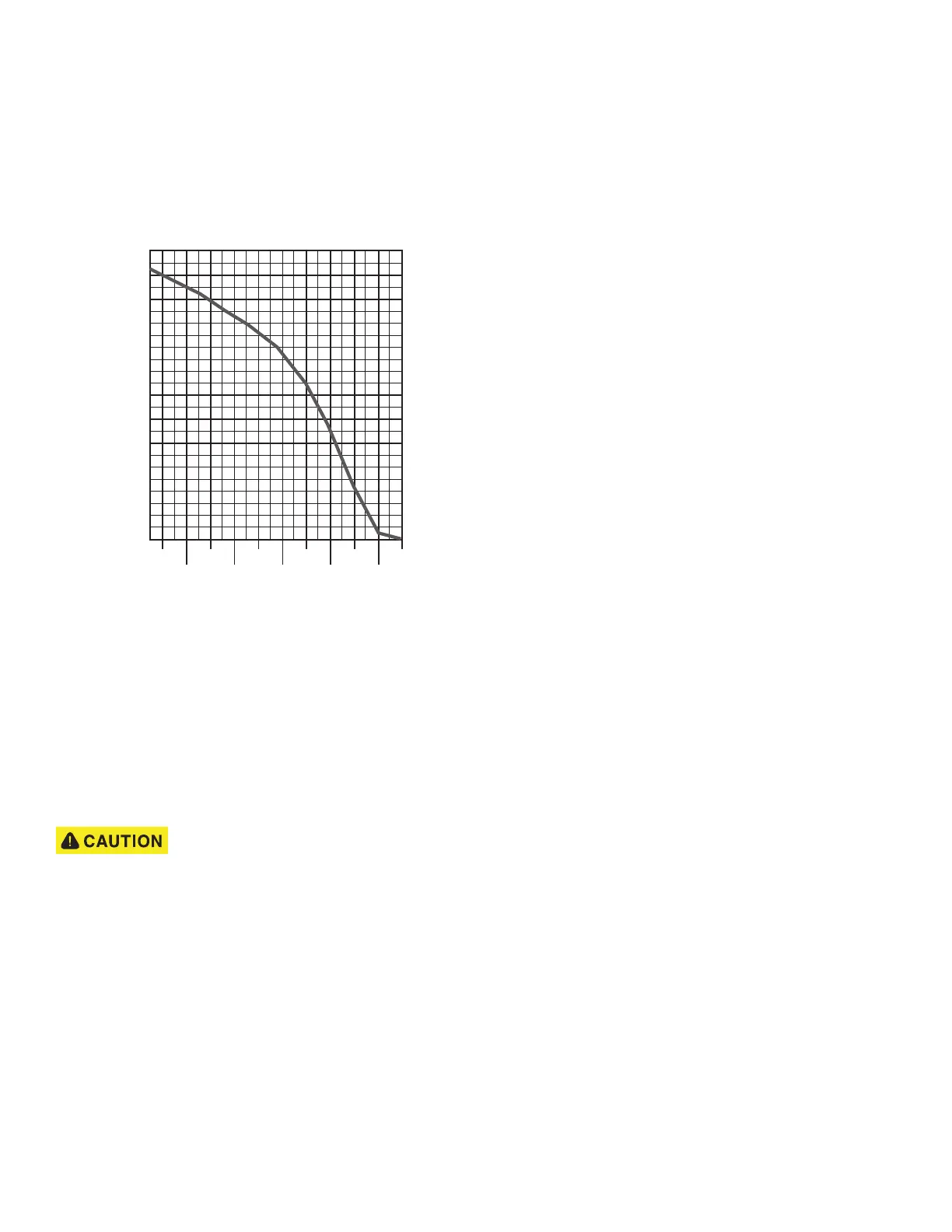
Fig. 8 Freezing Point of Electrolyte
Battery Charging
The battery charger is designed to fully charge the battery
set. Some automatic battery chargers contain an elec-
tronic module that can not activate if the batteries are
severely deep cycled. Automatic chargers will determine
the correct duration of charge to the battery set and will
shut off when the battery set is fully charged. Always refer
to the instructions of the specific charger used.
Before charging, the following should be observed:
Do not overfill batteries. The
charging cycle will increase electro-
lyte volume and force it out of the
battery and damage surrounding
components.
• The electrolyte level in all cells must be at the
recommended level and the plates covered (See
Electrolyte Level and Water on page 16).
• Charging must be done in an area that is well
ventilated and capable of removing the hydrogen
gas that is generated by the charging process. A
minimum of five air exchanges per hour is rec-
ommended.
• The charging connector components must be in
good condition and free from dirt or debris.
• The charger connector must be fully inserted into
the vehicle receptacle.
• The charger connector and cord set must be pro-
tected from damage and located in an area to
prevent injury resulting from personnel running
over or tripping over the cord set.
• The charger is automatically turned off during the
connect/disconnect cycle, and therefore no elec-
trical arc is generated at the DC plug/receptacle
contacts.
NOTICE: In some portable chargers, an audible rat-
tle is present in the body of the charger DC plug.
This rattle is caused by an internal magnet within
the charger plug. The magnet is part of the interlock
system that prevents the vehicle from being driven
when the charger plug is inserted in the charging
receptacle.
AC Voltage
Battery charger output is directly related to the input volt-
age. If the vehicle routinely receives an incomplete
charge in a normally adequate time period, low AC volt-
age could be the problem. Consult the electrical provider.
FAULT TESTING
Fault testing is done for two distinct reasons:
• A battery that performs poorly and is outside of the
manufacturers specification should be identified in
order to replace it under the terms of the manufac-
turer’s warranty. Different manufacturers have differ-
ent requirements. Consult the battery manufacturer
or the manufacturer’s representative for specific
requirements.
• Determine why a particular vehicle does not perform
adequately. Performance problems can cause a
vehicle to operate slowly or be incapable of operating
for the time required.
A new battery must mature before it will develop its maxi-
mum capacity. Maturing can take up to 100 charge/dis-
charge cycles. After the maturing phase, as the battery
ages, its capacity diminishes. The only way to determine
the capacity of a battery is to perform a load test using a
discharge machine following manufacturer’s recommen-
dations.
A cost effective way to identify a poorly performing battery
is to use a hydrometer to identify a battery in a set with a
lower than normal specific gravity. Once the problematic
cell or cells are identified, the suspect battery can be
removed and replaced. At this point there is nothing that
can be done to save the battery. The individual battery
should be replaced with a good battery of the same
brand, type, and approximate age.
1.100
1.120 1.160 1.200 1.240 1.280
1.140 1.180 1.220 1.260
1.300
-9
-15
-21
-26
-32
-37
-43
-48
-54
-60
-65
-71
E
L
E
C
T
R
O
L
T
E
T
E
M
P
E
R
T
U
R
E
SPECIFIC GRAVITY ELECTROLYTE FREEZING POINT
O
C
+15
+5
-5
-15
-25
-35
-45
-55
-65
-75
-85
-95
O
F



 To Next Page