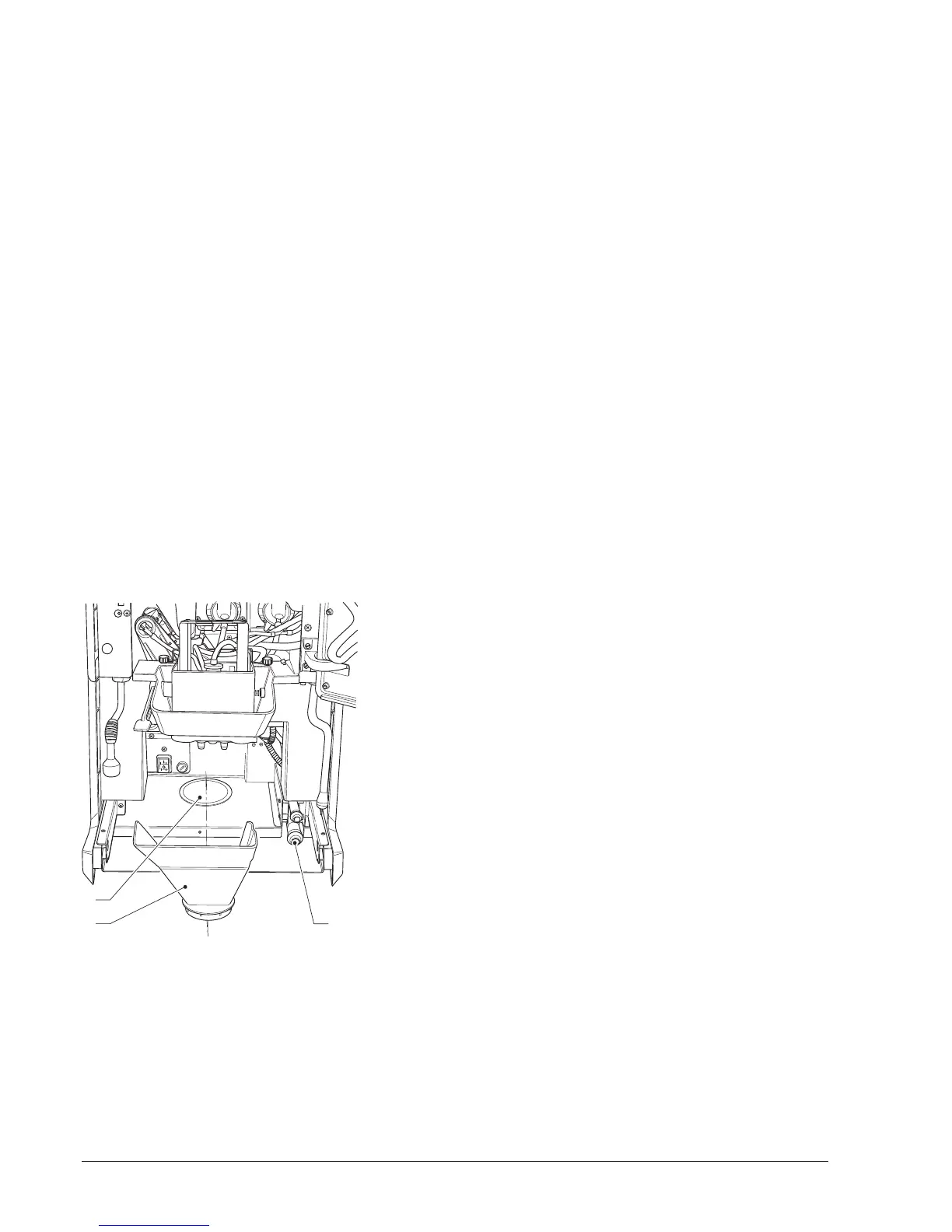
The discharge of the solid residues can be done directly
into a bucket using the solid residue slide supplied by
default, by inserting it into the drain hole.
- Remove the metal part of the setup for discharge on
bench
- Place the residue slide
- Place the solid residue container in a clean and pro-
tected location (closed cabinet), convenient for empty-
ing and periodic cleaning.
3
1
2
Fig. 17
1- Preparing solid residue discharge on bench
2- Liquid residue container drain connector
3- Solid residue discharge slide (only models with discharge on
bench)
ELECTRICAL CONNECTION
Given the power consumption, it is preferable to connect
the machine to a 400-415 V∿.3P+N+T three-phase line.
If a three-phase line is not available, the machine can
be connected to a 230-240V∿ single phase line, after
having qualied personnel check that it is properly sized
to handle the required load.
The machine is protected with 15 A fuses.
The machine is supplied without a power cord; use only
HO5 VV-F or HO5 VV H2 - F cords with a suitable sec-
tion or otherwise compliant with national legislation.
For the connection, ensure that details on the plate cor-
respond to those of the mains, in particular that the value
of the supply voltage falls within the recommended limits
for the connection points.
-
for supporting the maximum load and ensures the
omnipolar disconnection from the power supply
The device must be connected permanently.
-
sion cables is forbidden.
The electrical safety of the machine is ensured only
when the machine is correctly connected to an ef-
safety regulations.
It is necessary to verify this fundamental safety require-
ment and, in case of doubt, request an accurate check
of the system by qualied personnel.
The cable connection should be made to the appropriate
terminal board on the left side of the machine, respecting
the position of the phases shown in the diagrams.
For the cable connection it is necessary to remove the
left side panel (see side panel removal)


 To Next Page