© by N&W GLOBAL VENDING S.p.A. 23 02-2014 4535 00
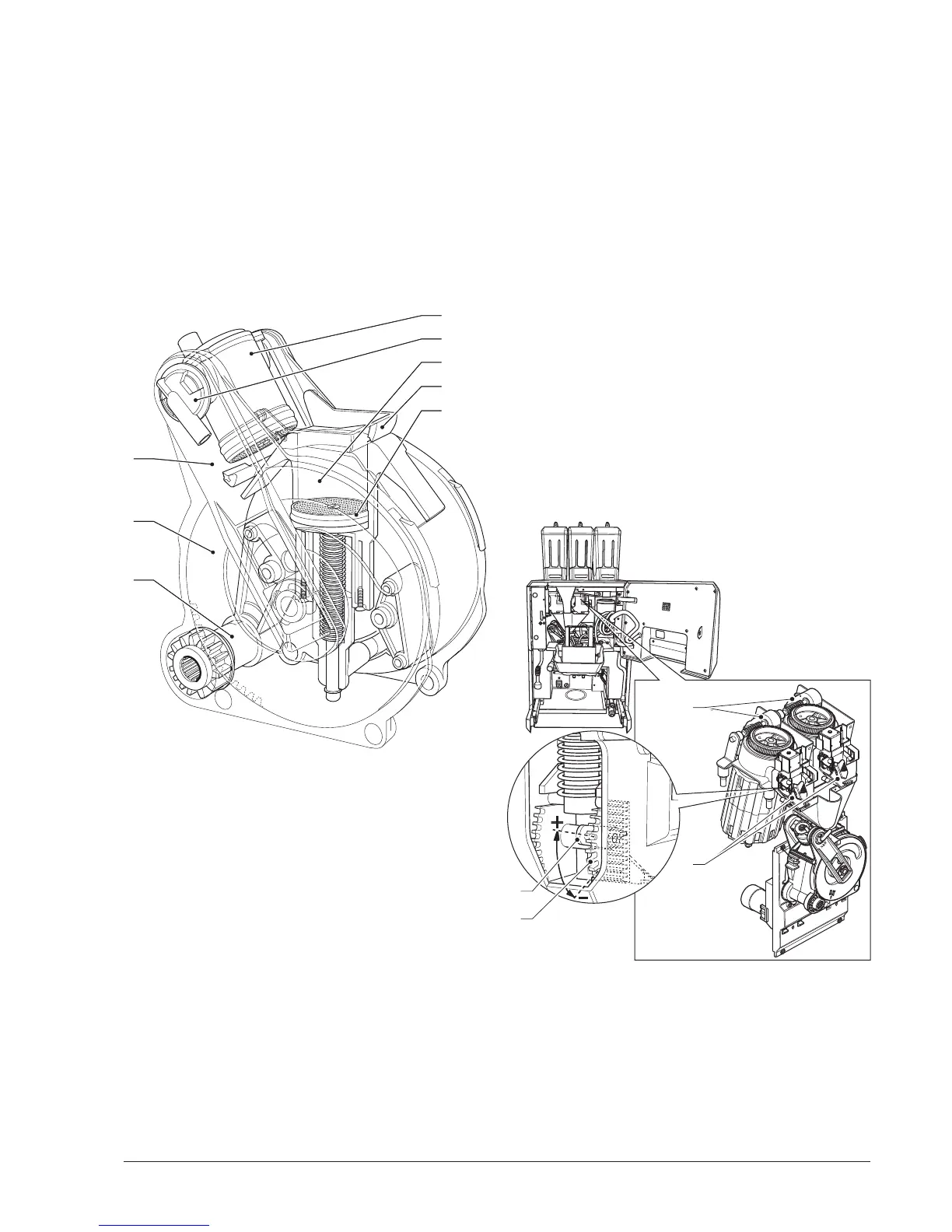
At the end of the coee dispensing phase, the upper
piston goes down in order to mechanically squeeze the
coee pod, facilitating the expulsion of excess water
through the 3rd route of the dispensing solenoid valve.
At the end of the cycle the gear motor is activated in the
opposite direction, lifting the upper piston and rotating
the infusion chamber towards the emptying side, on the
opposite side of the dispensing side; the lower piston
rises.
Once the emptying position is reached, the gear motor
inverts its rotation direction again, bringing the infusion
chamber back to the idle position.
The scraper holds the coee pod and lets it fall, while
the lower piston returns to the idle position.
8
The coee unit can operate with coee doses between 7
and 13,5 gr.
The upper piston positions itself automatically according
to the programmed pressure.
A coee dose is composed of two quantities of ground
coee, released consecutively from the doser.
The doser can be set to dispense two dierent quantities
of ground coee;
- a first quantity, volume-dosed (more precise), is re-
leased upon the filling of the doser chamber;
- the second quantity, time-dosed, adjustable in percent-
age (from 1 to 99%) of the volumetric amount grinding
time, is released when the set time is achieved.
If the percentage is set to 0 only one release is carried
out;
if the percentage is set to 100 two volume-dosed re-
leases are carried out (filling of the chamber also for the
second release).
The chamber volume of the variable-dose doser can be
adjusted between 5.5 and 8.5 g using the adjustment
lever.
The dose adjustment lever can be positioned on one of
the 10 reference notches, taking into consideration that:
- raising the lever increases the dose:
- lowering the lever decreases the dose:
- each notch changes the dose by approx. 0.35 g.
3
4
1
2
Fig. 24
1- Blade-adjustment engine
2- Dosers
3- Dose adjustment lever
4- Dose adjustment


 To Next Page