2.5.1 Contamination when operating with neutral or basic mobile
phases
Contamination is a concern in neutral and basic pH environments due to the accumulation of
bacteria and particulate debris.
Notice: To prevent fused silica tubing from dissolving, never use mobile phases
exceeding pH 10.
Important: You can prevent contamination associated with neutral or basic pH operation within
the range of pH 7 to pH 10. For example, the iKey separation device or column can become
clogged, and the back pressure can increase rapidly until it reaches the upper limit of usability.
See the recommendations listed in Operation with neutral or basic mobile phases.
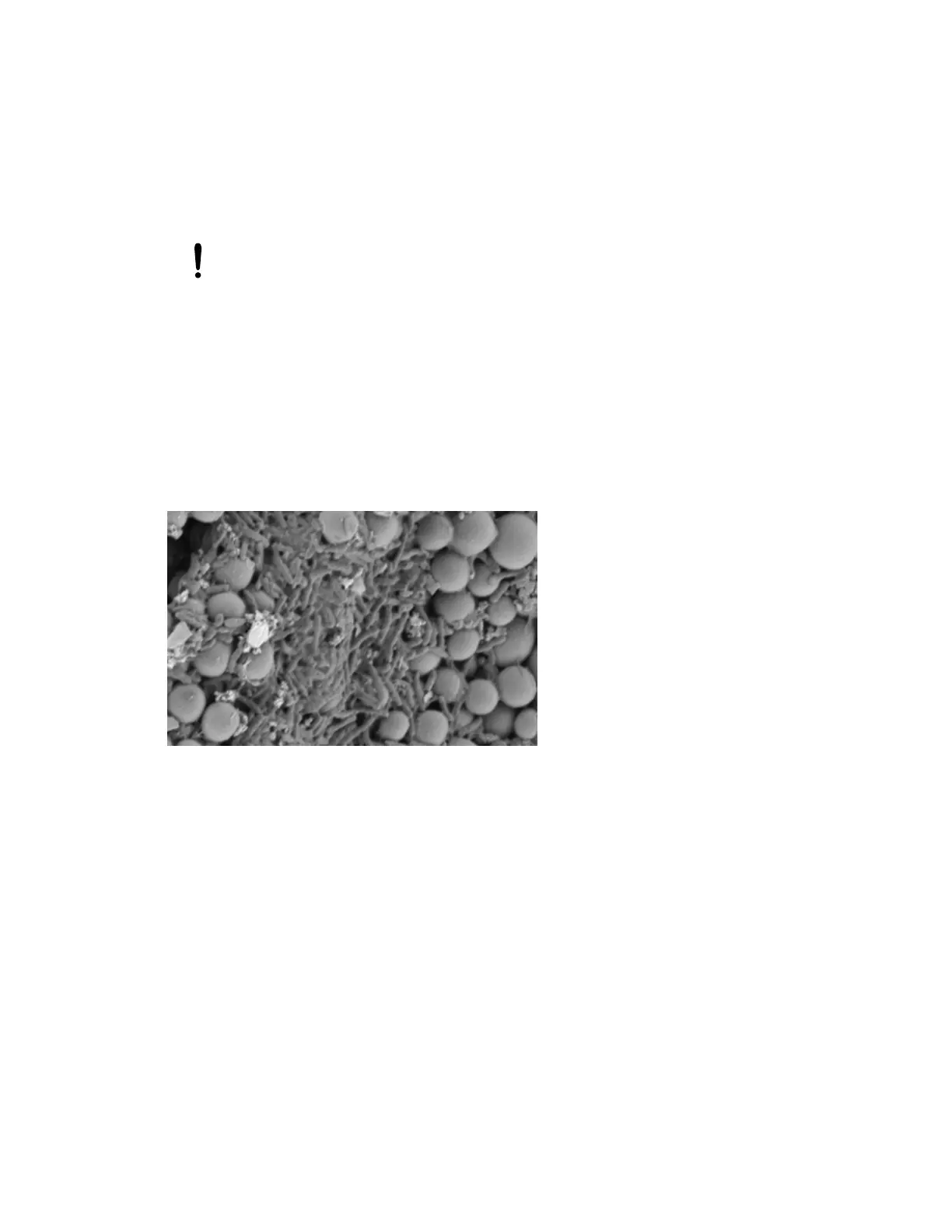
Neutral and basic pH supports the growth of bacteria that accumulate on the column, as shown in
the following figure.
Figure 2–1: Scanning electron microscope (SEM) image showing bacterial growth on a
column inlet because of basic mobile phase
Basic buffers, such as ammonium formate and ammonium bicarbonate, contain particulate matter
of sub-micron scale, as shown in the following figure. This debris is small enough to pass through
the 0.5-μm sintered filters in the wetted path of the mobile phase, but much of it is not small
enough to pass through the chromatographic bed.
November 26, 2019, 715003588 Revision C
Page 28



 To Next Page