The Yaskawa Varispeed V7 is a compact, general-purpose inverter designed for DeviceNet communications, offering both V/f (Voltage/Frequency) and Voltage Vector control modes. It is engineered for ease of use, akin to a contactor, and provides a comprehensive set of features for motor control, monitoring, and maintenance.
Function Description
The Varispeed V7 inverter is primarily used for controlling the speed and torque of AC motors. It supports DeviceNet communications, allowing it to be integrated into a DeviceNet network and controlled by a DeviceNet master. This enables remote operation, monitoring, and parameter setting. The inverter can operate in four modes: RUN command from the Digital Operator (potentiometer/digital setting), RUN command from control circuit terminals, and RUN command from DeviceNet communications.
Key functions include:
- Motor Control: Supports both V/f control (factory preset) and Voltage Vector control modes.
- Torque Adjustment: Allows adjustment of motor torque through V/f pattern settings and full-range automatic torque boost.
- Speed Control: Features multi-step speed selection (up to 16 steps via DeviceNet or input terminals), JOG operation for low-speed movement, and adjustable speed setting signals (analog inputs).
- Acceleration/Deceleration: Provides two acceleration/deceleration times and S-curve selection for smooth starts and stops, preventing mechanical shock.
- Stopping Methods: Offers options for deceleration to a stop or coast to a stop, with DC injection braking at startup or stop.
- Motor Protection: Includes electronic thermal overload relay for protection against motor overheating, overtorque detection, undertorque detection, and input/output open-phase detection.
- Energy-saving Control: Features an energy-saving control mode that calculates and outputs the optimal voltage for motor efficiency.
- PID Control: Supports PID control mode for maintaining process variables, with adjustable proportional gain, integral time, derivative time, and feedback loss detection.
- Constant Management: Allows reading, copying, and verifying inverter constants using the Digital Operator, with options to prohibit accidental overwriting.
- Fault Diagnosis: Provides protective and diagnostic functions, including alarm and fault displays on the Digital Operator and DeviceNet communication status indicators for troubleshooting.
Important Technical Specifications
- DeviceNet Specifications: Conforms to DeviceNet release 2.0, operating as a Group 2 Only server (slave).
- Device Protocol: AC Drive, DeviceType = 02.
- Baud Rate Settings: Supports 125 kbps, 250 kbps, and 500 kbps, configurable via rotary switches or constant n152.
- Supported Messages: Group 2 Only server, UCMM not supported. Explicit messages or I/O poll messages are supported.
- I/O Message Communications: Supports seven kinds of I/O instances, ranging from Basic I/O (4 input/4 output bytes) to General-purpose DI/DO control (8 input/8 output bytes).
- Explicit Message Communications: Up to 32 bytes of data can be transferred, conforming to the DeviceNet AC/DC drive profile.
- Communications Power Supply: 11 to 25 VDC (20 mA max.).
- Input Power Supply Voltage:
- 200 V Class: 3-phase, 200 to 230 V, 50/60 Hz; Single-phase, 200 to 240 V, 50/60 Hz.
- 400 V Class: 3-phase, 380 to 460 V, 50/60 Hz.
- Allowable Voltage Fluctuation: -15% to +10%.
- Allowable Frequency Fluctuation: ±5%.
- Control Method: Sine wave PWM (V/f control/vector control selectable).
- Frequency Control Range: 0.1 to 400 Hz.
- Overload Capacity: 150% rated output current for one minute.
- Braking Torque: Short-term average deceleration torque (e.g., 150% for 0.1/0.25 kW, 20% for 2.2 kW or more); continuous regenerative torque approx. 20% (150% with optional braking resistor).
- Ambient Temperature:
- Open chassis (IP20): -10 to 50°C (14 to 122°F).
- Open chassis (IP20, top closed type) and enclosed wall-mounted (NEMA 1): -10 to 40°C (14 to 105°F).
- Humidity: 95% or less (non-condensing).
- Storage Temperature: -20 to 60°C (-4 to 140°F).
- Vibration: Up to 9.8 m/S² (1G) at 10 to less than 20 Hz, up to 2 m/S² (0.2G) at 20 to 50 Hz.
- Wiring: Use 75°C copper wire or equivalent. Low voltage wires must be wired with Class I Wiring. Control wiring must be less than 50 m (164 ft) and separated from power wiring.
Usage Features
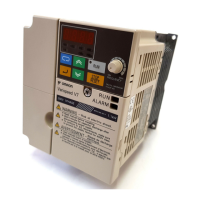
- Digital Operator (JVOP-140U): Used for setting and changing constants, with a potentiometer for frequency setting. It displays status indicators (RUN, ALARM, FREF, F/R, FOUT, IOUT, LO/RE, MNTR, PRGM) to show the inverter's operational status and selected functions.
- Multi-function Input Terminals (S1-S7): Can be configured for various functions like FWD/REV RUN commands, external fault input, fault reset, multi-step speed references, JOG command, acceleration/deceleration time selection, external baseblock, and UP/DOWN commands.
- Multi-function Analog Inputs (CN2 terminal): Can be used as the main speed frequency reference (0 to 10 V or 4 to 20 mA).
- Multi-function Output Terminals (MA, P1, P2): Can be configured to output signals for fault, running, zero speed, frequency agree, frequency detection, overtorque detection, undervoltage detection, minor error, baseblock, operating mode, inverter run ready, fault retry, UV, speed search, and PID feedback loss detection.
- LOCAL/REMOTE Mode: Allows switching between control via the Digital Operator (LOCAL) or external commands/DeviceNet (REMOTE).
- 3-wire Sequence Selection: Configurable for specific terminal functions (S1 for RUN, S2 for STOP, S3 for FWD/REV RUN).
- Carrier Frequency Selection (n080): Allows adjustment of the inverter output transistor switching frequency to reduce motor noise or leakage current.
- Motor Code (n158): Used in energy-saving control to match motor characteristics.
Maintenance Features
- Periodic Inspection: Regular checks for loose terminal connections, dust/debris on heatsinks and PCBs, abnormal odor/discoloration of power elements and smoothing capacitors, and abnormal noise/vibration of the cooling fan.
- Part Replacement Guidelines:
- Cooling Fan: Replace every 2 to 3 years.
- Smoothing Capacitor: Replace every 5 years (determine need by inspection).
- Breaker Relays: Determine need by inspection.
- Fuses: Replace every 10 years.
- Aluminum Capacitors on PCBs: Replace every 5 years (replace board, determine need by inspection).
- Fault Diagnosis: The Digital Operator displays alarm and fault codes (e.g., oC for overcurrent, oL1 for motor overload, GF for ground fault, PF for main circuit voltage fault, oH for heatsink overheating, bUS for DeviceNet communications fault). DeviceNet communication status indicators (MS, NS) also provide diagnostic information. Corrective actions are provided for each fault.
- Fault Reset: Faults can be reset by turning ON the FAULT RESET signal (or pressing the RESET key on the Digital Operator) with the operation signal OFF, or by cycling the power.
- Cooling Fan Replacement: Detailed procedures are provided for removing and mounting the cooling fan, ensuring correct airflow direction.
- Safety Precautions: Emphasizes disconnecting power and waiting before servicing, avoiding contact with high-voltage terminals, not performing withstand voltage tests, and ensuring only authorized personnel perform maintenance.

 Need help?



 To Next Page
 General