OPERATION
Axiovert 200 Illumination and contrasting techniques Carl Zeiss
B 40-080 e 03/01 3-31
• Swing out 3-position filter changer (3-16/14).
• Place a high-contrast specimen on the microscope stage (3-16/21).
• Match the eyepiece distance (interpupillary distance) to the user's individual interpupillary distance:
For this purpose, pull apart or push together the binocular component (3-16/11) of the tube.
• Set the zero point of ametropia compensation on the setting ring (3-16/12) of the eyepieces (3-16/13)
to the white dot if no eyepiece reticle is available,
to the red dot if eyepiece reticle is available.
• If required, optimize focus of the selected object detail via the setting ring of the relevant eyepiece for
ametropia compensation.
• Use the coarse / fine focusing drive (3-16/6) to focus on the selected detail of the specimen. If no light
is visible in the eyepieces, check whether light exits the housing of the halogen illuminator. If this is
not the case, switch on the halogen illuminator by pressing the HAL on/off key (3-16/7).
• Use the toggle switch (3-16/8) to set the light intensity to a comfortable brightness. Adjustment is
made in small steps when the key is pressed half down (pressure point), and in big steps when the
key is pressed down completely.
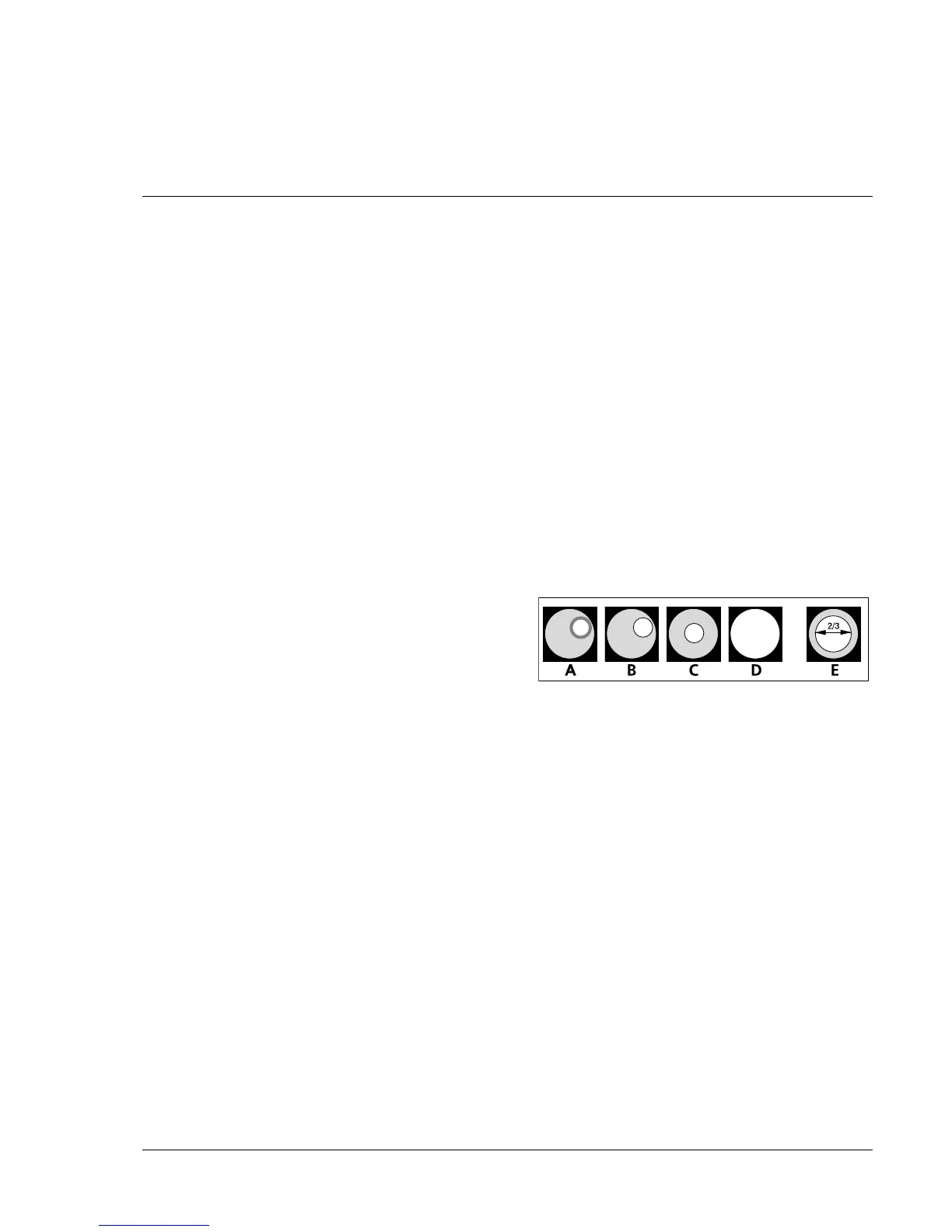
• Close luminous-field diaphragm (3-16/16) until
it is visible in the field of view, even if not in
focus (3-17/A).
• Focus on the edge of the luminous field
diaphragm (3-16/B) by moving the condenser
(3-17/17) vertically.
• Center (3-16/C) luminous-field diaphragm using
centering screws (3-17/15 and 18) and open it
until the edge of the diaphragm just disappears
from the field of view (3-17/D).
• For aperture diaphragm setting, remove one eyepiece from the eyepiece tube and set aperture
diaphragm (3-16/20) to approx. 2/3 of the diameter of the objective exit pupil (3-17/E).
Optimum contrast setting is dependent on the respective specimen.
• Insert eyepiece again and, if required, refocus on the specimen via fine drive.
• Match the light intensity via the toggle switch.
☞
The field size and the objective aperture change after every objective change, i.e. the luminous-
field diaphragm and aperture diaphragm settings must be repeated to ensure optimum results.
Fig. 3-17 Diaphragm settings for KÖHLER
illumination in transmitted-light
brightfield



 To Next Page