SWT
GIGABIT/FAST ETHERNET SWITCH TYPE SWT 10/137
USER GUIDE - M0SWTA1903Iv09 - V09 March 2019
❖ Multicast traffic.
The SWT has two protocols for adapting the multicast traffic to the desired interfaces.
The protocols are:
o GARP/GMRP (IEEE 802.1D 2004). The GMRP clients request to the SWT the
selective transmission of the multicast traffic desired by each of them.
o IGMP. The SWT manages multicast traffic based on the IGMP messages
exchanged by the client equipment and the multicast routers (IGMP Snooping).
To be operative, the GARP/GMRP protocol must be INACTIVE.
The SWT also establishes the multicast flows in an explicit and manual way.
❖ Port mirroring.
The SWT resends traffic copies of one or more ports to another one, the monitoring port,
being able to establish incoming or outgoing traffic copies in each monitored port in an
independent manner.
1.3 EQUIPMENT COMPOSITION
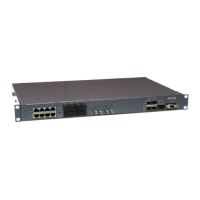
The SWT is provided in a 19" shelf that is 1 standard unit (s.u.) in height, prepared for rack
mounting.
It includes a serial maintenance interface (DCE mode) and an I/O connector (see section
2.8), and can include 4 Gigabit Ethernet SFP bays and up to 32 ports, front or rear.
The SWT has a 4-block mechanical structure for the installation of the ports. See in section
1.4.2, Equipment interfaces, the types of blocks available and their requirements.
The main power supply may be isolated DC or multirange (V
DC
and V
AC
). The SWT may
include an isolated DC or multirange (V
DC
and V
AC
) redundant power-supply option and, in
the front port model, a PoE power-supply option for the direct connection of IP devices
(IEEE 802.3 af) in the first four electrical ports (1 to 4).


 To Next Page