Introduction 1
1 Introduction
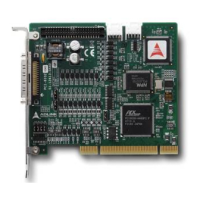
The PCI-8102 is an advanced 2-axis motion controller card with a
PCI interface. It can generate high frequency pulses (6.55MHz) to
drive stepper or servomotors. As a motion controller, it can provide
2-axis linear and circular interpolation and continuous interpolation
for continuous velocity. Also, changing position/speed on the fly is
available with a single axis operation.
Multiple PCI-8102 cards can be used in one system. Incremental
encoder interface on all four axes provide the ability to correct
positioning errors generated by inaccurate mechanical transmis-
sions. PCI-8102 features the postion compare and trigger output
function which users can put the comparing points with ADLINK
library and sending the triggering pulse to other device. In addi-
tion, a mechanical sensor interface, servo motor interface, and
general-purposed I/O signals are provided for easy system inte-
gration.
Figure 1-1 shows the functional block diagram of the PCI-8102
card. The motion control functions include trapezpoidal and S-
curve acceleration/deceleration, linear and circular interpolation
between two axes and continuous motion positioning, and 13
home return modes. All these functions and complex computa-
tions are performed internally by the ASIC, thus it can save CPU
loading.
The PCI-8102 also offers three user-friendly functions. The PCI-
8102 can let users assign the card index with the DIP switch set-
ting. The value is within 0 to 15. It is useful for machine makers to
recognize the card index if the whole control system is very huge.
The emergency input pin can let users wire the emergency botton
to trigger this board to stop sending pulse output once there is any
emgergency sitiuation happened. For security protection design,
users can set the 16-bit value into EEPROM. Users’ interface pro-
gram can uses this EEPROM to secure the software and hard-
ware in order to prevent piracy.


 To Next Page
 Loading...