S220/S221/S230/S231/Z200 7-7
Recue, Towing, 7
Lashing, Lifting by Crane
B
DD
A
2
A
1
C
1
C
2
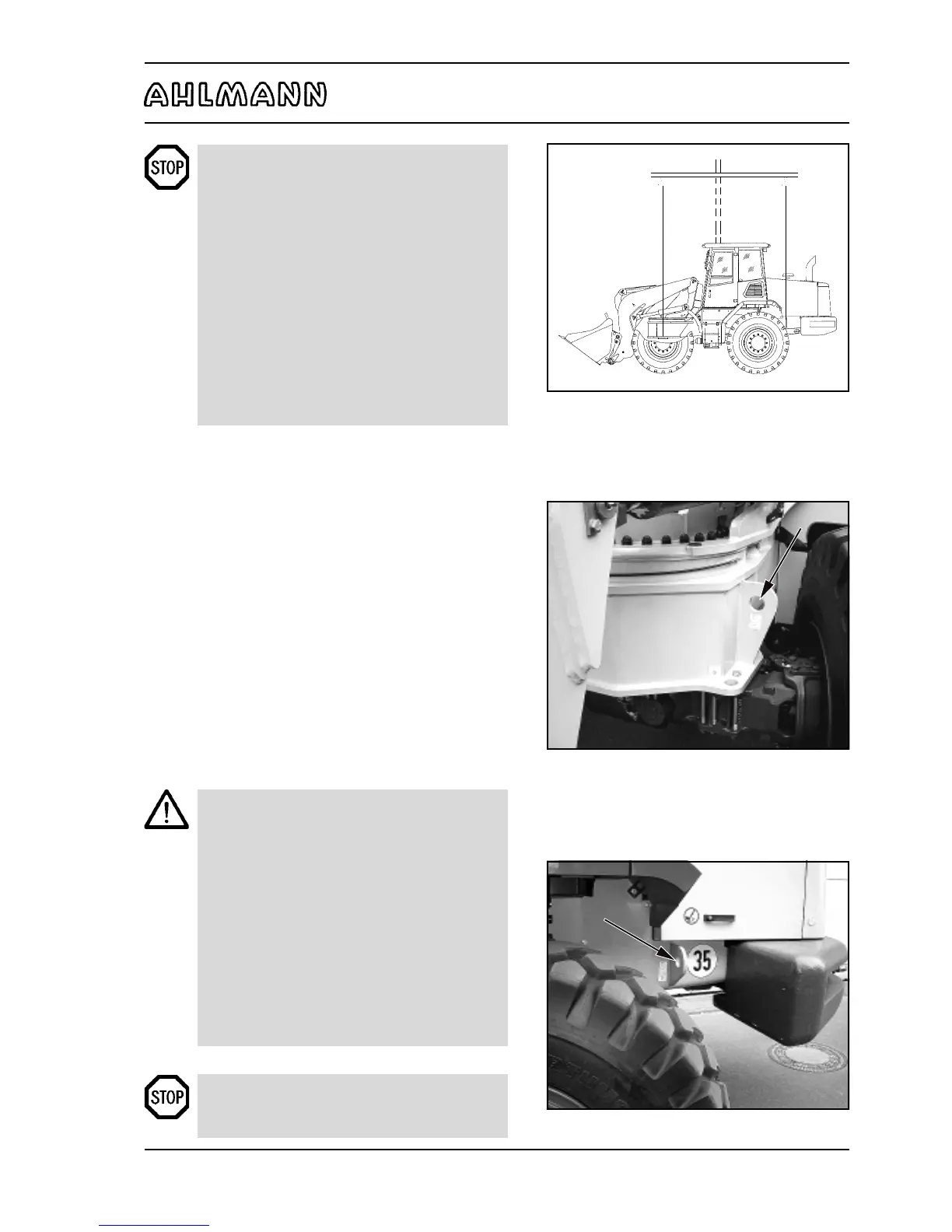
Figure 7-8
Figure 7-10
Figure 7-9
- For a longer towing distance, the defective
loader must be loaded onto a truck (for the
lashing points, see 7-2/1 and 7-2/2 or 7-3/1
and 7-3/2).
- The max. permissible load of the shunting
and towing coupling (7-2/1) is 8.0 t
horizontally in the longitudinal direction.
- The max. permissible load of the rear
shunting and towing coupling (7-3/1) is
12.0 t horizontally in the longitudinal
direction.
- The max. permissible load of the lashing
points/load-bearing points (7-2/2 and
7-3/2) is 4.0 t at an assumed bracing angle
of 45°.
- Pay attention to clearances under
structures!
7.2 Lifting by crane
The loader to be lifted must be prepared as follows:
(1) Apply the parking brake (4-9/7).
(2) Set the drive switch (4-9/5) to “0”.
(3) Switch to gear stage „Alpha max.“ (4-9/1).
(4) Lift or lower the bucket arm until the lowest point of the
bucket arm or of the bucket is at least 30 cm above the road
(5-2).
(5) Close the ball block valve for the working and auxiliary
hydraulics (4-8/2).
(6) Block the swivel unit by inserting the blocking wedge
(1-3/arrow) into the swivel block (1-4/arrow).
(7) Lock both doors.
(8) Fold the outside mirror inwards.
CAUTION
The following items must be observed when lifting
the loader by crane (Figure 7-8):
- The lifting point (A
1
- loader without standard
bucket or A
2
- loader with standard bucket) of
the lifting device (B) must be precisely vertically
over the centre of gravity (C
1
or C
2
) of the
loader so that the lifting device is horizontally
above the longitudinal centre axis of the
loader.
- The lifting gear (D) must lead vertically upwards
from the lifting points to the left and right of the
loader (7-9/arrow and 7-10/arrow).
DANGER
The lifting gear must have a lifting capacity of at
least 7.0 t.



 To Next Page