page 9 – 3
D-16 / Feb 2003
OPERATION
Console Operation
INTRODUCTION
This chapter describes the operation of the D-16 console.
CONSOLE OVERVIEW
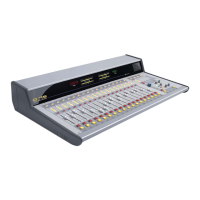
The console surface consists of 16 FADERS (2 faders in the PHONE
SECTION handle incoming callers, while the remaining 14 are used to handle
other console sources) with associated switches, a MONITOR SECTION, a
CONTROL SECTION, and a TIMER SECTION. Each section is described
below.
The Basics
The basic purpose of the console is to take some of the many audio signals
that are wired to the console inputs, and generate several outputs that
combine these inputs in various groups and at various degrees of loudness, or
signal strength. The typical application is in a radio station where it is desired
to develop the signals that the station will broadcast (the on air signal), as well
as several additional signals for recording and monitoring.
This discussion will center on the characteristics of the console and the
terminology needed to understand its operation.
Inputs - What Goes in to the Console
Audio signals come in several flavors. They can be mono or stereo, mic
level or line level, analog or digital. The D-16 is designed to handle up to eight
analog stereo line level inputs. Two other stereo line inputs can be used for
stereo signals or can be split to provide four mono mic inputs (two each per
stereo line input) instead.
The console can also handle up to eight digital stereo line level inputs, and
has two analog inputs dedicated to use as telephone caller inputs and an
additional analog mono Producer talkback input. Not all inputs are available
at the same time. An input must be selected by a FADER before it is available
for combination into a main output.
Analog Mono Mic Level Inputs
These inputs are used to connect to microphones, which typically put out
signals at relatively low signal strength, and therefore require more amplifi-
cation (increase in signal strength) to be properly audible in the output.
Analog Stereo Line Level Inputs
These inputs are typically used to connect to machines, such as tape decks,
cart machines, CD players, etc., that provide analog outputs.
Note: Mic level inputs can
be wired to the inputs of the
internal mic preamps. You
must then wire the mic
preamp outputs over to the
line level analog inputs you
want to use them with.



 To Next Page