Chapter 6: Using Pro Tools | Sync X 31
To use MTC output from Sync X:
Connect the Sync X MIDI Out connector to a MIDI In connector of a device that can recognize and use MTC. Typically, this
would be a console, sequencer, synthesizer or sampler keyboard, a drum machine, or other device.
MTC Output and Idle MTC Enabled Option
MTC is normally output whenever LTC is output. Whenever LTC output stops, Sync X will continue to output MTC in bursts of
one frame every 200 milliseconds. This allows any connected MIDI-reading device to be continuously updated as to the position
of Bi-Phase (either of which might be operating at slow or still speeds). Thus, you can still use a connected MIDI device for
Auto-Spotting from Bi-Phase. Optionally, this constant output can be set to mute when timecode (LTC) is idle.
To mute idle-time MTC output:
1 Choose Setup > Peripherals, and if necessary click Synchronization.
2 Deselect the Idle MTC Enabled option.
3 Click OK.
External Offsets and Timecode Display
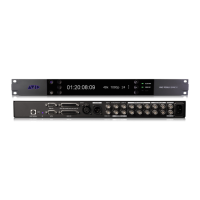
The Sync X Timecode Display always shows the actual incoming timecode, regardless of any External Offset settings defined in
the Session Setup window.
To apply an offset to the external timecode settings:
In the Session Setup window, enter the desired timecode offset value in the offset field for the desired timecode format (MMC,
9-PIN, or LTC).
To apply the same external timecode offset to all devices:
In the Session Setup window, select Link to apply the same offset value for all timecode formats.
Using Fader Start
You can apply Pro Tools | Sync X GPIO capabilities to different commands on different GPIs, such as monitoring commands,
Transport, turn on Record lights, turn off AC (air conditioning), and so on. Using the
GPIO, BI-PHASE/TACH IN, PILOT IN
DB-25 port, Sync X provides six GPI outputs in total, two TTL-level and four relays. Together, this combination of outputs makes
it possible for the Sync X to provide Fader Start capability.
Fader Start allows the level faders on Auxiliary Input tracks in a Pro Tools session to trigger play and stop for external devices. To
implement Fader Start, Pro Tools maps the first two Auxiliary Input tracks in a session to GPI Relay outputs 0 and 1.
To configure tracks in a session for Fader Start Play and Stop:
1 Create two Auxiliary Input tracks, or if the session already has two or more Auxiliary Input tracks, use the first and second of
them in the session (the two top-most in the Edit window or left-most in the Mix window).
2 When the fader on the first Auxiliary Input track in the session moves above –120 dB, GPI Relay output 3 (Fader Start #1) is
enabled.
3 When the fader on the second Auxiliary Input track in the session moves above –120 dB, GPI Relay output 4 (Fader Start #2)
is enabled.
Example Fader Start Scenario
In a live television scenario, the Fader Start feature can be used to trigger bumper SFX and music before or after a commercial
break. For example, coming back from commercial, move an Aux fader above –120 dB to automatically trigger Digicart SFX play-
back. Similarly, bringing the fader back down automatically stops playback.
Utilization of Fader Start has specific wiring requirements, for additional GPI information, see GPI Relay Wiring for Fader-Start.








 To Next Page