40
Appendix B: Additional Synchronization Information
Video Reference Signals
Video Reference
Black Burst
A black burst signal is essentially a “position-less” video signal. As with any “shared” video signal, you’ll want to ensure that your video
feed comes from a properly buffered and distributed source, such as a video distribution amplifier, or the house video reference/black
burst output of another device in the chain.
Tri-Level Sync
Tri-level sync, like black burst, is an analog video synchronization pulse primarily used for the locking of HD video signals. It is pre-
ferred in HD environments over black burst, as timing jitter is reduced since it runs at a higher frequency.
LTC Signals
Because it’s an analog audio signal, LTC can sometimes be susceptible to either tape dropouts (tape shedding), or to level mismatches
between the LTC source and the LTC input. The Sync X freewheeling feature allows you to compensate for brief timecode dropouts.
However, if you have serious dropouts, you may not be able to sustain accurate synchronization.
If you plan to use LTC as a clock reference (whether or not you are also using it as a positional reference), you will need to ensure that
your LTC is recorded at as high a level as possible without distortion, and that there are no dropouts longer than 2 frames.
Sync X reads LTC most reliably when fed with a LTC signal of at least –12 dBu (and preferably 0 dBu to +3 dBu.)
Working with Analog Machines
It is good practice on a 24-track analog tape machine to record timecode on Track 24 at a reference level of –10 dBu (or lower), with
Track 23 left blank as a “guard” track. This practice avoids crosstalk “bleed” that can occur between the timecode track and otherwise
adjacent audio tracks. Timecode (which is a mid-frequency alternating pitch square wave) is very sensitive to crosstalk from adjacent
tracks, and conversely you don’t want audible timecode leaking onto your audio tracks.
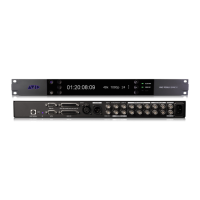
If your ATR is under the control of a synchronizer, you must make sure that the synchronizer and the Sync X are both locked to the same
reference source (such as, typically, from a video black burst generator.)
Digital Clock Signal Types
A reference clock signal is part of any digital recording system. It is required because whenever digital audio information is mixed to-
gether or passed between devices, the playback samples must be aligned with the recording samples. Pro Tools | Sync X can resolve to
AES3, AES3id, 10 MHz, and Word Clock.
AES3 and AES3id
Some professional digital audio products use AES “null clock” (which is an AES data stream that contains only clock information and
no audio information) as a system clock reference source. If you are connecting Sync X to such a system, you will want to use the
Sync X AES3 or AES3id input as the clock reference connection, so that all system components are referenced to the same time base.
Word Clock
Many professional digital audio products—including Pro Tools | MTRX, open-reel multitrack tape recorders, and digital mixing con-
soles—have Word Clock connectors.








 To Next Page