41
Word Clock allows Word Clock-compatible devices to send or receive external clock information which determines the sample rate,
which in turn (where applicable) controls the play and record speed.
Using just Word Clock, it is possible to create a “chain” of digital devices in your studio by picking one source as the Word Clock mas-
ter, and configuring other sources to follow Word Clock.
10 MHz
A 10 MHz reference signal is most often available from an Atomic Clock or a GPS receiver or satellite communications receiver. The
input for using 10 MHz is on the same BNC port as is used for the AES3id input signal.
Bi-Phase/Tach
Bi-Phase and Tach are used with mag machine,16, 35, and 70 mm projectors, flatbed editing systems and other types of motor-driven
film equipment. Bi-Phase (sometimes called Quadrature Sync) and Tach information are similar, though they do differ.
Bi-Phase
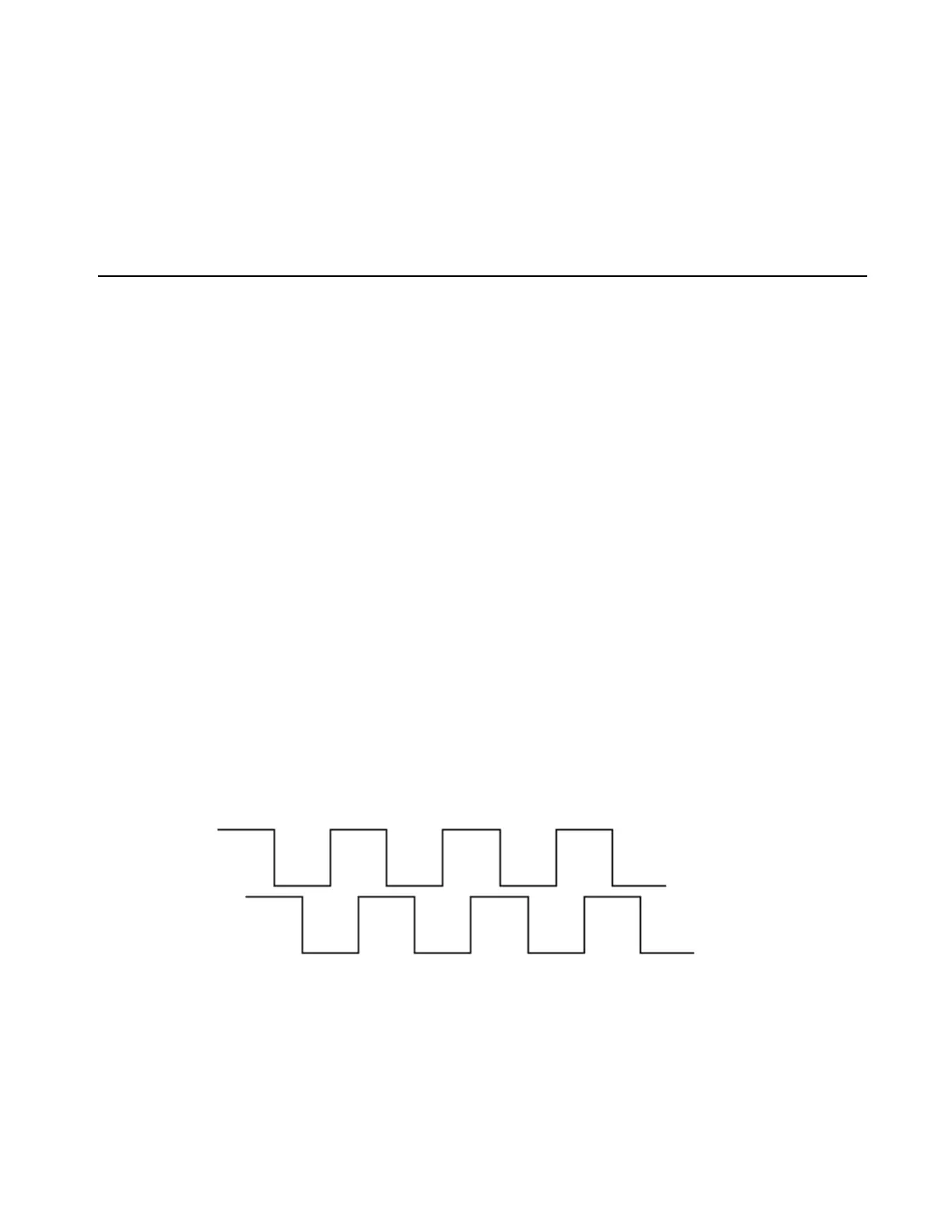
A Bi-Phase signal consists of two square waves, which are generated directly by a device’s transport mechanism, and which are 90°
out-of-phase with one another. As a Bi-Phase-generating device plays it outputs a steady stream of square waves that Sync X can use
as its clock reference, provided that the Bi-Phase transport speed is within +/– 8% of nominal.
Sync X uses the phase relationship between the two square waves to determine the device’s direction (forward or reverse). However,
this is relevant only when Sync X is using the Bi-Phase signal as a positional reference.
Tach
A Tach signal is a variation of Bi-Phase. With Tach’s two signals, one is used only as the direction indicator, while the other is used as
the velocity, or rate indicator. Sync X uses this rate signal when resolving to Tach as a clock reference.
There are several different standards for the number of pulses-per-frame for Bi-Phase or Tach devices. You can set Sync X to match the
PPF rate of the external device’s Bi-Phase/Tach encoder from Pro Tools.
Bi-Phase/Tach signals are clock reference signals, but do not contain positional information of their own. However, they do contain
enough information for Sync X to simulate positional information.
Bi-Phase/Tach signals use two square waves to generate pulses that can function as a clock reference. The two square waves are 90°
out-of-phase, in a pattern that resembles this:
With a Bi-Phase signal, Sync X can deduce the direction (forward or reverse) of the signal based upon which wave is read “high” relative
to the other. For instance, with some film equipment, when the device is running forward, it will generate a Bi-Phase signal where the
“A” wave leads the “B” wave—that is, where the A wave peaks before the B wave peaks. When the device is in reverse, the B wave will
lead the A wave.
Illustration of Bi-Phase/Tach signals
Square Wave A
Square Wave B








 To Next Page