HEMODIALYSIS BASICS
41
40
In hemodialysis, the cleaning of the blood takes place outside the
body in an “artificial kidney”, called a dialyzer. Blood is pumped via
disposable circuit to the dialyzer and back again, a process monitored
and controlled by a dialysis machine.
During the treatment blood flows on one side of a semi-permeable
membrane within the dialyzer. The dialysis machine mixes a fluid known
as dialysate and passes it through the dialyzer on the other side of the
membrane.
Waste products and excess fluid pass across the membrane from the
blood into the dialysate fluid. The cleaned blood is returned to the body
and the waste products and fluid are removed from the system.
As the dialysate is free from waste products, a concentration difference
is created across the membrane. This makes the waste products
move by diffusion from the blood, through the membrane and into
the dialysate. When the treatment starts, besides waste products,
the patient’s blood also contains excess fluid. To remove the fluid, a
pressure gradient is applied across the membrane in the dialyzer. This
forces water to leave the blood and enter the dialysate by the process
of ultrafiltration. The amount of fluid ultrafiltered during the entire
treatment session should correspond to the excess volume.
How Hemodialysis Works
The Dialyzer
This is a small plastic cylinder which attaches to the disposable circuit.
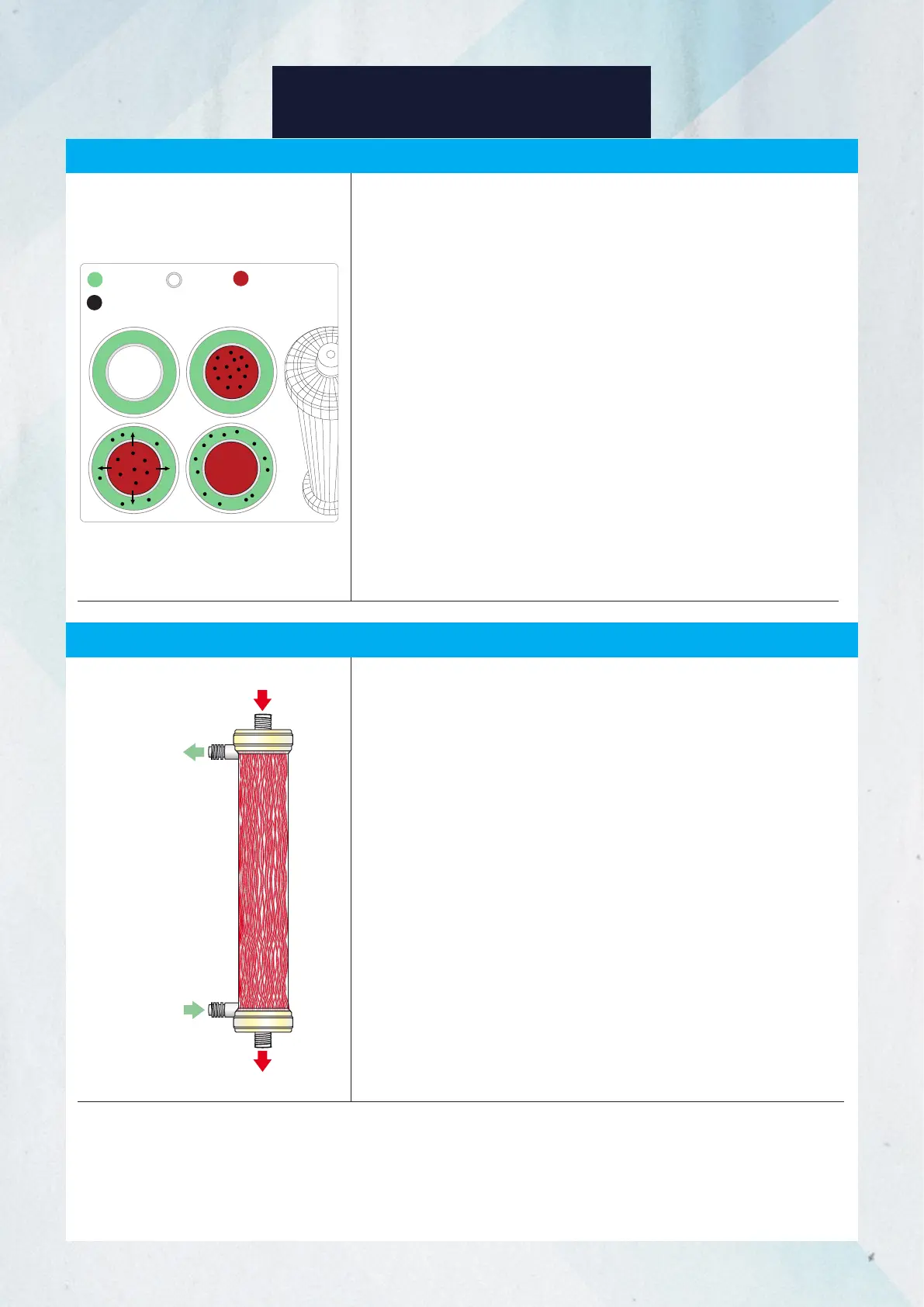
A dialyzer contains many fibers of a semi-permeable membrane.
This membrane is a thin film containing thousands of microscopic holes
(pores). The pores allow water and waste products to pass through them
but keep the blood cells and proteins within the blood.
Fluid is removed from the blood by ultrafiltration driven by a pressure
gradient, TMP (transmembrane pressure), across the membrane.
Dialysate passes continuously through the dialyzer on the other side of
the membrane.
All dialyzers have four external ports, two that allow blood to enter
and exit the dialyzer and two that allow dialysate to enter and exit the
dialyzer.
The dialysate flows through the dialyzer in the opposite direction to the
blood, also known as counter-current.
Dialysate out
Dialysate in
Blood in
Blood out
Blood
Membrane
Waste products
1 2
3 4
Dialysate





 To Next Page