HEMODIALYSIS BASICS
46
Efficiency of Hemodialysis (cont.)
Solute removal
The removal of solutes is directly impacted by the prescribed blood flow (QB).
One common waste is urea, which results from the breakdown of protein.
The simplest way to follow the urea removal is to analyze and compare the blood urea concentrations before (pre)
and after (post) dialysis.
The results of the pre and post blood tests can be entered into one of two main calculations to establish efficient
delivery of therapy.
These calculations are
• Urea reduction ratio (URR)
• Urea kinetic modeling (Kt/V)
The URR measures the level of urea in the blood before and after a treatment. The difference between the two
levels is shown as a percent.
The Kt/V is calculated by multiplying the amount of waste removed by the treatment time. The result is divided by
the estimated volume of water in the body.
• The K stands for clearance of urea
• The t stands for treatment time
• The V stands for the volume of the body water
Several factors facilitate the efficiency of a dialysis treatment. Those
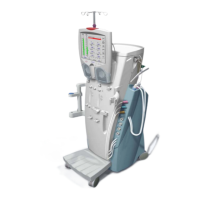
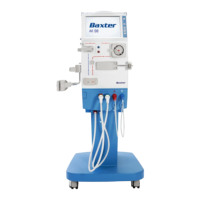
parameters can also be checked on the AK 98 dialysis machine.
The non-diffusion time:
This is the time during the treatment when no dialysis has occurred
when the blood pump is stopped or when the dialysate is bypassed.
This may be due to:
• An alarm that has put the dialysate in bypass
(e.g., a conductivity alarm)
• An alarm that has stopped the blood pump
(e.g., an arterial pressure alarm)
Note: The AK 98 dialysis machine has a feature integrated that can provide information on the efficiency of
the treatment. The Diascan monitoring system can be used for theoretical clearance measurement (K)
and (Kt/V).
Note: Clearance describes the cleansing capacity of a dialyzer with consideration to the blood flow and
dialysate flow rates.
The Accumulated Blood Volume (ACC QB) is:
Blood flow (ml/minute) x Time (minutes)
• To achieve an efficient solute removal the blood flow rate, QB,
should be maintained per provider order, as dialysis access will
allow.
• The length of the treatment is prescribed by a physician to achieve
efficient solute and fluid removal appropriate for the individual
patient.
• A stopped blood pump or reduced blood flow will also reduce the
accumulated blood volume processed.





 To Next Page