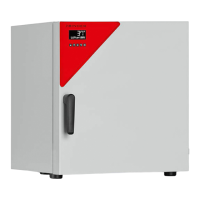
What does message “End” mean on my Binder Laboratory Equipment?
- MMatthew TrujilloSep 8, 2025
If your Binder Laboratory Equipment displays the message “End”, it means the sterilization cycle has completed. Start up the unit.
What does message “End” mean on my Binder Laboratory Equipment?
If your Binder Laboratory Equipment displays the message “End”, it means the sterilization cycle has completed. Start up the unit.
What to do if my Binder C 170 E3 Laboratory Equipment shows message “dor”?
If your Binder Laboratory Equipment displays the message “dor”, it indicates that the outer unit door is not closed properly. Ensure that you close the unit door properly.
How to fix a Binder Laboratory Equipment with no unit function and a dark display?
If your Binder Laboratory Equipment shows no unit function and a dark display, the main power switch is likely off. Turn on the main power switch to resolve this.
How to troubleshoot a Binder C 170 E3 with no function?
If your Binder Laboratory Equipment is not functioning, start by checking the connection to the power supply. Also, verify that the power supply voltage matches the unit's requirement of 120 V / 230 V.
Why is the CO concentration inside my Binder C 170 E3 Laboratory Equipment too low?
If the CO concentration inside your Binder Laboratory Equipment is too low, it could be due to several reasons: * Doors not closed properly: Ensure the door is tightly shut. * Defective door gaskets: Consider replacing the door gaskets. * CO cylinder issues: Make sure the CO cylinder is correctly connected, and that the cylinder is open and not empty. * Gas hose: Check the gas hose for any dirt accumulation or obstructions; clean or replace if necessary. If these steps don't resolve the issue, it may require professional attention.
What to do if sterilization program started with the CO sensor still plugged-in in Binder Laboratory Equipment?
To solve this problem, pull the CO sensor and remove it from the incubator.
What does alarm message “ - - - ” on my Binder Laboratory Equipment mean?
If your Binder Laboratory Equipment displays an alarm message “ - - - ”, connect the CO sensor.
How to resolve alarm message “Loc” on my Binder Laboratory Equipment?
To resolve the “Loc” alarm message on your Binder Laboratory Equipment, enter the password for unlocking and then start the sterilization again.
Why is there condensation on the door of my Binder Laboratory Equipment?
If you see condensation on the door of your Binder Laboratory Equipment, it could be due to several reasons: * The unit is placed on a very cold floor. Place the unit on a BINDER stand to increase the distance to the floor. * The doors are not closed properly. Make sure to close the door properly. * The door gaskets are defective. Replace the door gaskets.
What to do if CO concentration inside my Binder Laboratory Equipment is too low and message “con” is displayed?
If the CO concentration inside your Binder Laboratory Equipment is too low and the message “con” is displayed, make sure that the doors are closed properly and replace the door gaskets if they are defective.
Essential safety guidelines for installation, operation, and general precautions.
Safety measures for handling hazardous CO2 gas, including ventilation.
Safe practices for storing, transporting, and using gas cylinders.
Defines the approved applications and proper usage of the CO2 incubator.
Explains the FPI infrared system for accurate CO2 measurement.
Details on connecting, handling, and maintaining the CO2 sensor.
General information and safety for connecting the CO2 gas supply.
Step-by-step procedure for connecting the CO2 gas cylinder.
Procedures for connecting the incubator to the power supply.
Procedure to input altitude for accurate CO2 concentration calculation.
Steps for setting the desired incubation temperature and CO2 levels.
Details the secondary, independent safety controller for over-temperature protection.
How to configure the safety controller as 'Limit' or 'Offset'.
Procedure for setting the activation temperature for the safety controller.
Details the specific alarm triggered by the safety controller.
Alarm and operational response when the unit door is left open.
Alarms for CO2 levels deviating from the set point.
Alarm triggered by a fault in the temperature sensor system.
Alarm indicating a defective or failed CO2 sensor.
Procedures for routine cleaning of the incubator and its parts.
Steps for chemical disinfection of the incubator chamber.
Recommended methods for disinfecting the CO2 sensor.
Detailed procedure for performing high-temperature hot-air sterilization.
Step-by-step instructions for executing the sterilization cycle.
Procedures for safely stopping the sterilization cycle.
Information on recommended maintenance, service schedules, and BINDER contacts.
Specific troubleshooting tips for issues related to heating performance.
Troubleshooting steps for problems with gas supply and concentration control.
Troubleshooting errors and malfunctions of the control unit.
Essential safety guidelines for installation, operation, and general precautions.
Safety measures for handling hazardous CO2 gas, including ventilation.
Safe practices for storing, transporting, and using gas cylinders.
Defines the approved applications and proper usage of the CO2 incubator.
Explains the FPI infrared system for accurate CO2 measurement.
Details on connecting, handling, and maintaining the CO2 sensor.
General information and safety for connecting the CO2 gas supply.
Step-by-step procedure for connecting the CO2 gas cylinder.
Procedures for connecting the incubator to the power supply.
Procedure to input altitude for accurate CO2 concentration calculation.
Steps for setting the desired incubation temperature and CO2 levels.
Details the secondary, independent safety controller for over-temperature protection.
How to configure the safety controller as 'Limit' or 'Offset'.
Procedure for setting the activation temperature for the safety controller.
Details the specific alarm triggered by the safety controller.
Alarm and operational response when the unit door is left open.
Alarms for CO2 levels deviating from the set point.
Alarm triggered by a fault in the temperature sensor system.
Alarm indicating a defective or failed CO2 sensor.
Procedures for routine cleaning of the incubator and its parts.
Steps for chemical disinfection of the incubator chamber.
Recommended methods for disinfecting the CO2 sensor.
Detailed procedure for performing high-temperature hot-air sterilization.
Step-by-step instructions for executing the sterilization cycle.
Procedures for safely stopping the sterilization cycle.
Information on recommended maintenance, service schedules, and BINDER contacts.
Specific troubleshooting tips for issues related to heating performance.
Troubleshooting steps for problems with gas supply and concentration control.
Troubleshooting errors and malfunctions of the control unit.
| Temperature Variation | ±1.5 °C |
|---|---|
| Max. Load per Shelf | 30 kg |
| Voltage | 230 V |
| Protection Class | IP 20 |
| Temperature Uniformity | ±1.5 °C |
| Frequency | 50/60 Hz |
| Type | Convection Oven |
| Temperature Range | Ambient +5 °C to 300 °C |
| Interior Volume | 170 liters |
| Shelves (Std./Max.) | 2/ |
| Weight (Empty) | Approx. 85 kg |
Loading...