C (E3) 08/2015 page 76/93
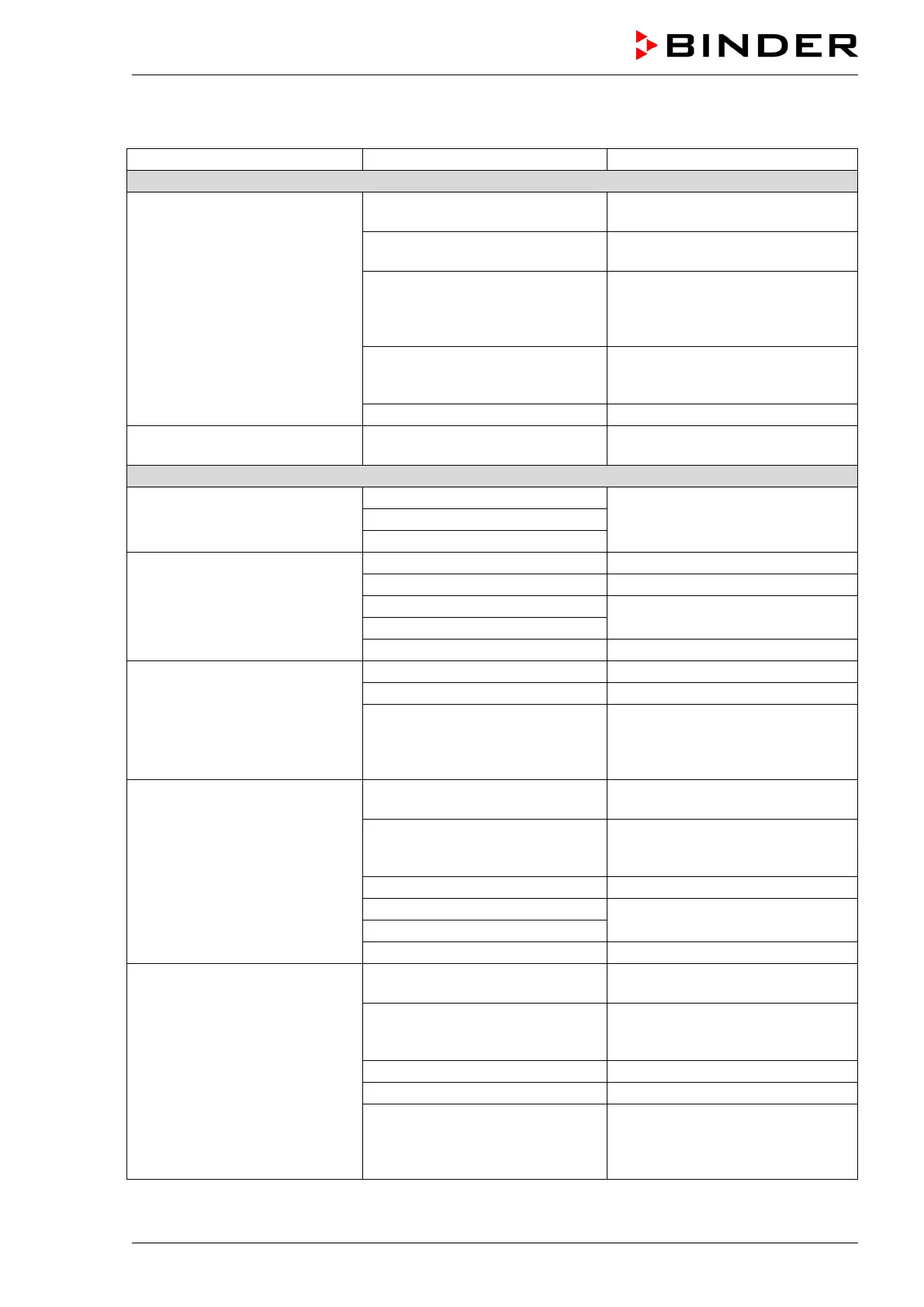
18. Troubleshooting
Unit without function.
No power supply.
Check connection to power sup-
ply.
Wrong voltage.
Check power supply for voltage of
120 V / 230 V.
Nominal temperature exceeded
by 10 °C due to unit failure. Over
temperature protective device
(class 1) responds (chap. 9.1).
Contact BINDER service.
The miniature fuse for overcur-
rent protection has triggered
Check unit fuse and replace it if
appropriate. If it responds again,
Message “dor” is displayed.
The outer unit door is not closed
properly.
Close unit door properly.
Chamber does not heat up.
Contact BINDER service.
Heating element defective.
Semiconductor relay defective.
Temperature inside too low.
Contact BINDER service.
Calibrate and adjust controller.
Temperature inside too low.
Message “tol” is displayed
(temperature tolerance range
alarm)
Wrong controller setting.
Check and, if appropriate, set the
operating function “AL.12” (tem-
perature alarm threshold) (chap.
7.3). Value should be ≥ 1 K.
Temperature inside too high.
Installation site too warm.
Select cooler place of installation
(chap. 3.4).
Difference between the set tem-
perature and the ambient tem-
Difference between the set tem-
perature and the ambient tempera-
Too much external heat load.
Contact BINDER service.
Semiconductor relay defective.
Calibrate and adjust controller
Temperature inside too high.
Message “tol” is displayed (tem-
perature tolerance range alarm).
Installation site too warm.
Select cooler place of installation
(chap. 3.4).
Difference between the set tem-
perature and the ambient tem-
Difference between the set tem-
perature and the ambient tempera-
Too much external heat load.
Semiconductor relay defective.
Wrong controller setting.
Check and, if appropriate, set the
operating function “AL.12” (tem-
perature alarm threshold) (chap.
7.3). Value should be ≥ 1 K.



 To Next Page