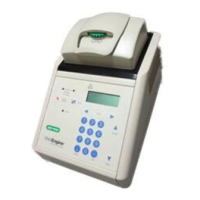
DNA Engine Tetrad 2 Thermal Cycler Operations Manual
5-10 Tech Support: 1-800-4BIORAD • 1-800-424-6723 • www.bio-rad.com
Calculated control is also the method of choice for most types of programs because
it yields the most consistency, reliability, and speed. Calculated control provides for
shorter protocols in three ways:
1. Brief and precise block temperature overshoots are used to bring samples to
the desired incubation temperature rapidly.
2. Incubation periods are timed according to how long the samples, not the
blocks, reside at the target temperature.
3. The instrument automatically compensates for vessel type and reaction volume.
Note: We will choose calculated control for our example.
Block Control
The DNA Engine Tetrad 2 cycler maintains the block at the programmed temperature,
independent of sample temperature. This mode of temperature control is common to
older models of thermal cyclers.
Block control provides less accurate control of sample temperatures than calculated con-
trol provides. Under block control, the temperature of samples will lag behind the
temperature of the block. The length of the time lag depends on the vessel type and
sample volume but typically is between 10 and 30 seconds. Block control is chiefly used
to run protocols developed for other thermal cyclers that use block control, or if you use
the <Instant> command to incubate samples at a set temperature for long periods of time.
Modifying Block-Control Programs for Calculated Control
Block-control programs can be changed to calculated control by subtracting at least
15–20 seconds from each temperature step. Some empirical testing may be required to
adjust modified programs for optimum performance. We generally recommend not
reducing the incubation time for a step below 5 seconds while in calculated control mode.
Modifying a Program Designed for a Different Machine
The ramp programming step can be used to adapt programs designed for thermal
cyclers with slower maximum heating and cooling rates than the DNA Engine Tetrad 2
cycler. In addition, a given protocol will occasionally work better with a slower rate of
temperature change; the ramp step can be used to optimize the program for such a
protocol.


 To Next Page