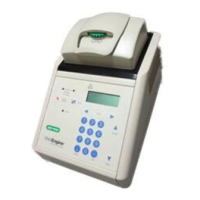
DNA Engine Tetrad 2 Thermal Cycler Operations Manual
5-12 Tech Support: 1-800-4BIORAD • 1-800-424-6723 • www.bio-rad.com
programmable hold time for a step is 1 hour 39 minutes and 59 seconds (99:59), with
the exception of a forever incubation. In advanced programs, the maximum pro-
grammable hold time is 18 hours, with the exception of a forever incubation.
Choosing a Thermal Gradient
Molecular biology labs routinely optimize annealing and denaturing temperatures for
thermal cycling reactions. Optimization is critical, but not always easy. The T
m
(‘melting temperature’) of an oligonucleotide can be estimated using an empirically
derived correlation which considers a combination of DNA length, G+C content, and
salt concentration. However, since the T
m
is only an estimate, the “true” annealing
temperature may need adjusting in the actual experiment. This optimization involves
repeating a reaction at several different annealing temperatures, which requires a
great deal of time and monopolizes the instrument while several experiments are run
in tandem. To complicate matters further, similar time-consuming experiments may
also be required for denaturing temperature optimization.
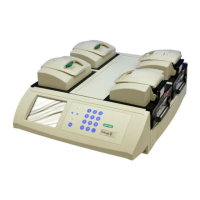
The DNA Engine Tetrad 2 cycler programmable temperature gradient feature allows
for optimization of an incubation temperature in a single experiment by analyzing a
number of different temperatures simultaneously. The thermal gradient delivers a
controlled thermal difference, left to right, across the sample block. This will result in
a precisely defined temperature gradient that is repeatable from experiment to exper-
iment. The range of temperatures that can be achieved from left to right across a
96-well Alpha unit can be as small as 1°C or as great as 24°C. The maximum pro-
grammable temperature is 105°C; the minimum programmable temperature is 30°C.
Note: The programmable temperature gradient feature is only accessible if a 96-well
Alpha
™
unit(s) is mounted in the DNA Engine Tetrad 2 cycler. The gradient feature is
not compatible with other types of Alpha units.
The temperature of any well or column in the sample block may be displayed using
the <Gradient Calculator> available from the <Tools> drop-down menu in the Status
window.
Since our oligonucleotide annealing temperature is not optimized, we will replace our
annealing step with a gradient step. We will optimize in the range of 45°C to 65°C.
Your written program should now appear as follows:
Raw program:
Use calculated temperature control mode
Use constant lid control mode at 100°C
1. 92°C for 30 seconds
2. Gradient from 45°C to 65°C for 3 minutes
3 Goto step 1, 29 more times
4. END


 To Next Page