and start-up
3.4.3 Over temperature protection (derating)
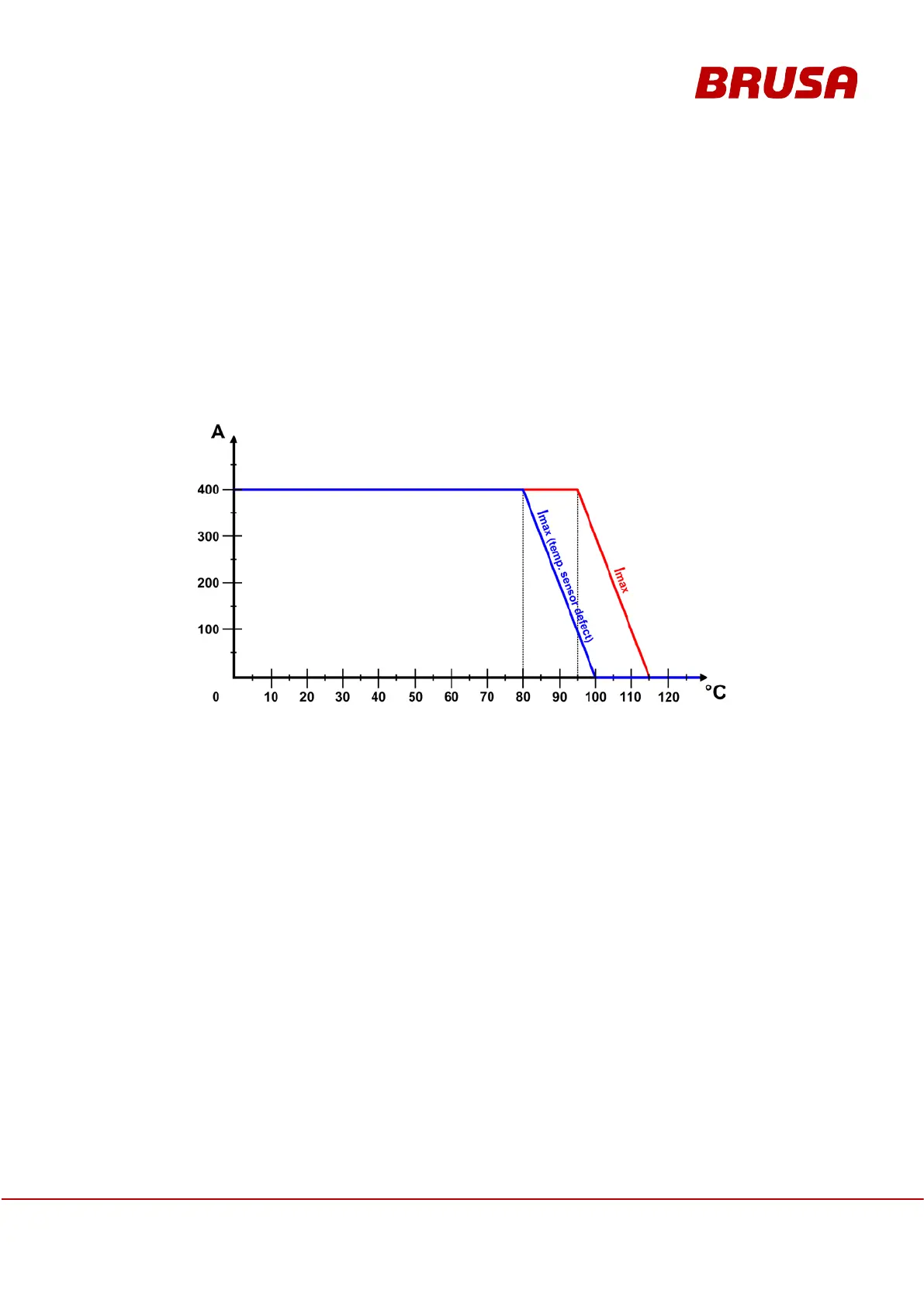
This protective system is a self-protection feature of the BDC546. If the device reaches a defined temperature
threshold, the power rating is reduced (derating) to protect the device from damage caused by overheating. The
maximum permissible lowside current (400 A) will subsequently be reduced in proportion to the temperature
increase until the temperature falls back to the target range. The module and choke temperatures are measured.
Derating is activated if a temperature value of ≥ 95 °C is reached. The power or choke current is now reduced in
stages to a temperature not lower than 115 °C (0 A). This means that the choke current is reduced by 20 A for
every degree temperature increase. If a temperature sensor is defective, derating is activated at temperatures ≥
80 °C for safety reasons, and, correspondingly, the lowside current is reduced to 0 A at a temperature of 100 °C.
3.4.4 HV - Automatic intermediate circuit discharge
The BDC546 is equipped with an active as well as passive feature for discharging the HV circuit. This includes the
highside as well as the lowside. Active intermediate circuit discharge is implemented inherently via an internal HV
supply and cannot be controlled. Passive discharge is achieved by means of a resistor string:
Active intermediate circuit discharge:
As soon as the device is separated from the HV supply, the internal HV circuits discharge to a value of < 60 V
within <5 s.
Passive intermediate circuit discharge:
As soon as the device is separated from the HV supply, the internal HV circuits discharge to a value of < 60 V
within <300 s.


 To Next Page