The CSMA/CD type of MAC is 'probabilistic' or 'non-deterministic'; this is
because the ability of any one station to transmit information has a
probability corresponding to the activity on the bus and the nature of that
activity, thus preventing the pre-determination of performance or
propagation delays for any given station on the network. This generally
isn't a problem, but in some circumstances (e.g. process control), this form
of system is unsuitable. In these situations other technologies can be used,
such as token ring and token bus, both of which provide a 'deterministic'
element to performance.
Ethernet technology is currently the most popular system and has been
standardised – firstly by the inventors Xerox, DEC and Intel; the
specification is the DIX Ethernet Specification Version 1 and Version 2.
The Institute of Electrical and Electronics Engineers (IEEE) has adopted,
improved, and slightly modified this specification. The IEEE specification
is IEEE 802.3 – part of the 802 Local Area Networking standards. The
differences between the DIX specification and the IEEE specification are
detailed in C.3.
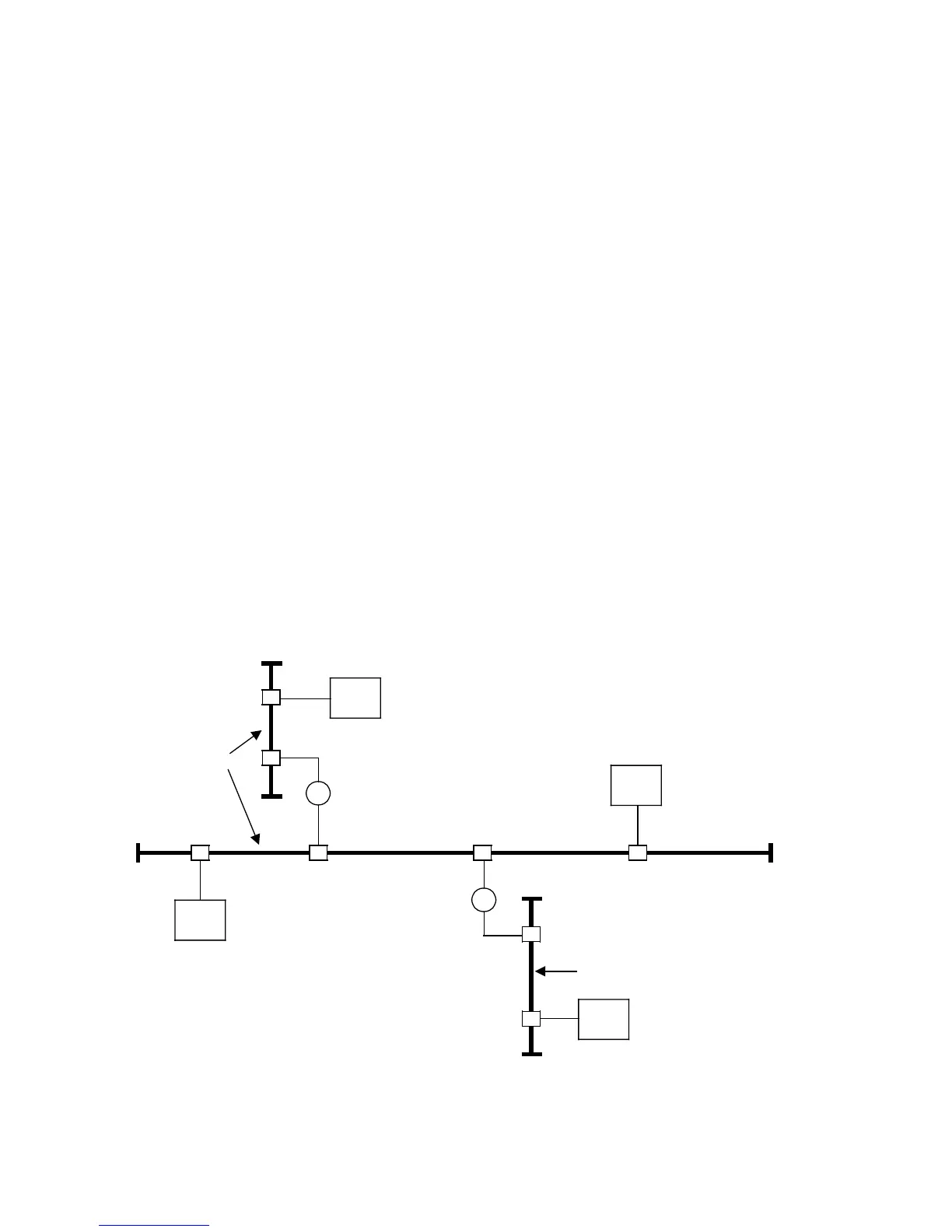
The topology of Ethernet is a tree structure of interconnecting segments.
Each segment can be a maximum length of 500 metres, when using thick
coax. Repeaters may be used to join segments up to a maximum of two
repeaters per three segments, thus resulting in a maximum of 1500 metres
between any two stations.
Figure C-1 Ethernet Topology
Repeater
Repeater
Segments
Segment
X870-300351 Issue 1 C-2 Rev.0



 To Next Page