C.2 TCP/IP Protocols
TCP/IP is currently the de facto standard for LAN interworking. It was
developed by researchers within and around the Advanced Research
Projects Agency (ARPA) in the United States. It is currently the most
popular non-proprietary protocol in use today. TCP and IP both refer to
specific protocols within a complete suite of interworking protocols known
as the 'Internet Protocol Suite'; however the term TCP/IP has evolved by
common use to describe the suite of protocols as a collective. The purpose of
the Internet Protocol Suite is to allow co-operating computers to share
resources across a network. Today thousands of networks of all kinds, LAN
or not, use TCP/IP as their main communication method.
Most of the work and knowledge gained from the development and use of
TCP/IP has led to the definitions of the OSI/ISO protocols. It is therefore
not very difficult to show similarities with the OSI model and TCP/IP.
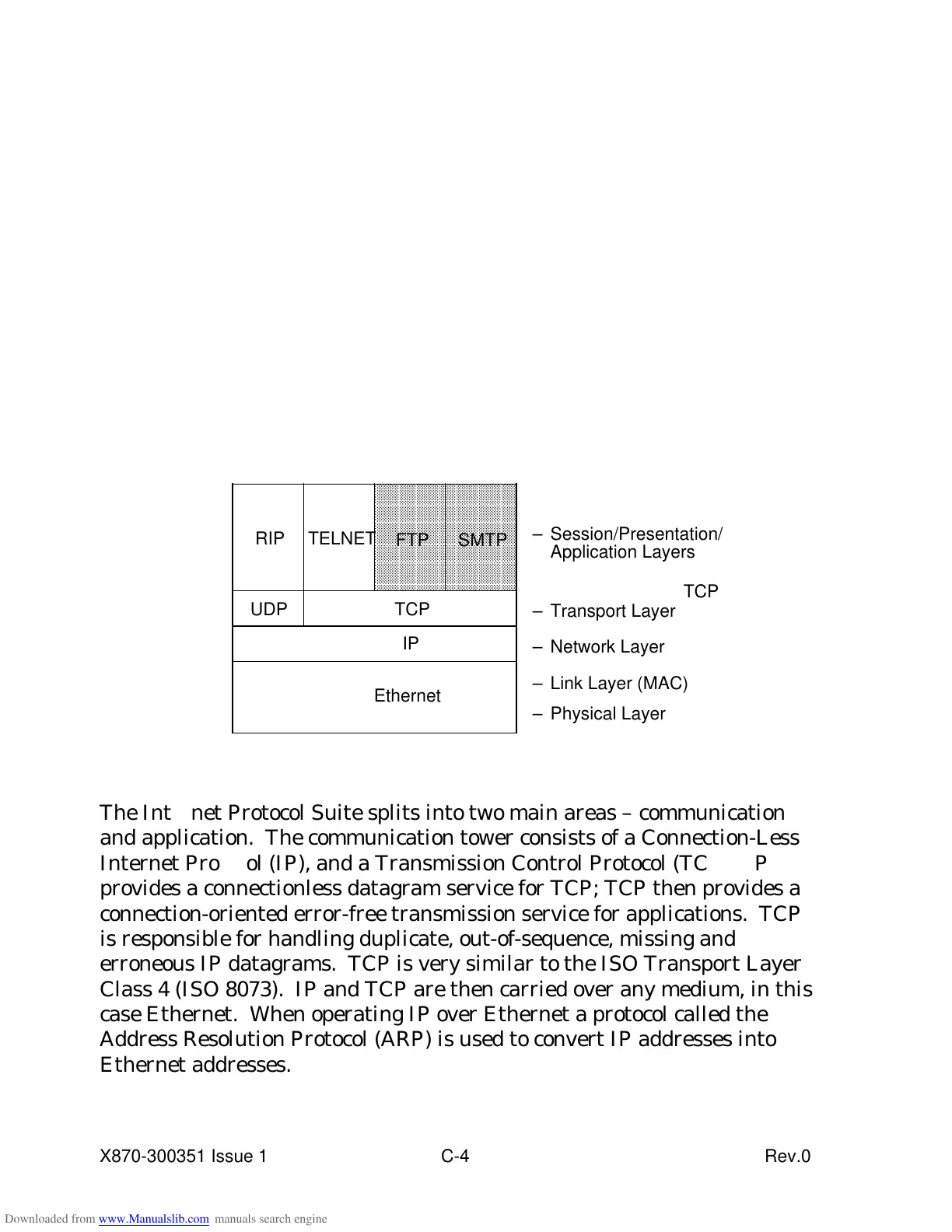
Figure C-2 TCP/IP Protocol Stack
SMTP
The Internet Protocol Suite splits into two main areas – communication
and application. The communication tower consists of a Connection-Less
Internet Protocol (IP), and a Transmission Control Protocol (TCP). IP
provides a connectionless datagram service for TCP; TCP then provides a
connection-oriented error-free transmission service for applications. TCP
is responsible for handling duplicate, out-of-sequence, missing and
erroneous IP datagrams. TCP is very similar to the ISO Transport Layer
Class 4 (ISO 8073). IP and TCP are then carried over any medium, in this
case Ethernet. When operating IP over Ethernet a protocol called the
Address Resolution Protocol (ARP) is used to convert IP addresses into
Ethernet addresses.
X870-300351 Issue 1 C-4 Rev.0



 To Next Page