CHAPTER 3 – INSTRUMENTS AND CONTROLS
3-50
Mirrors Adjustment
ATTENTION: Always check mirrors positio-
ning before start the machine engine. The
internal mirror in your machine is a convex
type. Vehicles and other objects seen through
a convex mirror look smaller and farther away
then they really are. Take this into conside-
ration and observe the same objects throu-
gh the external mirrors to better evaluate the
situation. Do not use the convex mirror to
determine the distance of vehicles or objects
behind the machine.
INTERNAL MIRROR
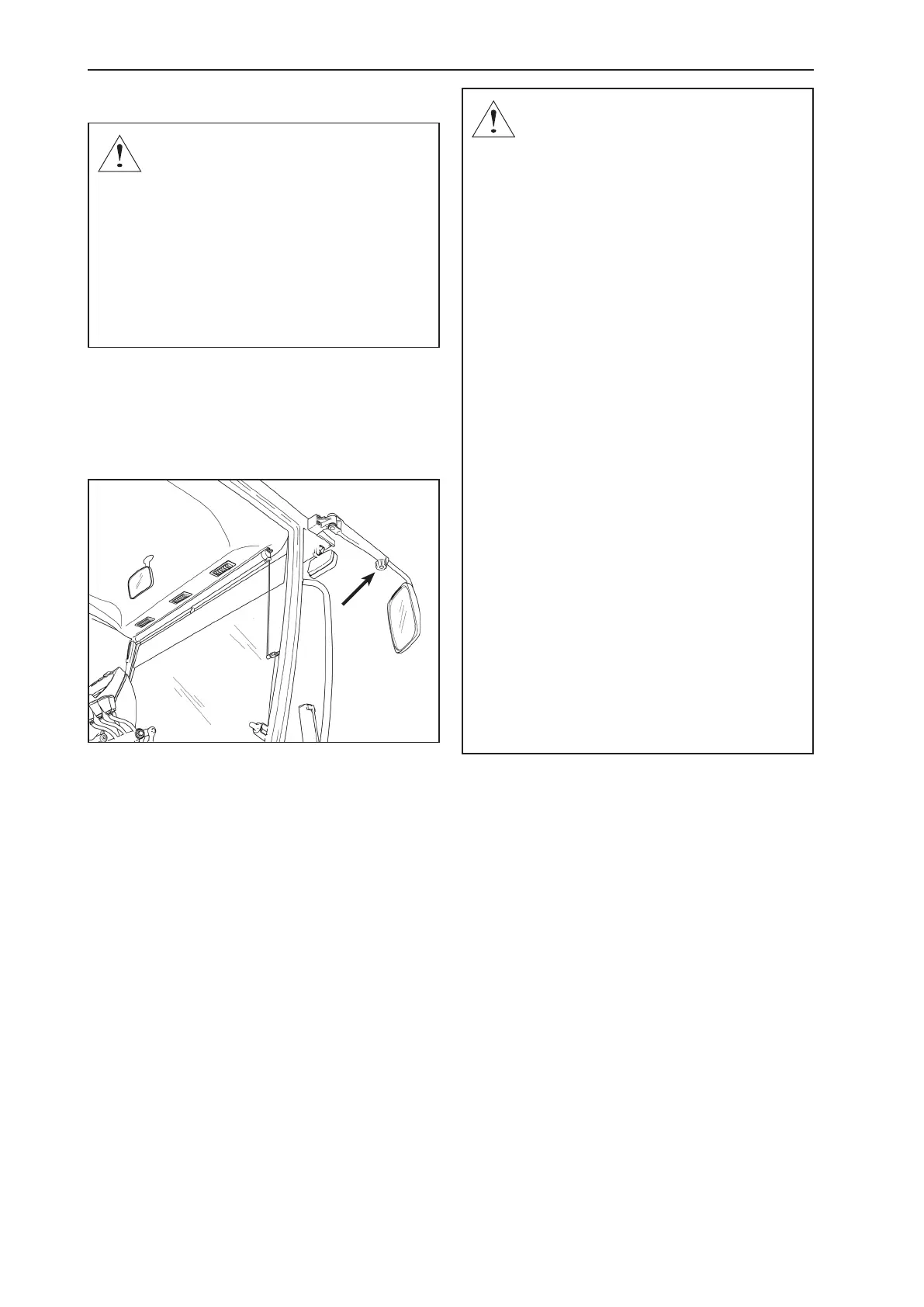
The internal mirror can be moved in all directions. Use
your hands to adjust it to the desired position.
EXTERNAL MIRRORS
The external mirrors can be moved in all directions. Use
your hands to adjust it to the desired position.
You can also extend, retract, and articulate the external
mirror rod inside or outside.
For extending or retracting the external mirrors rod, turn
the adjustment handler anticlockwise to release and ad-
just it to the desired position. After adjusted, turn the han-
dler clockwise to lock. Make sure the mirrors are tight in
the desired position.
WARNING: Always check work area to avoid
accidents. The following are examples of
dangerous work areas: slopes, overhangs,
timber, demolitions, re, high walls, drop offs,
backlls, rough terrain, ditches, ridges, exca-
vation, crowded parking lots, heavy trafc and
closed areas. Use extreme care when in are-
as such as these.
Be on the look out for edges, slides or falling
objects. Beware of brush and undergrowth or
other obstacles that conceal dangerous con-
ditions.
For night operation keep all the machine
mounted lights on. Replace burned out lights
immediately.
Always shut-off engine when leaving
operator’s seat.
Before moving machine or attachments, be
sure people in the area are clear of the unit.
Walk completely around the machine before
mounting and sound horn.
Be sure exhaust system is free from leaks
under the hood. (When operating inside a
closed cab, always keep a vent to outside air
open at all times)
Avoid applying brakes continuously on long
grades. Select the proper gear entering the
grade.
Keep engine exhaust manifolds clear of com-
bustible trash. Shut engine off before clea-
ning it.
Keep people clear of the attachments and to-
ols while they are in a raised position to pre-
vent injury.


 To Next Page