13 610 02 1018
12
Principles
2 Principles
2.1 Physical principles
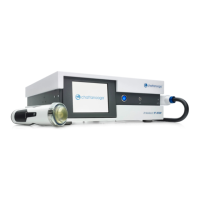
The Chattanooga Intelect F-SW is a universal, compact shock wave unit that can be
used for treatment involving medium- to high-energy electromagnetically generated
shock waves - focused shock waves – referred to below as F-SW.
F-SW waves have a short pulse length and are concentrated on areas a few
millimetres in diameter, allowing pulse waves to be applied to a tightly localised area,
even in deeper tissue layers.
2.1.1 Indications
The Chattanooga Intelect F-SW is designed in order to treat the indications specied
below:
Orthopaedics / Pain Therapy
– Plantar fasciitis / heel spur / heel pain / calcaneal spur
– Trigger Point Therapy
– Treatment of deep muscle trigger points
– Treatment of supercial muscle trigger points
– Myofascial pain syndrome / Myofascial trigger points* / Acupuncture points
– e.g. chronic back pain (cervical and lumbar parts of vertebral column), trape-
zius, pelvic oor muscle trigger points
– Tendinopathy / Tendinitis / Tendonitis / Tendinosis / Tendon Pain
– Insertion tendonitis in general
– Supercial insertion tendonitis (paratendinary area)
– Shoulder pain with or without calcications / tendinopathy of the shoulder,
the supraspinatus, or / and the rotator cuff (with or without calcications)
– (Radial/ulnar humeral) epicondylitis / tennis elbow / golfer’s elbow / elbow
tendinopathy
– Greater trochanteric pain syndrome (GTPS) / Trochanteric tendonitis / Tro-
chanteric bursitis
– Hamstring tendinopathy
– Patellar tip syndrome/ proximal iliotibial band (friction) syndrome / Patellar
tendonitis / Jumper’s knee
– Tibial edge syndrome / tibial stress syndrome / tibial tendonitis
– Achillodynia / Achilles tendinitis
– Pseudarthrosis / non-unions / delayed unions



 To Next Page
