Error! Reference source not found. 4
Tester Symbols
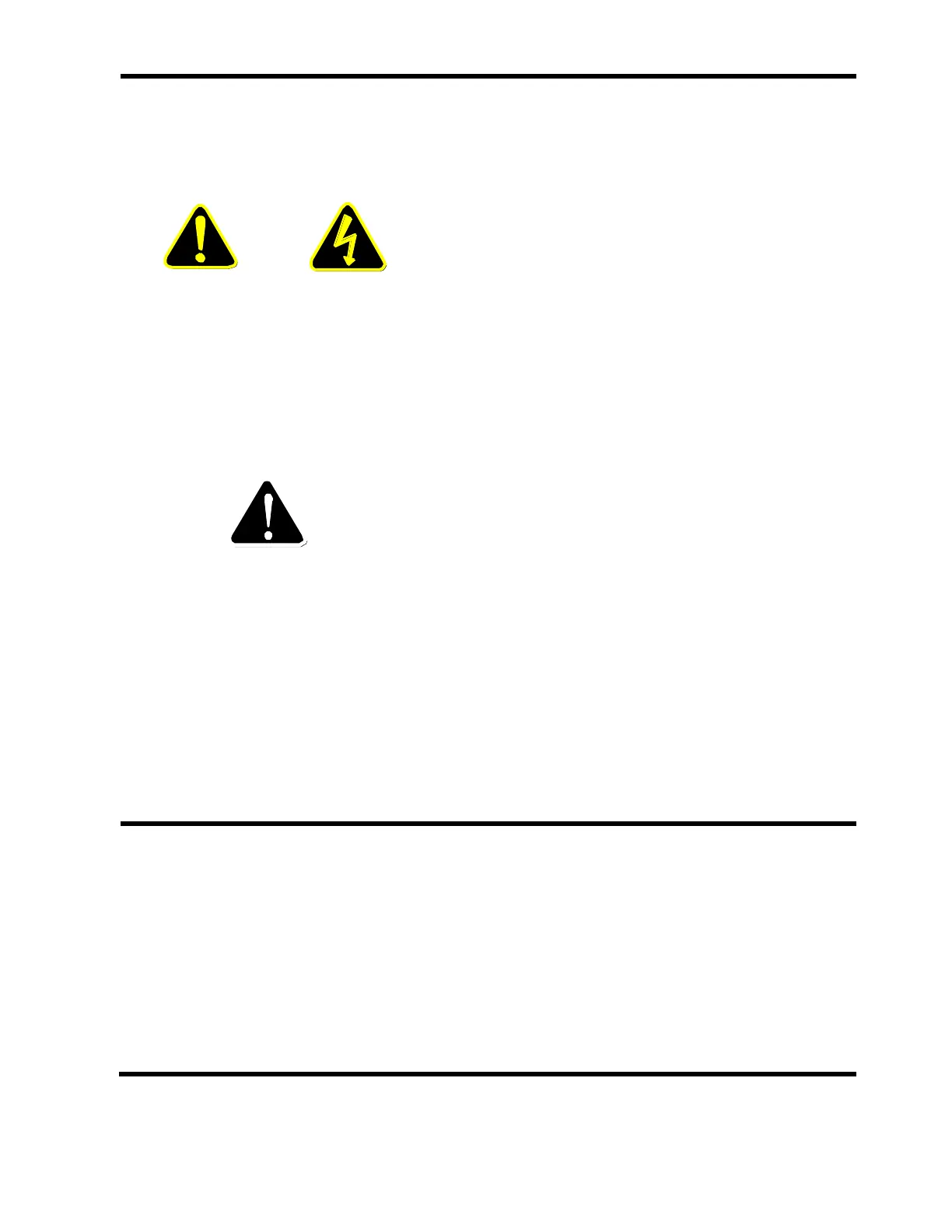
The yellow lightning bolt symbols on the CH2 tester inform operators that high voltage is
involved with the scanner modules and that there is risk of electric shock. The yellow
exclamation mark means to use caution and see the manual for more information. See more
details below.
Caution: See
manual for more
Information
When performing a high voltage test, the CH2 tester
limits the Total Current to 2.5 milliamps and the applied
charge to 45 micro coulombs. These electrical levels
are considered safe for adults; however, some people
could be adversely affected even at these levels. If
you are using an xHV supply, the applied current limit
is 22 milliamps. For these reasons, Cirris recommends
that you keep the Real Current setting as low as
possible (1 milliamp or smaller), and avoid touching the
cable during the hipot test. Using a DC voltage for
high voltage testing also provides an added level of
operator safety. See the Cirris website for more hipot
safety information.
See manual for more
Information
The symbols with a white exclamation mark on the back
of the tester, inform operators that more information
about the Digital I/O, Auxiliary HV input, and Auxiliary
Input Supply Connections can be found in the CH2
User Manual and in the Easy-Wire on-line manual/help
system.
The Digital I/O Connector allows the tester to respond
to inputs and create outputs without the use of a PLC.
Easy-Wire software version 8.80 or higher has Digital
I/O capability. See the Easy-Wire help system for more
information.
The Auxiliary HV Input and Auxiliary Supply
Connections are for non-standard features. You can
call Cirris for more information on the intended function
of these features.
Conditions for Operation
Your CH2 Tester is intended to be used indoors at a temperature of 50 to 104 degrees
Fahrenheit (10 to 40 degrees Celsius). Best performance can be obtained at a relative
humidity less than 70%. Insulation Resistance Measurements will degrade at over 70%
relative humidity. The unit can be mounted in a ventilated compartment. Be sure not to block
the vents on the sides and back of the tester.
Never apply live voltages to the test points or probe input of your Cirris tester. Power supplies
and other accessories not approved by Cirris may cause damage or present a hazard. If you
use a Cirris product in a manner not specified in this manual and the accompanying help
system, the protection provided by the product may be impaired.


 To Next Page