Four-wire Fixturing
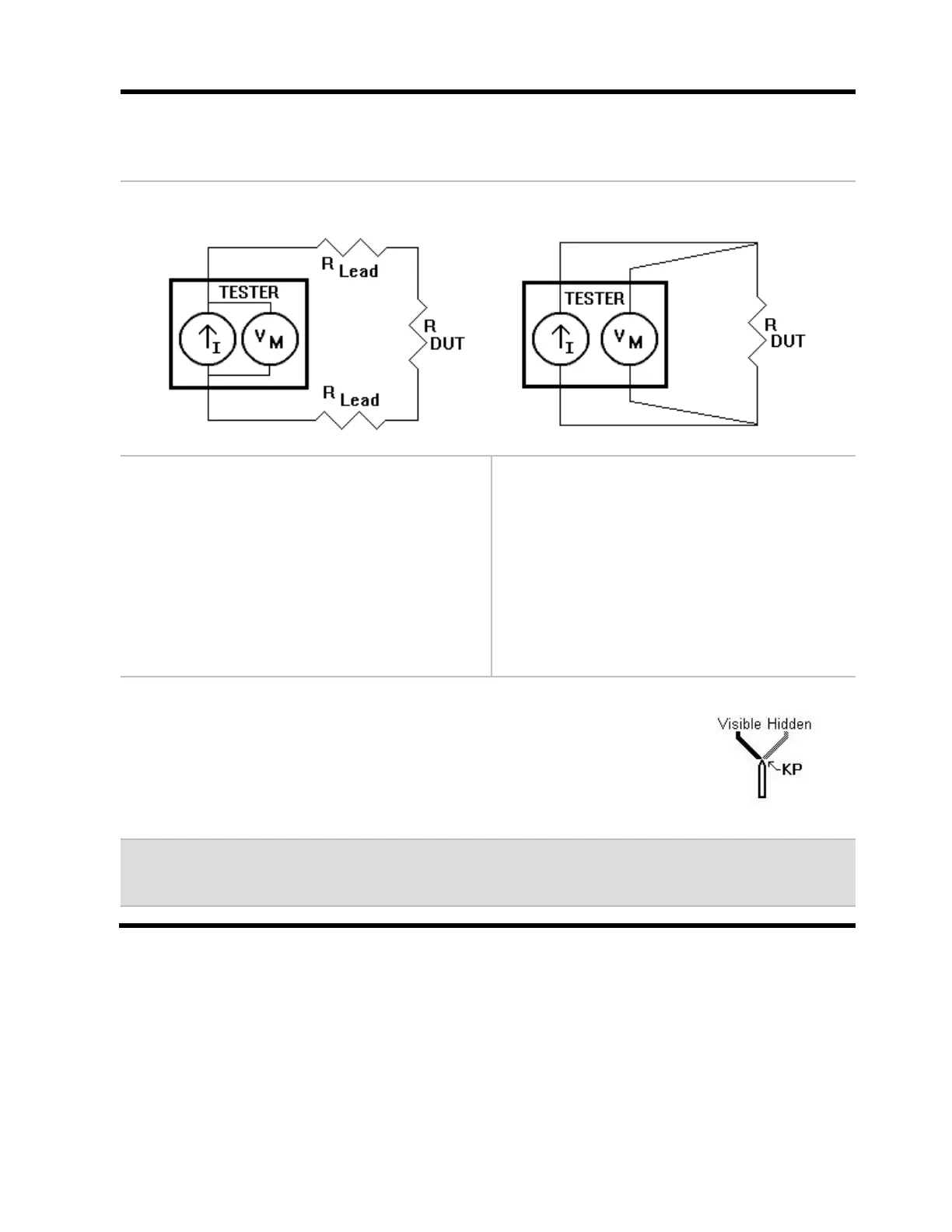
Four-wire testing allows you to measure resistances down to .001 Ohm. It also allows you to
eliminate the resistance of your interface wiring.
• Two-wire testing measures resistance at
the face of the CH2.
• Adds test lead resistance (R
Lead
) to
the resistance of the device-under-test
(R
DUT
).
• Uses two wires per measurement.
• Tests wires to different resistance values
using Wire Instructions.
• Resistance 0.1 Ohm to 1M Ohm +/- 2% +/- 0.1
Ohm
• Four-wire testing measures resistance at
the point where the 4-wire pairs come
together.
• Only measures the resistance of the
device-under-test (R
DUT
).
• Uses four wires per measurement.
• Tests wires to different resistance values
using 4-wire instructions.
• Resistance 0.001 Ohm to 1M Ohm +/-2% +/-
0.001 Ohm
Kelvin points in four-wire fixturing
A Kelvin point is a place that makes a Y junction by joining three parts:
• One of the end points of the device-under-test.
• Visible point wire of a 4-wire pair.
• Hidden point wire of a 4-wire pair.
Note: The Y junction can be a solder joint or it can be where a paired wire on one side of the
measurement is closest to a paired wire on the other side (see below - DUT #3).


 To Next Page