Requirements for Kelvin Points
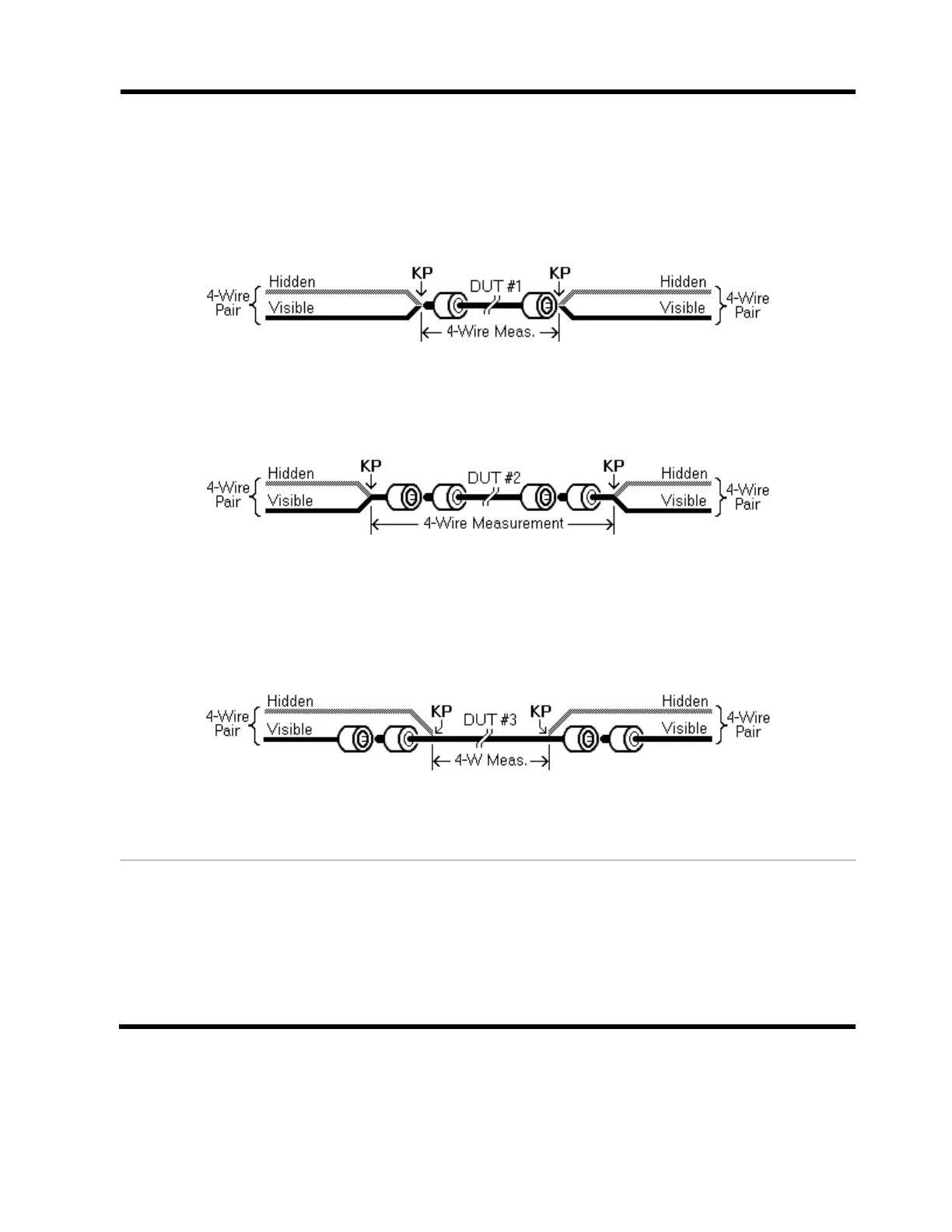
Each 4-Wire measurement requires two Kelvin pairs, one at each end. Place Kelvin pairs as
close to the device-under-test as possible. WHY? The 4-Wire Test measures from Kelvin pair
to Kelvin pair, so any contact and lead resistance between the Kelvin pairs is added to the
resistance measurement of the device-under-test.
Examples of how Kelvin pairs placement affects 4-wire measurement:
DUT #1: The measurement is only of the device-under-
test. This is the ideal, but in real-world situations it may be
nearly impossible to achieve.
DUT #2: The measurement includes part of the fixture.
Warning! If a lot of the fixture is between a Kelvin Point
and the device-under-test, the 4-Wire Test will be
considerably compromised.
DUT #3: The measurement tests only part of the device-
under-test. For example, by using probe pins, you can
eliminate the resistance of a connector from the
measurement.
Visible and Hidden Point Mates
Unlike conventional fixtures that require two wires per measurement, 4-Wire fixtures
require four wires in two pairs per measurement. In order to fixture four-wire to the
CH2, the two wires in each 4-Wire Pair must connect to two different kinds of test
points called Visible and Hidden. Each Visible point has one specific Hidden mate and
the two must go together.


 To Next Page