Lift Trucks Mast System Testing & Adjusting
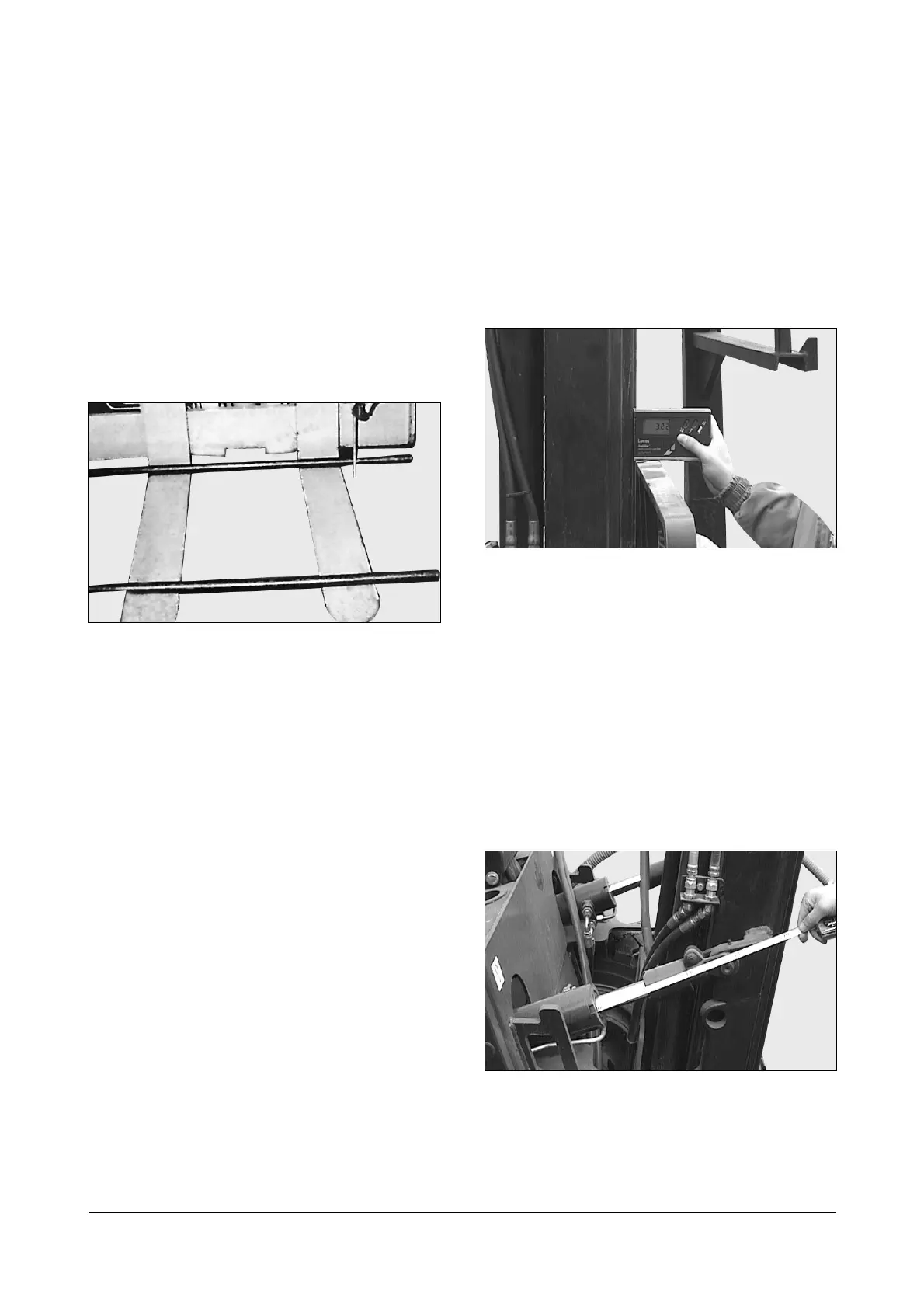
Forks Parallel Check
1. Lift the mast and operate the tilt control lever, until
the top surface of the forks is parallel with the
floor. Place two straight bars, that are the same
width as the carriage, across the forks as shown.
Measure the distance from the bottom of each end
of the two bars to the floor. The forks must be
parallel within 3 mm (.12 in) for Full Tapered and
Polished (FTP) forks, all other forks 6.4 mm (.25
in), for their complete length.
2. If not parallel, determine which one is defective
and replace it.
Forks Parallel Check
(Typical Example)
Tilt Cylinder Alignment
If the tilt cylinders are out of alignment, extra stresses
in the mast assembly and the mast hinge area will
result. To prevent damage, the tilt cylinders must stop
evenly at the end of the tilt back and tilt forward
strokes.
Tilt Angle Check
Tilt Angle Check (Typical Example)
The tilt angle of the mast must be checked in the full
tilt back and full tilt forward positions. A tilt indicator
or a protractor can be used to measure the angle.
Both sides of the mast must be checked to make
sure that the mast is not twisted.
The tilt angle is determined by the tilt cylinders used.
See tilt cylinders in specifications to determine the tilt
angle from the cylinder being used.
Tilt Cylinder Length Check
1. Tilt the mast to full forward position. Measure the
extended length of the cylinder rods from the
cylinder housing to the mast. The difference of
length between the two cylinder rods must be
within 3.18 mm (.125 in) of each other.
22
IDCS130S
Typical Example



 To Next Page