Operation Section
- 51 -
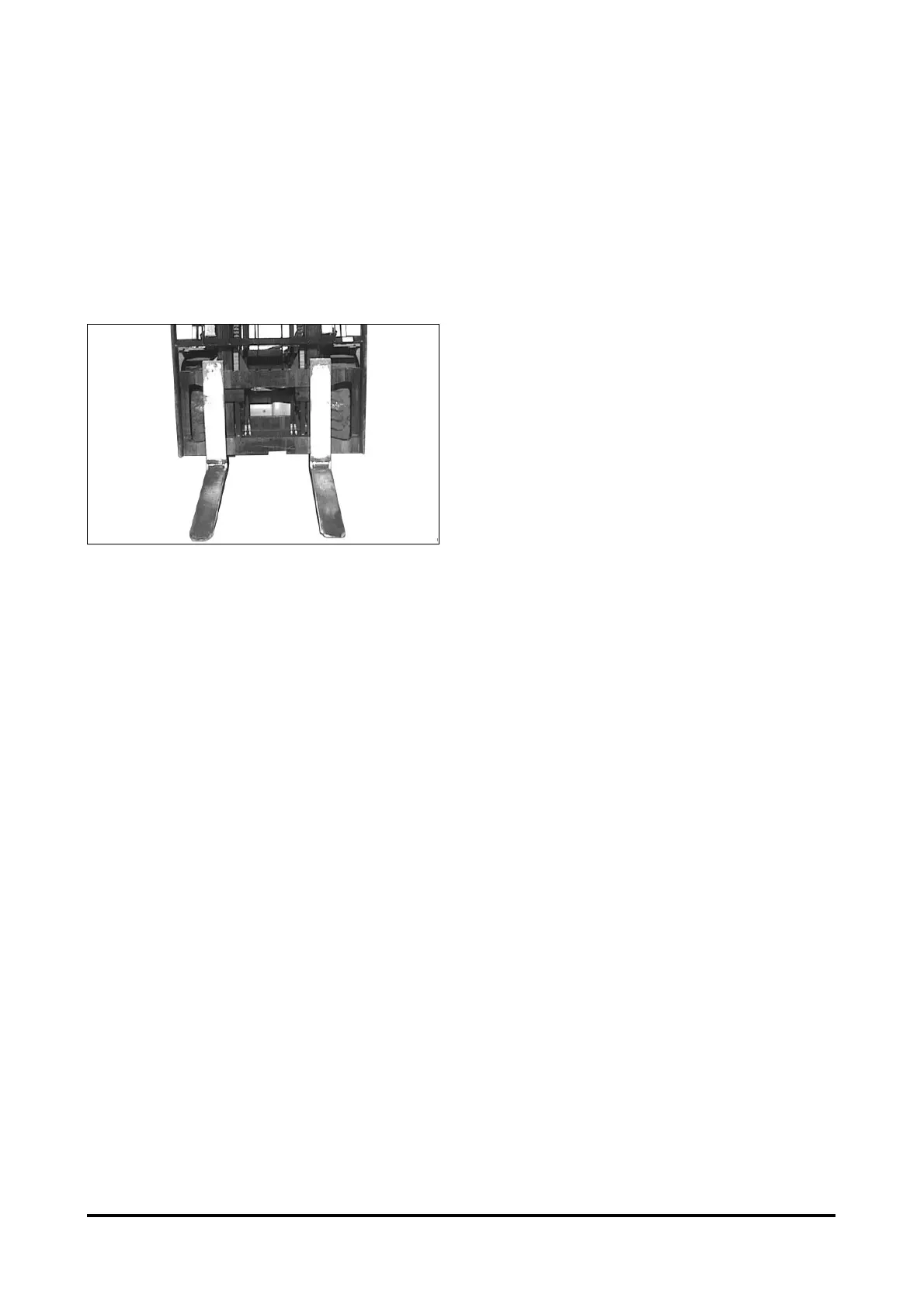
Hook-type Fork
For load stability, always adjust the forks as wide as
possible. Position the load evenly on both forks.
1. Lift the hook pin and slide the fork to the new
position.
2. Secure the hook pin in the carriage slot. Follow
the same procedure for the other fork.
Inspection, Maintenance and
Repair of Lift Truck Forks
The following provides practical guidelines for
inspection, maintenance and repair of lift truck
forks. It also provides general information on the
design and application of forks and the common
cause fo fork failures.
Lift truck forks can be dangerously weakened by
improper repair or modification. They can also be
damaged by the cumulative effects of age, abra-
sion, corrosion, overloading and misuse.
A fork failure during use can cause damage to the
equipment and the load. A fork failure can also
cause serious injury.
A good fork inspection and maintenance program
along with the proper application can be very effec-
tive in preventing sudden on the job failures.
Repairs and modifications should be done only by
the fork manufacturer or a qualified technician
knowledgeable of the material used and the
required welding and heat treatment process.
Users should evaluate the economics of returning
the forks to the manufacutrer for repairs or pur-
chasing new forks. This will vary depending on
many factors including the size and type of fork.
Forks should be properly sized to the weight and
length of the loads, and to the size of the machine
on which they are used. The general practice is to
use a fork size such that the combined rated capac-
ity of the number of forks used is equal to or greater
than the ÒStandard (or rated) CapacityÓ of the lift
truck.
The individual load rating, in most cases, will be
stamped on the fork in a readily visible area.
Generally on the top or side of the fork shank.
¥ A fork rated at 2200 pounds at 24 inch load center
will be stamped 2200B24.
¥ A fork rated at 1200 kg at 500 mm load center wil
be stamped 1200B500.
The manufacturer identification and year and date
of manufacture is also usually shown.
Some countries have standards or regulations
which apply specifically to the inspection and repair
of forks.
Users countries have standards for regulations
which apply specifically to the inspection and repair
of forks.
Users may also refer to the International
Organization For Standardization-ISO Technical
Report 5057-Inspection and Repair of Fork Arms
and ISO Standard 2330-Fork Arms-Technical
Characteristics and Testing.
While there are no specific standards or regulations
in the United States, users should be familiar with
the requirements for inspection and maintenance of
lift trucks as provided by the 29 Code Federal
Register Safety Standard (s) B56.1, B56.5 or B56.6
as applicable to the type of machine (s) in use.
Lift Fork Adjustment
IA3M3026



 To Next Page