Operation Section
- 52 -
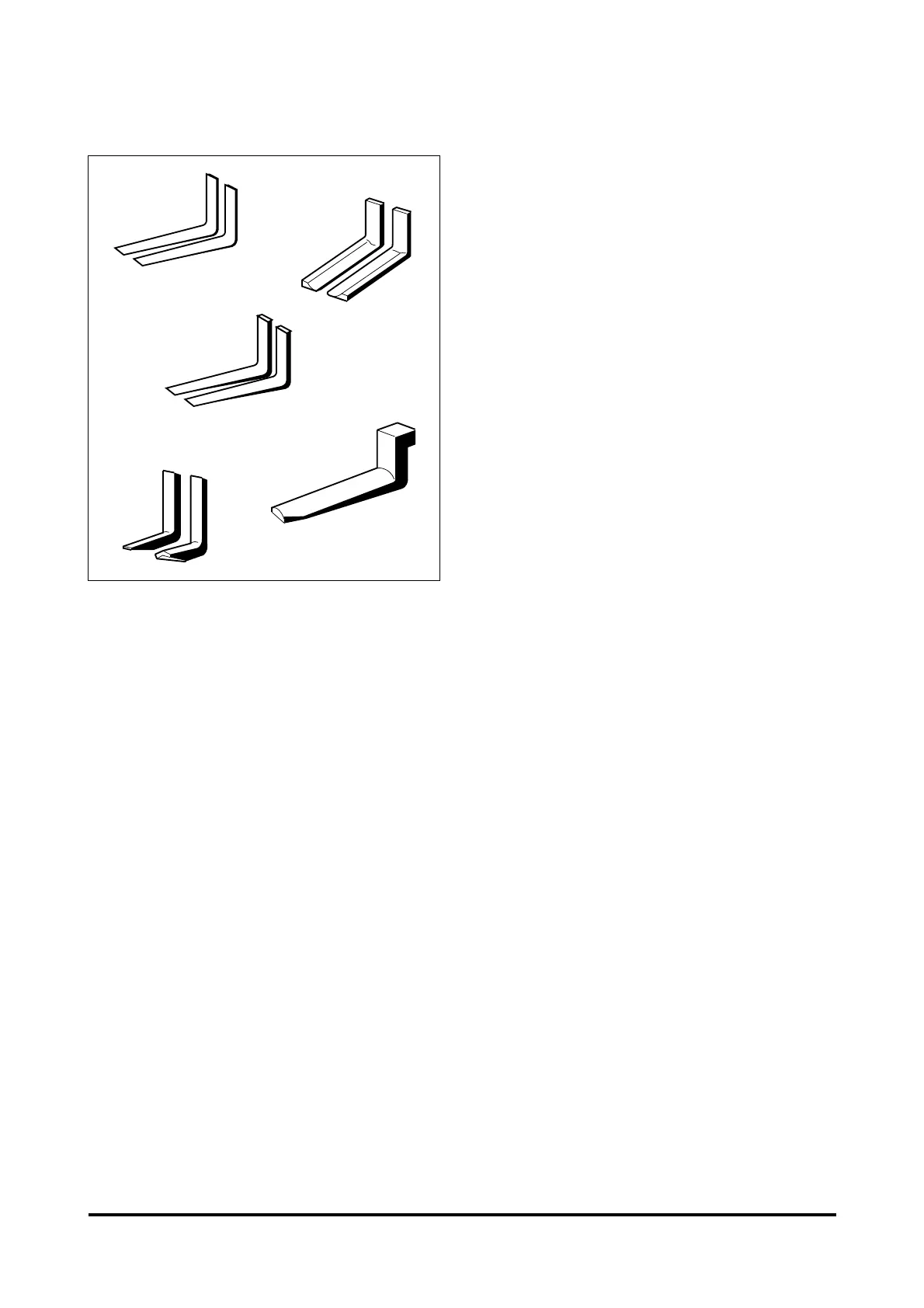
The most common lift truck forks are the standard
pallet and the fully tapered forks. Other types of
forks and similar engaging devices include lumber
and plywood forks, tire forks, coil forks, conctrete
block forks and ram forks. Forks may also be pro-
vided with special features such as high heat resis-
tance for use in furnace charging or non-sparking
for use in hazardous locations.
Forks may be made by several methods. In most
cases heat treated alloy steels are used to achieve
the desired toughness and strength. Special
processes and inspection procedures are required
for proper welding of the alloy steels. Welding and
machining operations are done prior to heat treat-
ment.
¥ Forks with forged upset heels
Most forks are made by this process. An upset forg-
ing press is used to gather extra steel into the fork
heel section as the fork is bent to shape. This
strengthens the highly stressed heel area.
¥ Fully forged forks
Some forks may be fully forged for the purpose of
providing improved mechanical properties and in
some cases to provide a unique shape or contour.
¥ Welded forks
A variety of devices such as rams, attachment
platens, special purpose forks and some large forks
may be fabricated from cold or hot rolled steel.
Causes of Fork Failure
1. Improper Modification or Repair. Fork failure
can occur as a result of a field modification involv-
ing welding, flame cutting or other similar process-
es which affect the heat treatment and reduces the
strength of the fork.
In most cases, specific processes and techniques
are also required to achieve proper welding of the
particular alloy steels involved. Critical areas most
likely to be affected by improper processing are the
heel section, the mounting components and the fork
tip.
2. Bent or Twisted Forks. Forks. can be bent out
of shape by extreme overloading, glancing blows
against walls or other solid objects or using the fork
tip as a pry bar.
Bent or twisted forks are much more likely to break
and cause damage or injury. They should be
removed from service immediately.
3. Fatigue. Parts which are subjected to repeated
or fluctuating loads can fail after a large number of
loading cycles even though the maximum stress
was below the static strength of the part.
The first sign of a fatigue failure is usually a crack
which starts in an area of high stress concentration
This is usually in the heel section or on the fork
mounting.
As the crack progresses under repetitive load
cycling, the load bearing cross section of the
remaining metal is decreased in size until it
becomes insufficient to support the load and com-
plete failure occurs.
Faigue failure is the most common mode of fork fail-
ure. It is also one which can be anticipated and pre-
vented by recognizing the conditions which lead up
to the failure and by removing the fork service prior
to failing.



 To Next Page