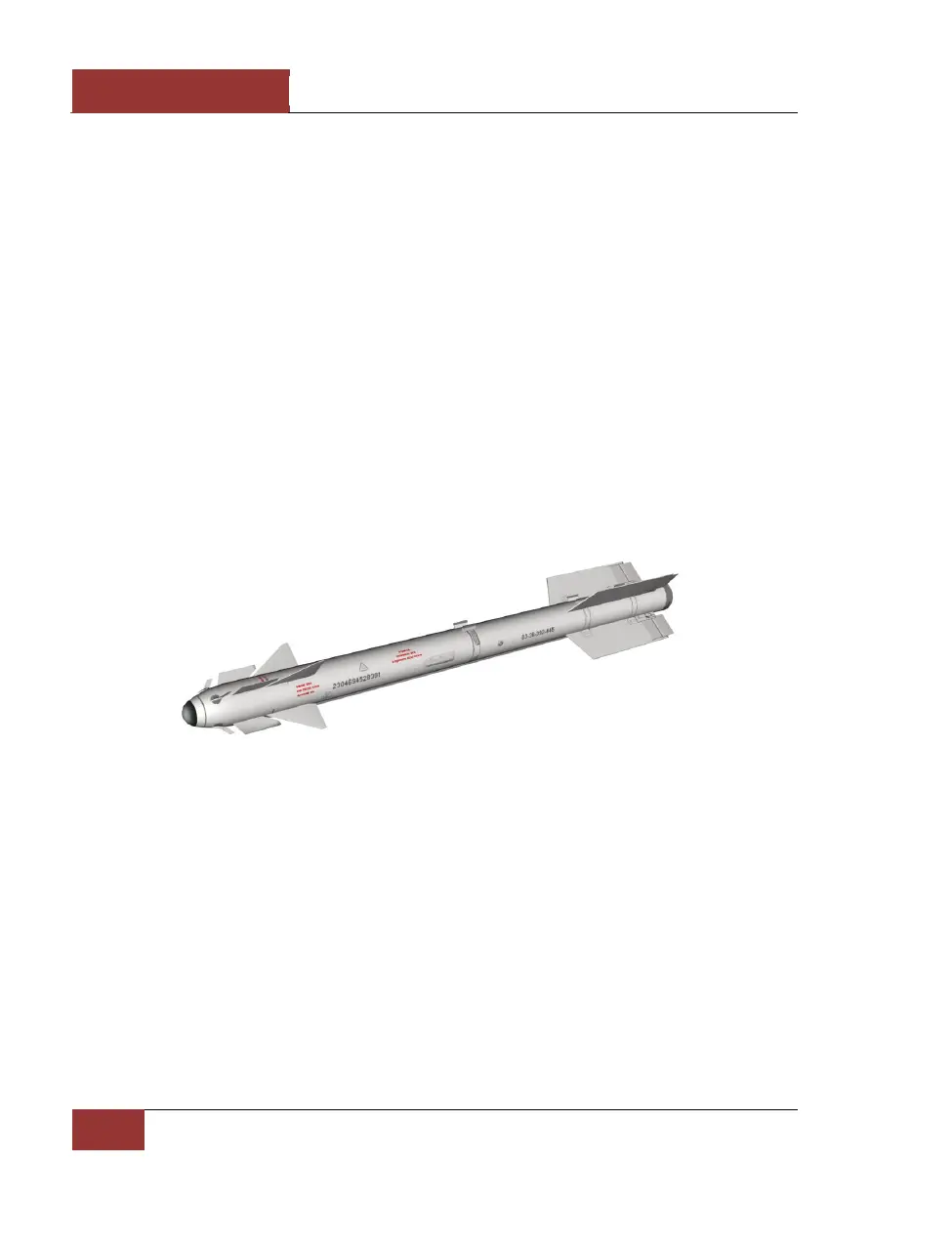
R-73 (AA-11) Short Range Missile
Following poor combat results in Vietnam at the end of the 1960s, the United States began
developing its fourth generation fighters, the F-14 and F-15. Like the F-16 and F/A-18 light fighters,
these aircraft were intended gain air superiority; this would include close range air combat. At the
beginning of the 1970s in the USSR, a sort of "symmetrical answer" to the western countries resulted
in the design of new front line fighters, later called the Su-27 and MiG-29.
Estimated requirements for a new missile to arm the new generation of Soviet fighters, showed that
even a specially enhanced version of the R-60M (its development was coming to an end in those
years) would not fully satisfy the new requirements. According to the analysis, missiles of the new
generation were to be highly maneuverable and have all-aspect engagement capabilities.
At first, these requirements were distributed between two different design bureaus. Reviewing the
results and preliminary developmental work performed in the framework of the avanproject, a
resolution dated July 26, 1974 defined the requirements of the future Su-27 and MiG-29, entrusted
"Molniya" design bureau with development of a highly-maneuverable, small, close air combat missile
- the K-73. The missile was first envisioned as an enhanced P-60, but taking into account the high
maneuverability requirements, it was allowed to increase its weight to be between the R-60 and R-
13.
Figure 70: R-73 missile
The same day, another resolution entrusted "Vympel" design bureau with development of an all-
aspect short-range missile. This K-14 was a further development of K-13 family and included an
infrared seeker and superb aerodynamic performance.
The "Super-maneuverability" requirements defined the necessity of K-73 operations at extremely high
angles-of-attack (about 40°). At such angles, the efficiency of traditional A-A missile control surfaces
are completely lost. A transition to gas-dynamics control units in such conditions was inevitable. Wing
surfaces changes was also considered inefficient with regard to a relatively short launching range.
Given the assumption of the first K-73 variant’s small size and weight, an all-aspect seeker was not
envisioned. Nevertheless, at Kiev "Arsenal" design bureau, which earlier worked with the Moscow
"Geophisica" design bureau, developed a rather compact seeker "Mayak" (OGS MK-80) with a new
seeker. The new seeker provided target acquisition up to 60°, which was 12 times greater that the
corresponding seeker for the R-60. Later, the K-73 gimbal limits were increased to 75° with a


 To Next Page