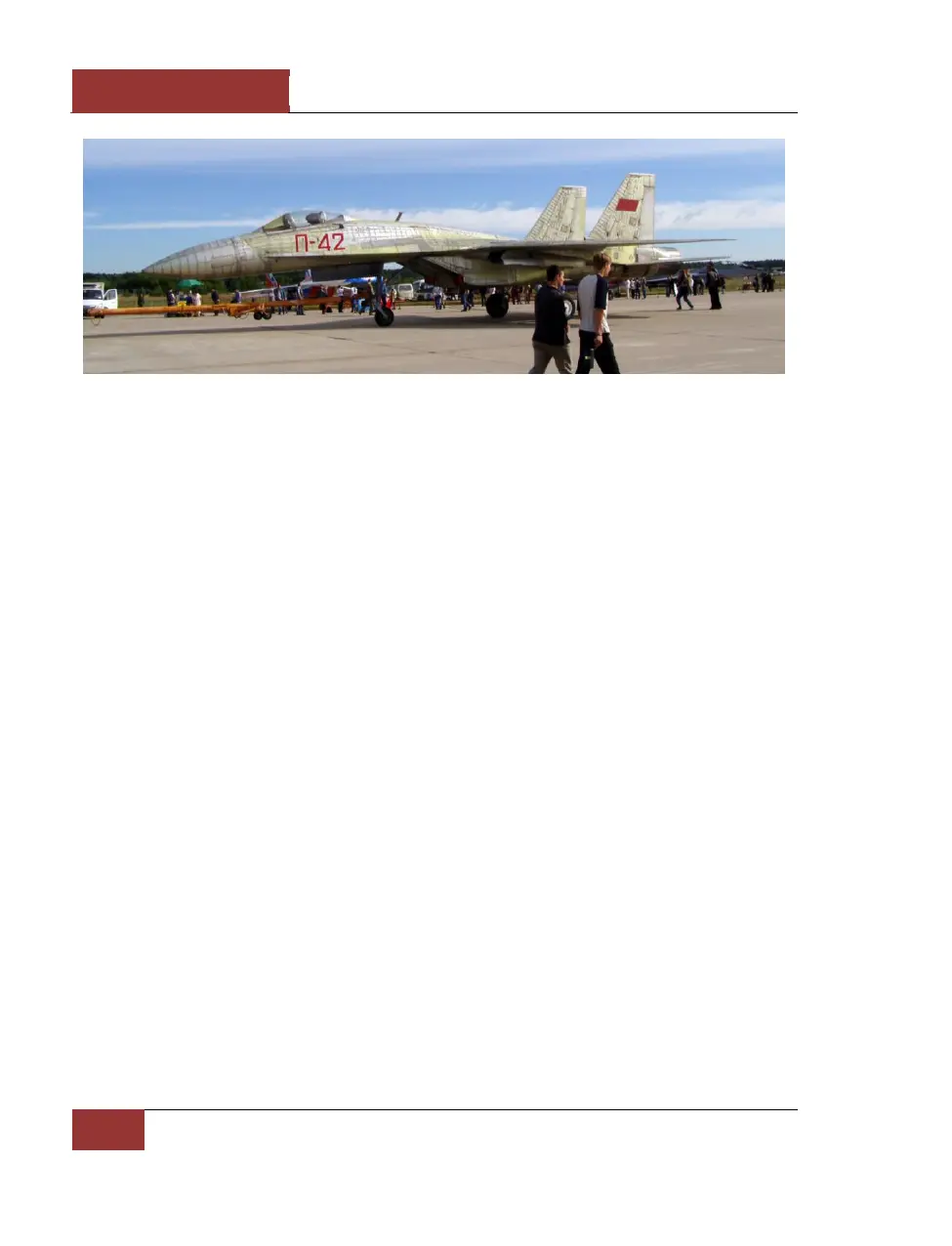
Figure 13: P-42 record plane
However, the aircraft's great thrust-to-weight ratio evoked a very peculiar problem: the P-42's brakes
were unable to hold it at the starting position when the engines went in afterburner. So, a rather
ingenious solution was made: the plane was linked up with a towrope and a special lock to a
powerful tractor protected from the exhausts with an armoured plate. The tractor would go to the
runway and keep the aircraft from the premature run by its impressive weight. At a predetermined
moment, the lock would separate the towrope from the plane, the cameras and stopwatches would
be switched on and the P-42 would rush to set new world records. The work on the P-42 record
preparation was headed by leading engineer (later - Chief Designer) R.G.Martirosov. On 10 March,
1987, the P-42 flown by N.F.Sadovnikov exceeded its own 9 and 12 km climb records by another
three seconds - 44.2 sec and 55.5 sec respectively. On the next day, the aircraft was used in the
STOL class. The rate of climb to an altitude of 3, 12 and 15 km was 25.4, 57.4 and 75.7 sec
respectively. On 10 June, 1987, the P-42 flying as a STOL-class aircraft set a record for the level
flight altitude that amounted to 19,335 m. The last of the official records set by V.G.Pugachov while
flying the P-42 was a climb to 15,000 m in 81.7 sec with a weight of 1 tonne. All in all, the aircraft
had established 27 world records during 1986-1988 with world record-holder diplomas having been
issued to V.G.Pugachov, N.F.Sadovnikov, O.G.Tsoy and Ye.I.Frolov.
In Service
The deliveries of Su-27 fighters to the combat units began in 1984. When under development, a
decision was taken that the aircraft of the class would be operational in fighter air regiments of two
types - in Air Force and Air Defence Forces' units. In so doing, the Air Force tactical aviation and ADF
fighter units were supposed to have in service virtually the same aircraft, with the development of
specialised RusAF and ADF versions not envisaged. It is noteworthy that earlier the Russian fighters
had only one 'master' as a rule, with the MiG-21 operated exclusively by Air Force units and the Su-9,
Su-11, Su-15, Tu-128, and MiG-25P by the ADF. The only aircraft, which used to be operated by both
the Air Force and Air Defence, is the MiG-23. And still, there was a special version developed for ADF
units designated MiG-23P, while the ADF's MiG-23M aircraft differed greatly from the version
operated by the Air Force in the settings of the weapons control system and a range of weapons
employed. The same situation preserved in the 1980s when the MiG-29 tactical fighters started
entering the inventory of the Air Force, with ADF units adopting MiG-31 interceptors. Thus, the Su-27


 To Next Page