target is flying towards the missile. Near ground level where the air density is very high, the launch
range is more than halved.
When attacking an enemy from the rear, the launch range significantly decreases because the missile
has to catch up with a target that is flying away. Rear hemisphere, low aspect, launch ranges are
usually two to three times less than high aspect launch ranges. For example, these are the launch
ranges of the R-27ER at different aspects and altitudes:
• Maximum forward hemisphere launch range at the altitude of 10 000 m. – 66 km.
• Maximum forward hemisphere launch range at the altitude of 1000 m. – 28 km.
• Maximum rear hemisphere launch range at the altitude of 1000 m. – 10 km.
Maximum launch range is calculated with the assumption that the target will not take any maneuvers
after missile launch. If the target begins to maneuver, the missile will also need to maneuver and
quickly lose energy. This is why it is more practical to use a different gauge of maximum range –
maximum launch range that takes into account target maneuverability (Rpi in western terminology).
The weapon control system constantly calculates the maximum launch range to a non-maneuvering
target, as well as the Rpi. Rpi is at a much shorter range than the maximum launch range but
ensures a much higher probability of kill. In game, these ranges are indicated on the HUD and
HDD/VSD.
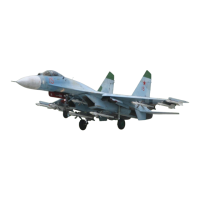
Su-27 Missiles
R-27 (AA-10) Medium Range Missiles
The R-27 medium range missile family is intended for the interception and destruction of all types of
aircraft, helicopters, unmanned aerial vehicles (UAV) and cruise missiles. The missiles can be
employed in medium and long range air combat independently or as part of a group of aircraft at day
or night. The R-27 is effective in all meteorological conditions and is very capable against low flying
and maneuvering targets.
The R-27 is manufactured in several variants that differ according to their seekers – semi-active radar
or infrared – and two types of propulsion systems – standard and extended. The variants with the
semi-active radar homing seeker are termed the R-27R and the R-27ER. Variants with the infrared
seeker are termed the R-27T and R-27ET. Both the R-27ER and R-27ET have the extended, longer-
burning motors.
The primary material of the missile body is a titanium alloy, and the engine body is made mostly of
steel.
The same rail and ejector launchers are used for both size variants of the R-27, the standard and
extended range. The APU-470 rail launcher is intended for missiles loaded under the wings and the
AKU-470 catapult device is used for missiles loaded underneath the fuselage or wings.
In addition to the seekers, the missile control system also includes an inertial navigation system with
radio correction. The all-aspect R-27 attacks the target at its any initial position within a 50 degree
gimbal limit for the semi-active radar seeker and 55 degrees for infrared. Maximum aircraft G loading
at the launch can be up to five units. The R-27 can intercept targets flying at speeds up to 3500


 To Next Page