guidance. The permissible launch zone for each type of unguided rocket is defined between its
maximum range, and the minimum safe blast distance. The minimum safe distance depends on the
warhead type and weight, and protects the firing aircraft from exploding fragments. Rockets are
usually fired at airspeeds of 600 – 1000 km/h with a dive angle of 10
0
– 30
0
. The pilot maneuvers the
entire aircraft to put the aiming pipper on the target before firing.
S-8 rocket
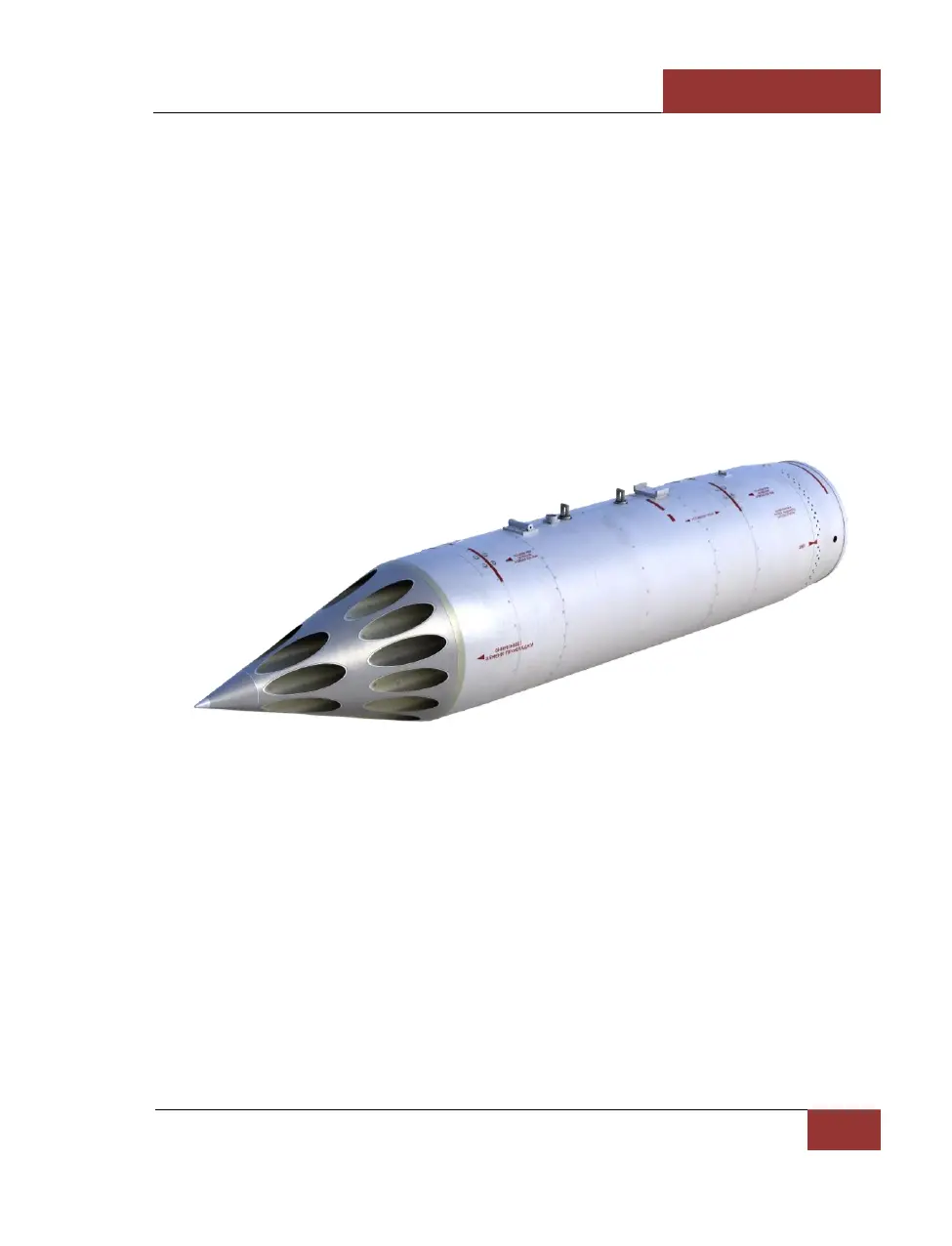
The S-8 is a medium caliber (80 mm) unguided rocket. Twenty rockets are carried per weapon
station in B-8 multiple launchers. For improved aiming accuracy, the rocket features 6 stabilizer fins,
which are unfolded at launch by a piston driven by the rocket motor exhaust gases. The fins are then
locked in the unfolded position. The fins are held in the folded position by a covering that is
discarded at the moment of launch. The impulse and burn rate of the S-8 rocket motor was increased
with respect to the S-5 rocket, to provide the heavier S-8 with rapid acceleration and rotation; the
motor burn time was decreased to 0.69 sec. S-8 dispersion during flight and circular error probable
(CEP) is 0.3% of the range. The maximum effective launch range is 2 km.
Figure 79: B-8M1 Rocket Launcher
The S-8TsM is a smoke rocket variant, used to designate targets for friendly strike aircraft. The signal
smoke indicates the position of the target.
S-13 rocket
These 132 mm unguided rockets are carried in B-13 launchers containing 5 rockets each. They are
designed for strikes against fortified and hardened objects (pillboxes, shelters, airport aprons and
runways). The Russian Air Force also uses 122 mm "type-013" unguided rockets. The S-13 preserves
the layout of the smaller S-8 rocket (folded stabilizing fins located between the rocket nozzles with
exhaust pressure actuation), with improved ballistic characteristics and hit accuracy.


 To Next Page