
 To Next Page

R
Robert ChandlerSep 12, 2025
How to fix Dexcom Blood Glucose Meter when the receiver has a low battery?
- AAmanda JohnsonSep 12, 2025
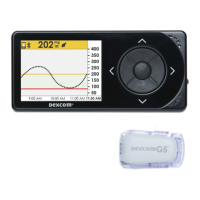
If the Dexcom Blood Glucose Meter displays a receiver low battery alert, charge the receiver.

How to fix Dexcom Blood Glucose Meter when the receiver has a low battery?
If the Dexcom Blood Glucose Meter displays a receiver low battery alert, charge the receiver.
What to do if Dexcom Blood Glucose Meter pairing failed?
If pairing failed on your Dexcom Blood Glucose Meter, check that the transmitter SN in the display device is correct. If it’s wrong: * Stop the sensor session. * Re-enter the correct transmitter SN. * App: Go to Menu > Trans SN > Enter correct SN * Receiver: Go to Settings > Trans SN > Enter correct SN If the SN is correct, contact Technical Support.
How to enable Bluetooth on Dexcom Blood Glucose Meter?
If your Dexcom Blood Glucose Meter is showing a 'No Bluetooth' error, go to your smart device’s Settings and make sure Bluetooth is turned on. If the problem persists, contact your device’s manufacturer.
Introduction to starting your Dexcom G5 Mobile CGM system journey.
Overview of available tutorials and resources for learning about the Dexcom G5.
Information on creating and using your Dexcom account for the G5 Mobile app and reordering supplies.
Introduction to the chapter on indications for use and safety statements.
Review of essential information for safe and effective use of the Dexcom G5 System.
Explanation of how safety statements are presented and organized within the user guide.
Review of safety statements, including indications, contraindications, warnings, and precautions.
Discussion of potential risks associated with using real-time CGM technology.
Explanation of the advantages and benefits of using the Dexcom G5 for diabetes management.
An overview of what the Dexcom G5 does and its primary functions.
Safety information regarding compatibility between Dexcom G4 PLATINUM and Dexcom G5 components.
Detailed description of the Dexcom G5 Continuous Glucose Monitoring (CGM) system.
Highlights key new features introduced with the Dexcom G5 system.
Information regarding system status, technical notifications, and prompts.
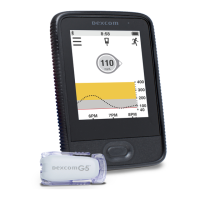
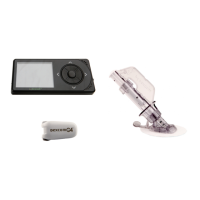
Overview of the physical components included in the Dexcom G5 package.
Information on how the G5 Mobile app works with your smart device.
Introduction to setting up your G5 Mobile app and Dexcom G5 receiver.
Safety statement about mixing Dexcom G4 PLATINUM and G5 transmitters/receivers.
Explanation of the convenience and benefits of using the app or receiver.
Steps to install and set up the G5 Mobile app on your smart device.
Instructions for initial setup of the Dexcom G5 receiver.
Overview of the sensor session process and available resources for insertion.
Review of warnings and precautions before starting a sensor session.
Information on items needed and preparation steps for sensor insertion.
Guidance on selecting the optimal location for sensor insertion on the body.
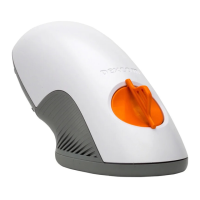
Step-by-step instructions for inserting the sensor using the applicator.
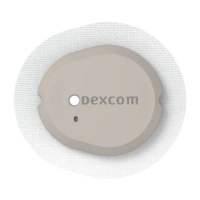
Instructions on how to attach the transmitter to the sensor pod.
Guidance on what to do if the sensor pod adhesive patch peels up.
Steps to initiate a new sensor session on your display device.
Tips for ensuring proper Bluetooth communication between the transmitter and receiver.
Explanation of the sensor warmup period and what to expect.
Introduction to calibration, its importance, and the steps involved.
Safety statements related to calibration procedures and medication interactions.
Explanation of what calibration is and why it is important for CGM accuracy.
Information on the important times when calibration is required.
Details on sensor session startup and update calibration prompts.
Eight essential steps to ensure successful calibration of the CGM system.
Instructions on how to enter calibration values using the app and receiver.
Information on potential calibration errors and how to resolve them.
Overview of what to expect when a sensor session ends and how to remove components.
Safety statements regarding sensor fractures and transmitter reusability.
Information on how sensor sessions end, including prompts for seven-day and early termination.
Step-by-step instructions for safely removing the sensor pod and transmitter.
Details on transmitter battery life and notifications when it's low.
Introduction to understanding the home screen, readings, trends, and troubleshooting.
Safety statements regarding medication interactions and interpreting readings.
Description of the app's home screen, Today view, Apple Watch, and receiver home screen.
Explanation of trend arrows and their meaning for glucose changes.
Information on common error messages and how to address them.
How daily activities impact glucose trends and how to track 'Events'.
Definition and examples of Events that affect glucose levels.
Instructions for entering Events (Carbs, Insulin, Exercise, Health) on the app and receiver.
How to view Event markers on the app and Event entries on the receiver.
How alarms and alerts help manage diabetes by notifying users of glucose trends.
Safety statements to ensure users receive important alerts and alarms.
Explanation of the Urgent Low Glucose Alarm and other system Alerts.
Visual presentation of alarm and alert notifications across different display devices.
Recommended settings for the G5 Mobile app to ensure proper alarm and alert delivery.
Overview of the receiver's default beep and vibration patterns for alarms and alerts.
How to confirm and acknowledge alarms and alerts on smart devices and the receiver.
How to personalize alarm and alert tones and glucose levels for optimal diabetes management.
Safety warning about ensuring settings are synchronized across both receiver and app.
Step-by-step guide to customizing alarm and alert settings within the G5 Mobile app.
Instructions for customizing alarm and alert profiles and settings on the Dexcom G5 receiver.
How to use Dexcom G5 readings and alerts to make informed treatment decisions.
Warning about relying on inconsistent readings and making treatment decisions.
Guidance on when to use your BG meter versus the Dexcom G5 for treatment decisions.
Information on using alarm/alerts, readings, and trend arrows for treatment decisions.
Scenarios and examples to help users practice making treatment decisions.
Guidelines for reviewing past treatment decisions and understanding factors affecting glucose levels.
Overview of Dexcom's warranty information for the G5 system.
Details on the limited warranty coverage for the Dexcom G5 Receiver.
Details on the limited warranty coverage for the Dexcom G5 Transmitter.
Information on how Dexcom will replace defective G5 Receivers and Transmitters.
Introduction to the maintenance and care of the Dexcom G5 system components.
Guidelines for proper cleaning and maintenance of the sensor, transmitter, and receiver.
Recommendations for storing the sensor, transmitter, and receiver correctly.
How to check software versions and system information on the app and receiver.
Information on proper disposal of Dexcom G5 components according to local regulations.
Information on traveling with the Dexcom G5 and navigating security checkpoints.
Procedures for walking through metal detectors, x-ray machines, and body scanners.
Contact information and services provided by Dexcom Technical Support.
Information about the Patient Care Team and the support services they offer.
Contact information for Dexcom sales support.
General corporate contact information for Dexcom.
Overview of clinical studies and performance data for the Dexcom G5.
Detailed technical specifications for the sensor, transmitter, and receiver.
Information regarding FCC compliance and interference statements.
Explanation of symbols related to expiration dates and lot numbers.
Explanation of caution symbols and part/catalog number identification.
Explanation of symbols for manufacturing date and sterilization method.
Explanation of symbols indicating single-use items and temperature storage requirements.
Explanation of symbols for serial numbers and IP28 moisture protection.
Explanation of symbols for equipment classification and IP22 moisture protection.
Explanation of basic electrical current symbols.
Explanation of symbols for applied part type and European representation.
Explanation of manufacturer symbols and non-ionizing radiation warnings.
Explanation of symbols for humidity limits and CE conformity marking.
Explanation of symbols for EU waste directives and package integrity.
Explanation of symbols for equipment usage and shipping date.
Explanation of symbols related to input type and prescription requirements.
Explanation of symbols indicating moisture precautions and MRI safety.
Explanation of symbols for manual references and Bluetooth connectivity.
Glossary of terms related to Dexcom Share and its features.
Explanation of how Dexcom Share works for remote monitoring.
Discussion of the potential risks and benefits associated with using Dexcom Share.
Safety information regarding intended use, contraindications, and warnings for Dexcom Share.
Step-by-step instructions for setting up and activating the Dexcom Share feature.
Guidance on managing Followers and understanding sharing status.
Description of the Dexcom Follow app and how Followers receive notifications.
Troubleshooting tips for common issues encountered with Dexcom Share.
 General
| Manufacturer | Dexcom |
|---|---|
| Continuous Glucose Monitoring | Yes |
| Sensor Life | Up to 7 days |
| Connectivity | Bluetooth |
| Mobile App Compatibility | iOS and Android |
| Measurement Range | 40-400 mg/dL |
| Warm-up Time | 2 hours |
| Type | Continuous Glucose Monitoring (CGM) System |
| Transmitter Battery Life | Up to 3 months |
| Transmitter Waterproof | Up to 8 feet for 24 hours |
| Data Sharing | Yes |
| Calibration | 2 calibrations required per day |
| Water Resistance | Up to 8 feet for 24 hours |
| Alerts | Customizable alerts for high and low glucose levels |
| Data Sharing (Followers) | Yes |
| Accuracy | MARD (Mean Absolute Relative Difference) of 9.0% |