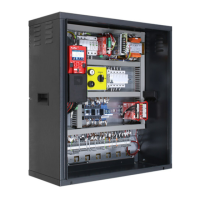
control panel in the machine room (in inspection mode the movement beyond the top and bottom
floor is disabled) to put the car or the counterweight on the shock absorbers and perform the rope
slipping test. Move the car out of the limit switch area and put the installation in normal operation
mode (if the second NO contact of the FCO input is connected, you must reset FCO in the menu
<Faults>).
Test 8: Motor run time test (EN 81 point 12.10)
Before starting the test, move the car to the ground or top floor.
During the test the car will move towards the opposite extreme floor at null speed. After 5 seconds,
the up/down run time error will be detected (check in the menu <Faults>). Clear all errors to put the
installation in normal operation mode again.
Test 9: System balancing test
Before starting the test, place the cab on the ground floor with the weight suited to balance the
system itself (typically 50% of the maximum load). During the test the cabin will start in the direction
of the highest floor and the absorbed current at the middle of the shaft will be displayed. The cabin
will then move to the lowest floor, once again displaying the absorbed current at the middle of the
shaft. The values will also be preserved after the end of the test for evaluation purposes.
Test 10 Test 17: Not Used
Test 18: Door Disable
Test for temporarly disabling door operators.
Test is useful if technician needs to make some test with lift in normal mode but without the risk
some user can enter in the car.
It is possible to program a time of 1/5/10/30/60 minutes.
Time is valid also if Lift will be put in inspection / Normal again.
At the end of timer, lift comes back in normal mode.
Test 19: Black out Simulation
Only for installation with full emergency option. Lift behaviour is the same you have when power
supply goes off, so it make an automatic emergency moving the car to the floor and opens the door.
Test 20: Telephon call for low batteries level simulation
Controller send command to DMCPIT (output ALARM Enable) as if the battery level was wrong for
an emergency call. This signal has to be connected to the telephone’s input for emergency call.
Test 21: Simulation of system shutdown need (ELGO or VVVF system only)
The system simulate a long time without any shutdown.
-) at first executiion, system simulate a switch-on beyond 9 months (270 days), as an effect only the
information defect “1 = Reset Cod 9”. In the Errors menu DAY COUNTER = 270 is displayed. Lift
continues to operate regularly.
-) at second executiion, system simulate a switch-on over 12 months (365 days), as an effect the
blocking fault “1 = Reset Cod 12”. The lift stops at the floor without being able to take further calls.
In the Errors menu DAY COUNTER = 365 is displayed. To return in normal operation, the main
power switch must be turned off and then on again.
Test 22: Integrated Weighing Calibration Procedure (VVVF system only)
The Test must be repeat twice, the first for the full load (100%), the second time (110%) for the
overload measurement.
Before starting the test, place the cabin on the ground floor or on the top floor.
Select in order:
-) Test 22 - 100%: Put into the car the FULL LOAD. When you confirm the test lift automaticaly will
make a start from each floor in both direction. During the test doors will not be enabled to keep
constant load into the cabin. Test finish when the cabin come back to the starting floor and door
opens. On the Playpad is showed “End reg.”.
-) Test 22 - 110%: Add into the car 10% of the load with a minumum of 75 Kg. When you confirm
the cabin close the door (without moving from the floor) and the overload will be activated (and so
the door will be open. On the Playpad is showed “End reg.”.



 To Next Page