Every horizontal line during the next frame, one line of the charge matrix in the opaque storage
sites is shifted vertically into a horizontal shift register. The horizontal shift register is clocked out,
one pixel at a time, on to a charge detection node that converts it to a voltage, which can be
sampled and digitized.
7.2 HIGH SPEED SHUTTER
HDO: High speed shutter with discharge (one-shot)
HNL: High speed shutter without discharge
When one of the high-speed shutter modes is selected, the duration of exposure is set as an integral
number of horizontal-line-periods. In the shutter modes, the duration of exposure can be set from 1-
to-1045 horizontal lines, in 1-horizontal-line-period (approx. 90µ sec) increments.
7.2.1 Setting The Exposure Duration
DB(10:1) are exposure setting internal TTL level signals that can be set using the EXP command,
e.g. EXP 0A5 sets the exposure to Hex"0A6" number of lines in all the shutter modes (HDO, HDL,
HNL). The duration of exposure in the high-speed shutter modes is from 1 through 1052 horizontal
line periods, represented by an 11-bit control word.
High-speed shutter mode without discharge (HNL): In this mode asynchronous resets are ignored.
This mode is designed for use in applications in which the electronic shutter is used primarily as a
means of light level control, i.e. as an electronic "iris" in cases where there is too much light in the
field of view. This is usually done to prevent saturation of the CCD with a full frame or 1/10sec
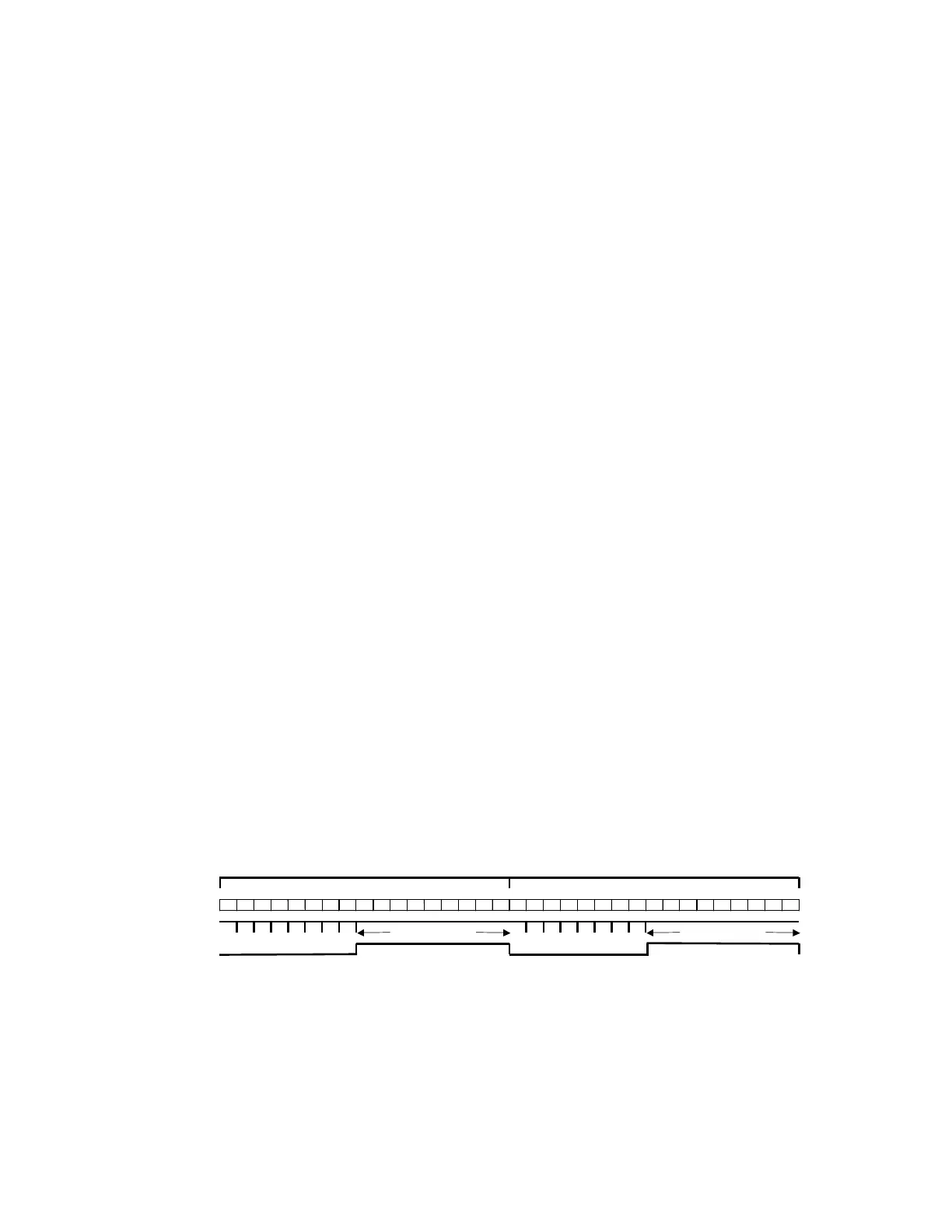
exposure. The normal sequence of timing (see fig. 7.2-1) is followed and there are no interruptions
of the Enable_frame, Enable_line and Pixel Clock signals.
In the example below, exposure is set to 1/500sec; this translates to 21 horizontal-line-periods (21 x
93µ sec = 1/500sec). In order to achieve this exposure, the CCD must be exposed for 21 line
periods out of the total of 1045 line periods in the frame. Since the CCD has to continuously
integrate charge, the 21 line-period exposure is obtained by "dumping" the charge every line for the
first 1020 line periods, and then stopping the "dumping" action for the last 21 line-periods. At the
end of this “active” 21 line exposure period, the charges are transferred to the storage matrix
followed by readout. This is shown graphically in the timing diagram below.
Charge transfer
Line count
1 2 3 4 .... .... .... .... 1031 1032 1033 1034 .... .... 1050 1051 1052 1 2 3 4 .... .... .... .... 1031 1032 1033 1034 .... .... 1050 1051 1052
Charge dump
Strobe output
Exposure = 21 lines Exposure = 21 lines
Figure 7.2-1: Timing diagram--shutter mode (HNL & HDL)
7.2.2 Strobe
In many applications, objects in the field of view can be moving too rapidly to be properly imaged
under normal conditions. A combination of the high-speed shutter and a strobe may be used to
stop motion. It is often desired to synchronize the strobe action with the camera exposure. For this
17


 To Next Page