7.2.4 Reset Modes
In the HDO and HDL shutter modes, an asynchronous falling edge on the VRST_INT (TTL) or
CC1/INPUT1 (differential) input of the camera is used to synchronize the exposure period of the
camera to the outside world (the rising edge is not significant, however, the LOW duration should
last at least 1µsec). Since the falling edge is truly asynchronous, in most instances it would have
the effect of interrupting the readout of a previously exposed frame from the storage area elements
of the CCD; a residual charge from the previous exposure therefore may exist on the storage area
elements. This charge must be removed from the storage area by a “discharge” process before the
next charge transfer takes place.
7.2.4.1 One Shot high speed shutter with discharge (HDO)
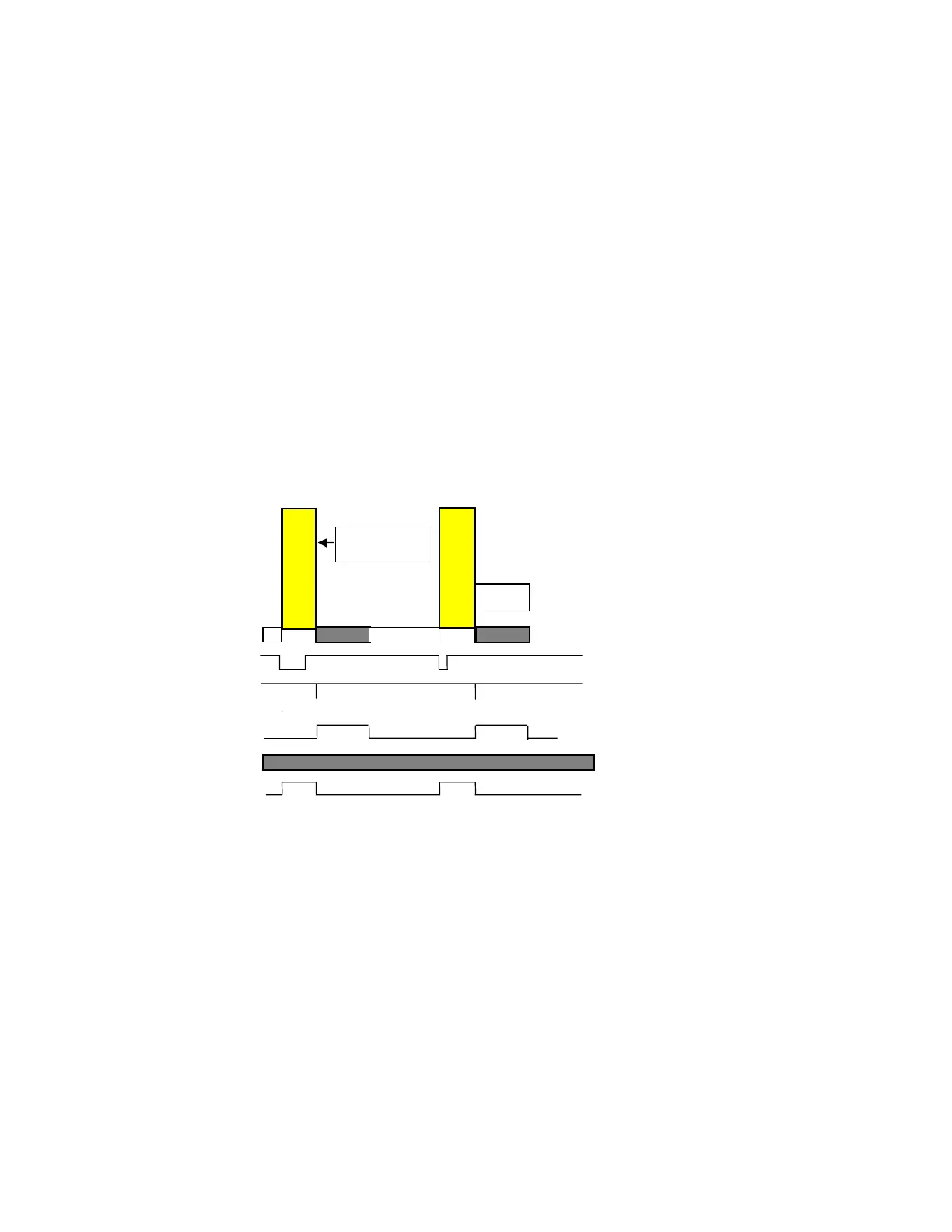
This mode is also referred to as the "one-shot" or "snapshot" mode. In this mode, the camera acts
like a snapshot digital camera. The camera outputs no frames (and no Enable_Frame signals) until
a reset signal is received (see above section related to reset signals). Once a reset signal is received,
the camera immediately performs one-and-only-one exposure (with the duration determined by the
previously set EXP command) resulting in one-and-only-one valid Enable_Frame signal. NOTE:
there is no latency or delay between the falling edge of reset and the start of the exposure.
READOUT
READOUT
E
X
P
O
S
U
R
E
User defined
exposure period
1 frame =
1/12sec
E
X
P
O
S
U
R
E
NO VIDEO
VRST_INT (TTL) or INPUT1 (LVDS)
CHARGE TRANSFER (Internal Signal)
STROBE OUT (TTL)
Pixel Clock and Enable_Line (run continuously)
ENABLE_FRAME
1/10 s
1/10 s
Figure 7.2-3: Timing diagram—HDO Mode
In a typical frame grabber based system, the displayed image is updated only when the reset is
generated; until then, the previously captured image (resulting from the previous reset) is
displayed. Therefore this mode is referred to as the asynchronous "snapshot" mode.
NOTE: The frame grabber should be capable of sustaining long periods of time without receiving
an Enable-Frame signal.
The exposure is set, as in all shutter modes, via the serial EXP command with its 11-bit argument.
For example, EXP 014 will set up the exposure to be equivalent to 21 lines of exposure (Hex"014"
= Decimal 20); since one-line-period is 93µsec, this is the same as 21 x 93µsec = 0.002sec or
1/500sec.
20


 To Next Page