7.3 N FRAME INTEGRATION
NFR: "N" frame integration (low speed shutter)
When the low-speed shutter mode (or N Frame Integration mode) is selected, the duration of
exposure is set as an integral number of frames. For the DVC-1412 camera, the duration of
exposure can be set from 1-to-1024 frames, in 1-frame increments. NOTE: since one frame is
1/10sec or 100msec, the range of control is from 1/10sec to 102 sec.
If the exposure is set to, for example, 1 second ; this translates to 10 second-periods (10 x 1/10sec =
1sec). In order to achieve this exposure, the CCD must be exposed for 10 frame periods between
transfers. Since EXP000 corresponds to a 1-frame exposure a 12 frame exposure will result from
an EXP 009, setting.
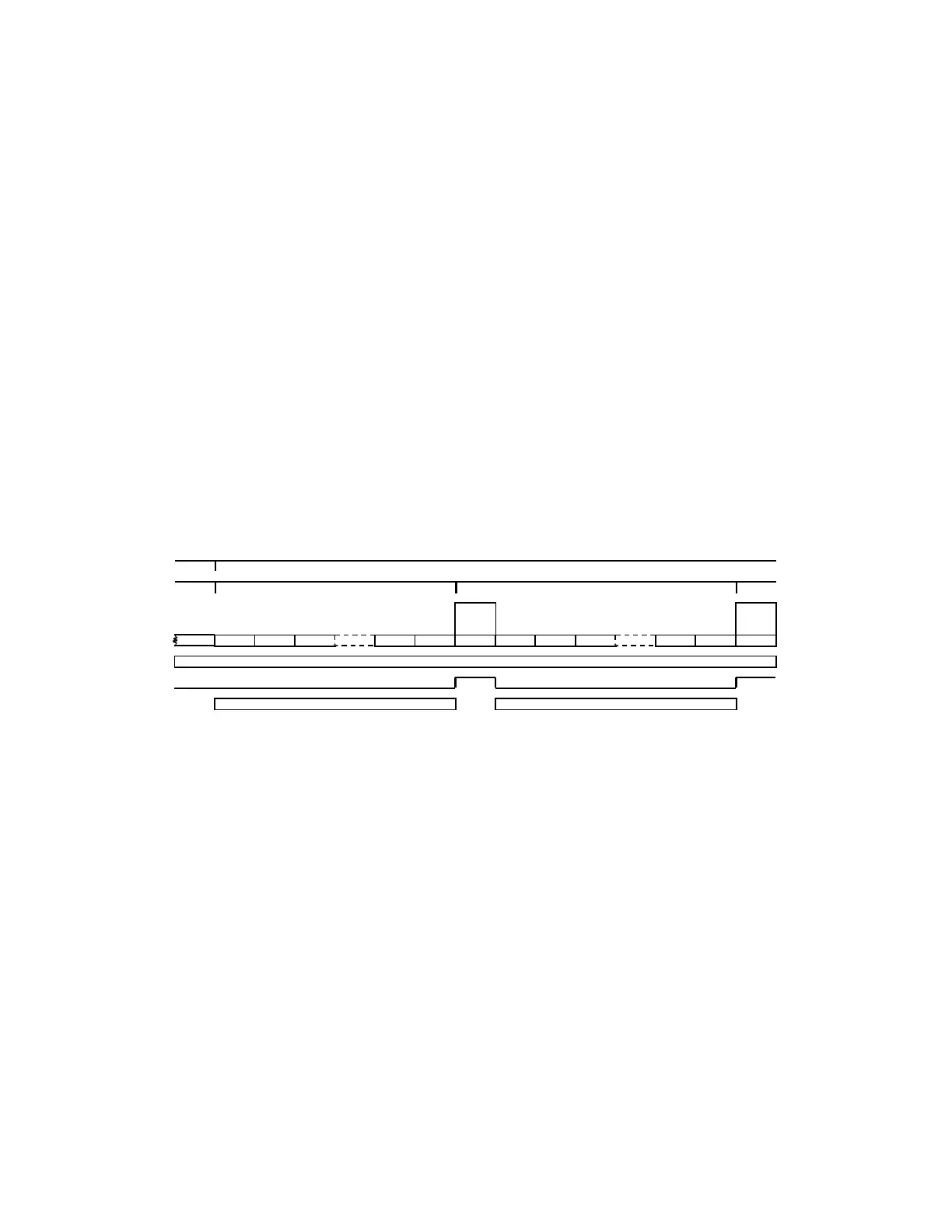
In order to maintain synchronization with a frame grabber, the pixel clock and enable line signals
are un-interrupted during exposure and subsequent readout. The enable frame signal, however, is
set "low" during exposure and goes "high" during readout to signify that the accumulated frame is
being read out and may be captured by the frame grabber. This is shown graphically in the timing
diagram below.
NOTE: The frame grabber should be capable of sustaining long periods of time without receiving
an Enable-Frame signal.
FRAME 1
FRAME 2
FRAME 3
FRM N-1 FRAME N READOUT
Video Blanked
Integrated
Image
FRAME 1 FRAME 2 FRAME 3 FRM N-1
FRAME N
READOUT
Video Blanked
Integrated
Image
Reset operation in the "N" Frame Integration Mode
ENABLE LINE & PIXEL CLOCK (RUN CONTINUOUSLY)
ENABLE FRAME
INTEGRATION PERIOD = N * 1/10 sec INTEGRATION PERIOD = N * 1/10 sec
Transfer Pulse (Internal Signal)
VRST_INT (TTL) or INOUT1 (RS-422)
Figure 7.3-1: Timing diagram--long exposure
7.3.1 Reset Operation in N-Frame Integration Mode
During the N-Frame integration mode, a falling edge of the VRST_INT (TTL) or the
INOUT1(LVDS) resets the camera and initiates a new N-frame exposure (as shown above).
7.4 ULT: ULTRA-LONG-TERM EXPOSURE
This mode is identical to the NFR mode, except that there is a x120 multiplier in the EXP
argument. This means that an EXP argument of N will have the effect of setting up an integration
of (N+1) x120 frames, e.g.: N=3 would result in an exposure of (3+1)X120 frames = 480 frames
or 48 sec.
In software applications such as CView, developers may choose to design a single “exposure”
slider bar for long exposures. When the exposure is less than eg. 60 sec, the NFR mode may be
used, with an increment of 1 frame time = 1/10 sec. For longer exposures, the ULT mode is
22


 To Next Page