25
IOM, VS/VT Models, Rev A Enertech Global
Open Loop Piping and Connections
Placement of the components for an open loop
system are important when considering water quality
and long term maintenance. The water solenoid
valve should always be placed on the outlet of the
heat pump, which will keep the heat exchanger
under pressure when the unit is not operating. If the
heat exchanger is under pressure, minerals will stay in
suspension. Water solenoid valves are also designed
to close against the pressure, not with the pressure.
Otherwise, they tend to be noisy when closing.
A ow regulator should be placed after the
water solenoid valve. Always check the product
specication catalog for proper ow rate. A
calculation must be made to determine the ow
rate, so that the leaving water temperature does not
have the possibility of freezing.
Note: Model shown in drawing reects typical
connection locations. Your model may have
different connection locations. Please identify
correct input and output port locations.
Other necessary components include a strainer,
boiler drains for heat exchanger ushing, P/T ports
and ball valves. Ball valves allow the water to be
Other necessary components include a strainer,
boiler drains for heat exchanger ushing, P/T ports
and ball valves. Ball valves allow the water to be
shut off for service, and also help when velocity
noise is noticeable through the ow regulator.
Spreading some of the pressure drop across the ball
valves will lessen the velocity noise. Always double
check ow rate at the P/T ports to make sure the
ball valve adjustments have not lowered water ow
too much, and essentially taken the ow regulator
out of the equation. It’s a good idea to remove the
ball valve handles once the system is completed to
avoid nuisance service calls.
Hose kits are recommended and make for an easier
installation, since the P/T ports and connections are
included. The hose also helps to isolate the heat
pump from the piping system.
Since the heat pump can operate at lower water
ow on rst stage, two stage units typically include
two water solenoid valves to save water. The ow
regulators should be sized so that when one valve
is open the unit operates at rst stage ow rate,
and when both valves are open, the unit operates
at full load ow rate. For example, a 4 ton unit
needs approximately 4 GPM on rst stage, and
approximately 7 GPM at full load. The ow regulator
after the rst valve should be 4 GPM, and the ow
regulator after the second valve should be 3 GPM.
When both valves are open, the unit will operate at
7 GPM.
The drawings show typical components, wiring and
connection points. Electrical connections are found
in the control box on the lock out board spade lugs
or terminal strips.
Two-Stage solenoid example is optional for all sizes. It
is not recommended for 3 ton and smaller. Use single
solenoid and ow regulator.
Section 5: Unit Piping Installation
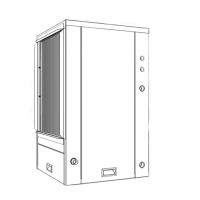
Figure 4: Open Loop Piping Example
Drawings represent typical unit installation.
LEFT
VIEW
air
coil
Non-Pressurized
Flow Center
P/T Ports
Source Out
Source In
P/T Ports
*Hose
Kits
Equipment Pad
2” Polyethylene Foam
Boiler
Drains
(2 required)
S
Single Stage
Units
Ball Valve
(2 required)
S
S
Two Stage Units
Strainer
(optional)
OR
**Flow
Regulator
From
Loop
Field
To
Loop
Field
Flush
Valve
*Hose kit is used for piping isolation, and includes ttings for P/T ports.
**See product specifications for flow rates.


 To Next Page