FARO Gage
May 2011
33
Chapter 5: Accuracy
Volumetric Accuracy
Perform a Sphere to Sphere, Point to Point, or Plane to Plane length measurement
in order to certify the volumetric accuracy of the equipment. This should be done
using traceable length artifacts, which are measured at various locations and
orientations throughout the working volume of the Gage. This test is a method
for determining articulating measurement machine accuracy.
• Use a compensated ball probe. See “Installing Probes” on page 26 and
“Compensate Probe” on page 56.
• In CAM2 Gage, measure and length dimmension two spheres, two points, or
two planes.
1 Measure points on each feature, from multiple directions. Ensure that you
digitize points on the entire Sphere or Plane surface.
2 Make sure that you move the joints of the Gage while measuring the points.
3 Do not digitize a point if any of the encoders reach their end stop. See “Error
and Status Indicators” on page 16.
4 Avoid a joint position where a degree of freedom is lost in the Gage. See
“Loss of a Degree of Freedom” on page 33.
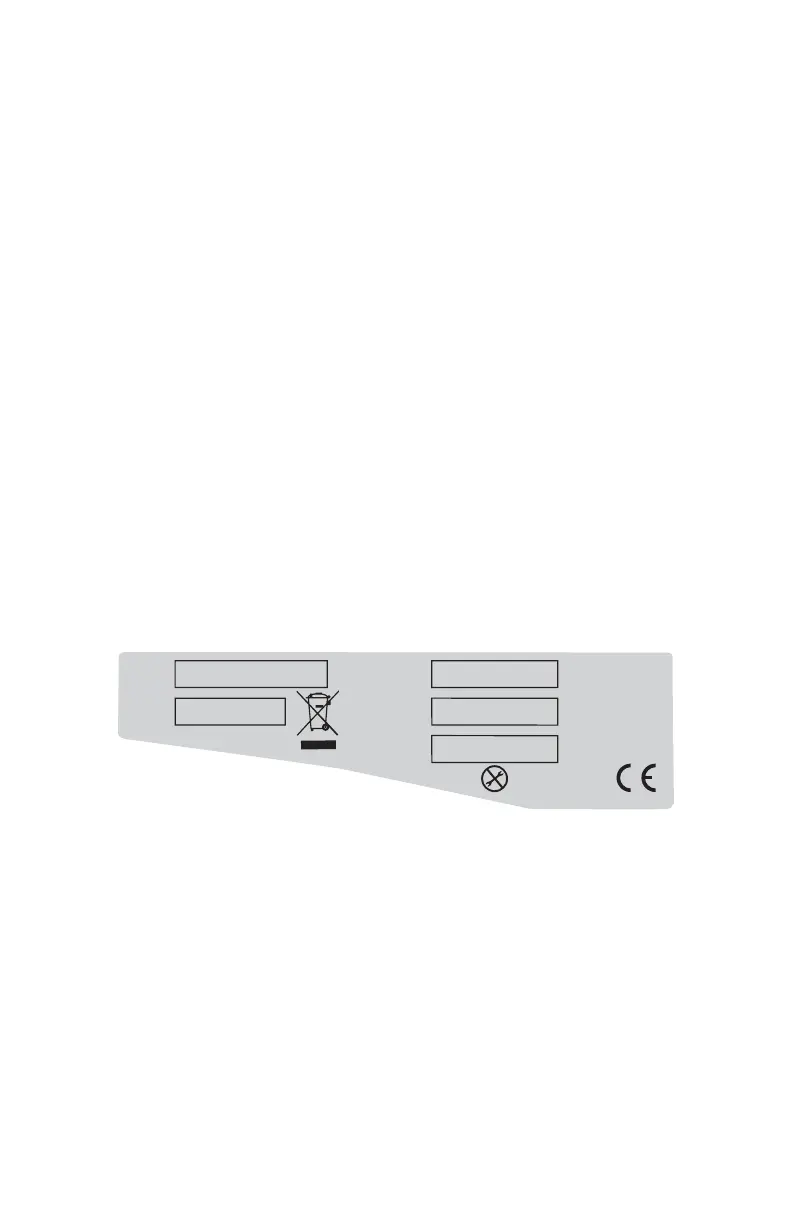
The specifications of your Gage are listed on the label to the right of the battery
pack slot.
N
OTE: For optimum performance, correctly mounting and operating the Gage
is very important. For more information, see “FARO Gage Performance
Verification Checklist” on page 44.
Loss of a Degree of Freedom
In a working volume of the Gage there can be a loss of a degree of freedom
(natural rotation of transfer case). With this loss, temporary bending occurs on
the transfer tubes of the Gage causing a movement of the probe position that
cannot be recorded by the Arm’s encoder system. Measurement results taken in
these positions are not accurate. This condition is never encountered in the
calibration of the Gage.
S/N
Rev
Single Point
Volumetric
Certification
Date
MADE IN
U.S.A.
F04-B2-11-08992
28.1
May 10, 2011
+/- .025 mm.
+/- .018 mm.
08M47E00_FAROGage.book Page 33 Wednesday, June 8, 2011 4:12 PM


 To Next Page