User’s manual FlexGain Plex, V2
Version 1.3 13 from 99
The V.35 interface allows one to configure flexibly the control lines and clocking
options, which provides its operation with a wide variety of telecommunication equipment.
The testing of the multiplexer and the performance check of the device and the
equipment connected to it is provided by the possibility of arranging technological loops
over E1 interfaces for the local and remote devices and over the V.35 interface for the local
device.
The use of the Flash memory as a read-only memory provides simple downloading
of new software versions and reliable storage of current configurations and protection from
power failures.
The device supports three clock modes, which can be chosen by the user during the
device configuration:
• The INTERNAL mode. This mode uses an internal clock source with a frequency
of 2048000 +/- 100 Hz. This mode is used by default and is configured with the
help of <SETDEFAULT> and <SETCLOCK INT> commands in the
CONFIGURATION MANAGEMENT menu;
• The E1 mode. This mode uses a clock signal recovered from the received E1
stream. This mode is activated by the <SETCLOCK PCM1> command in the
CONFIGURATION MANAGEMENT menu;
• The EXTERNAL mode. In this mode a clock signal is used from the external
clock source, whose parameters comply with the ITU-T Rec. G.703.10.
Synchronization from an external source for Mini-Rack devices is possible when
the clock signal is supplied to the “2048 kHz IN” input. Synchronization from an
external source for Sub-Rack devices is possible when ACU, CMU modules and
the Sub-Rack device are installed in the same shelf and the 2048-kHz clock
signal is supplied to the “2048 kHz IN” input. If the input signal of the external
clock is lost, the device switches to the internal clock source. This mode is
activated by the <SETCLOCK EXT> command in the CONFIGURATION
MANAGEMENT menu.
The device operation is controlled with the help of visual alarms, which show the
statuses of its ports. Alarm conditions trigger the warning relays, to which visual and
audible signal devices can be connected.
The device allows one to control and manage it as follows:
• Local management over the RS-232 interface by using the VT100 terminal or
a personal computer emulating it;
• Network management over the TELNET protocol.
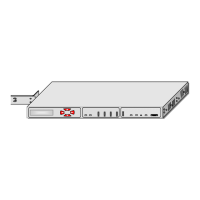
The multiplexer has three mechanic designs:
• Sub-Rack – a unit to be inserted into a 19’’ FlexGain shelf (FG-R-W-E), and
FG-LIT and FG-COMPACT shelves;



 To Next Page