Theory of Operation
Functional Description
3
3-7
A/D Measurement Cycle
AZ AZ
OL
Integ
100 ms
400 ms
Read
Overrange (“OL” on display)
Fullscale reading
Accumulated Counts
Waveform at
the Integ
Capacitor
OL
19999
10000
0
1
/
2
scale reading
dy27f.eps
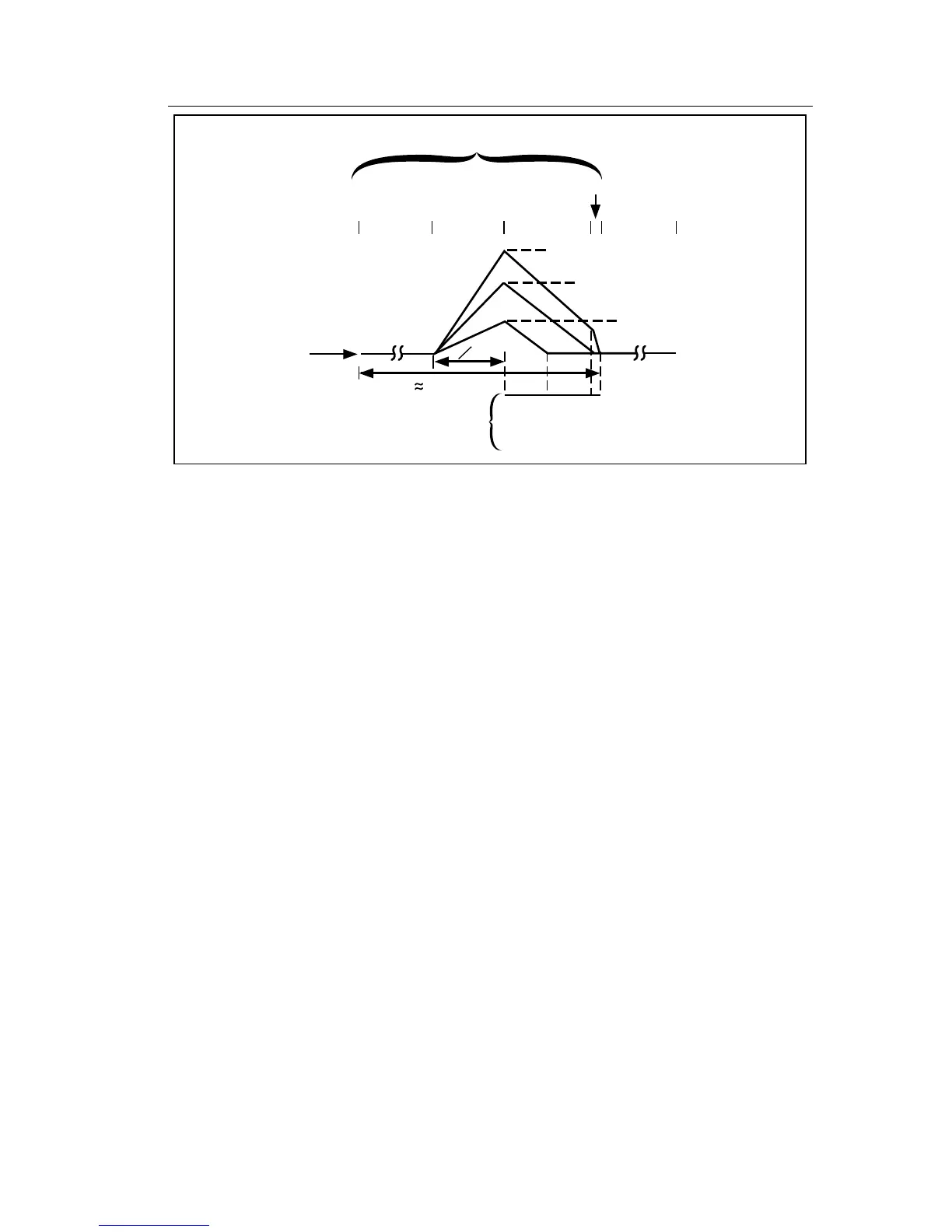
Figure 3-3. A/D Measurement Cycle
As the read period begins, the INTEG switches open and the READ switches
close. This applies the known reference voltage from a “flying” capacitor
whose polarity is chosen by the a/d converter to be the opposite of the
polarity of the unknown input voltage. The INTEG capacitor begins
discharging at a fixed rate while a counter begins counting. The counting
stops counting when the INTEG capacitor voltage equals the initial autozero
voltage. The count is proportional to the unknown input voltage, and is
placed on the display by the microcomputer.
If during the read period the counter counts up to the maximum number of
counts for a full-scale reading (19999 counts) and the INTEG capacitor
charge has not yet reached the initial autozero voltage, the microcomputer
knows an overrange reading has been taken. The microcomputer places
“OL” on the display and commands the a/d converter to go into the overload
(OL) period which rapidly slews the integrator voltage back to the initial
autozero voltage.
The measurement cycle ends at the end of the read period for an on-scale
reading, or at the end of the overload period for an overrange reading. A new
measurement cycle then begins with the autozero period. The display update
rate for measurement functions that use the a/d converter is approximately
0.4s, or about 2-1/2 readings per second.



 To Next Page