l (12) Direction of shaft rotation during measurement
l (13) Serial number of sensor used and recalibration due date
The "ASFOUND" coupling result (14) shows the initial alignment condition of the machines
before any Live Move is performed. The displayed result could be an average of selected meas-
urements. In the above example, the "ASFOUND" coupling result is based on selected meas-
urement number 1 only.
The "MOVE" result (15) shows the alignment condition after Live Move.
The "ASLEFT" coupling result (16) shows the alignment condition measured after Live Move.
The displayed result could be an average of selected measurements. In the following table,
the "ASLEFT" coupling result is based on measurement number 1 only.
Swipe horizontally to view all columns in the table and vertically to view all rows in the table.
Tap to delete highlighted reading (in this case "ASLEFT") from the measurement table.
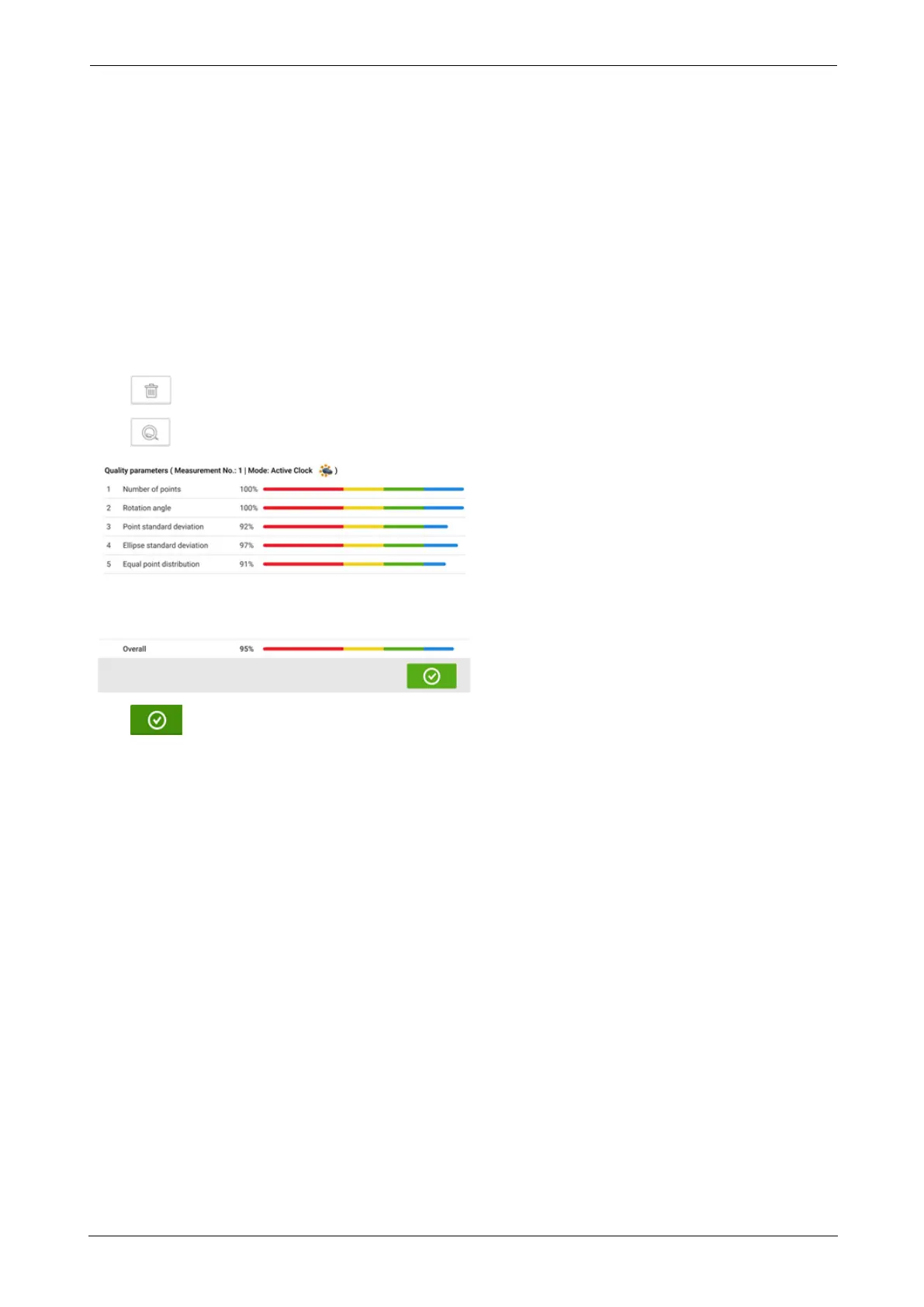
Tap to display the weighting of the quality factor parameters of the measurement.
Tap to exit the measurement table.
Measurement quality
Measurement quality is depicted using the following colour codes:
Blue – excellent; Green – acceptable; Yellow – not acceptable; Red – poor
Measurement quality is based on the following measurement and environmental criteria:
l Number of points – The higher the number of measurement points taken, the better the
effect on the quality factor. The measurement points should be spread over as wide a
rotational angle as possible.
l Rotation angle – The wider the rotational angle through which the shafts and/or coup-
lings are rotated during measurement, the better the effect on the quality factor.
l Point standard deviation – For every measurement point, a number of readings are
taken depending on the set averaging. Point standard deviation is the root mean square
deviation of these readings.
l Ellipse standard deviation – This is the root mean square deviation of the measurement
points on the calculated ellipse.
l Equal point distribution – In point measurements, it is advisable to take measurements
at equal angular steps, say 0°, 45°, 90°, 135°.
l Environmental vibration – the level of external vibration e.g. from neighbouring running
machine(s)
SHAFTALIGNtouch 69
On-board help


 To Next Page