6
1 INTRODUCTION
HUMBUSTER™ CABLES
For OUTPUT 1, use XLR-to-XLR or XLR-to-1/4" TRS cables when connecting to balanced inputs.
Use XLR-to-1/4" (TS) cables when connecting to unbalanced inputs.
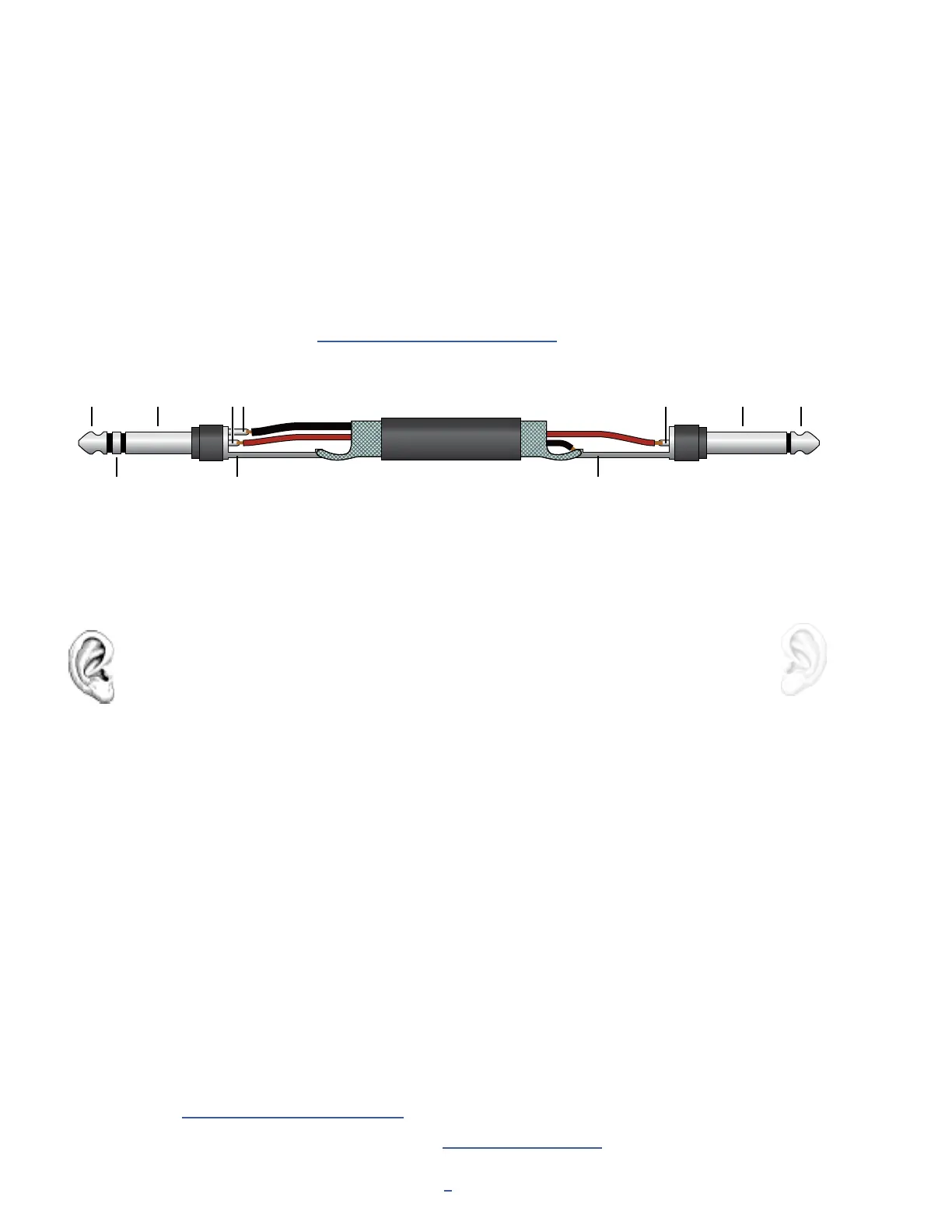
For OUTPUT 2, standard 1/4" (guitar) cables may be used, but there is a better option. Humbuster™ cables can
signicantly reduce unwanted hum due to ground loops. A Humbuster cable has one TRS end (like a balanced
cable) and one TS end (like a guitar cable). The TRS end connects to the FM3. The TS end connects to your amp
or other device.
Humbuster cables are available from http:/www.fractalaudio.com/cables. You can make your own by following
the diagram below. Be sure to use high-quality connectors and shielded cable.
The FM3 comes pre-congured for stereo but you can connect it in mono with no issues. If you
are NOT running in stereo, you may nd that certain presets or settings produce unexpected
results. For example, a panner sounds like a tremolo when one channel is missing. A ping-pong
delay may ping but never pong. Stereo enhancers or certain types of modulation may not be
apparent at all. Tone may change completely if amps or cabs have been hard panned. Here is
an overview of several scenarios, with recommended settings for each.
MONO VS. STEREO
Stereo: No special settings required.
Half-Stereo: Leaving the FM3 in its default stereo conguration but connecting only
one (Left) output results in a “half-stereo” setup. This works ne, aside from the
exceptions mentioned above (ping-pong, panning, etc). No special settings required.
Dual Mono: If you want to force your rig to mono, dual mono is a good choice. Sonically, this
is identical to half-stereo, with the same limitations, except that mono signal is produced
at both the left and right jacks so you can connect to two monitors. To switch to dual
mono, open SETUP: I/O: Audio and set Mode for the desired output to “COPY L->R”.
Summed Mono: In this setup, left and right channels are added together resulting in an identical
mono signal at both left and right outputs. This has the advantage of not discarding half of
the sound, but summing has its own issues. For example, short delays or phase differences
between channels can result in strange artifacts or even cancellation. To switch to summed
mono, open SETUP: I/O: Audio and set Mode for the desired output to “SUM L+R”.
On the FM3, a flexible block-based I/O system makes it easy to use different outputs with different
settings. See the “The Fractal Audio Blocks Guide” for more on Input and Output Blocks.
All options of the I/O menu under SETUP are detailed in Section 13: Setup Menu.
TIP TIP
RING
SLEEVE SLEEVETR
S
T
S



 To Next Page