33
4 SETTING UP
FRONT-OF-HOUSE + GUITAR SPEAKER BACKLINE
Global Settings: Default, check I/O Mono/Stereo settings
Presets: Custom
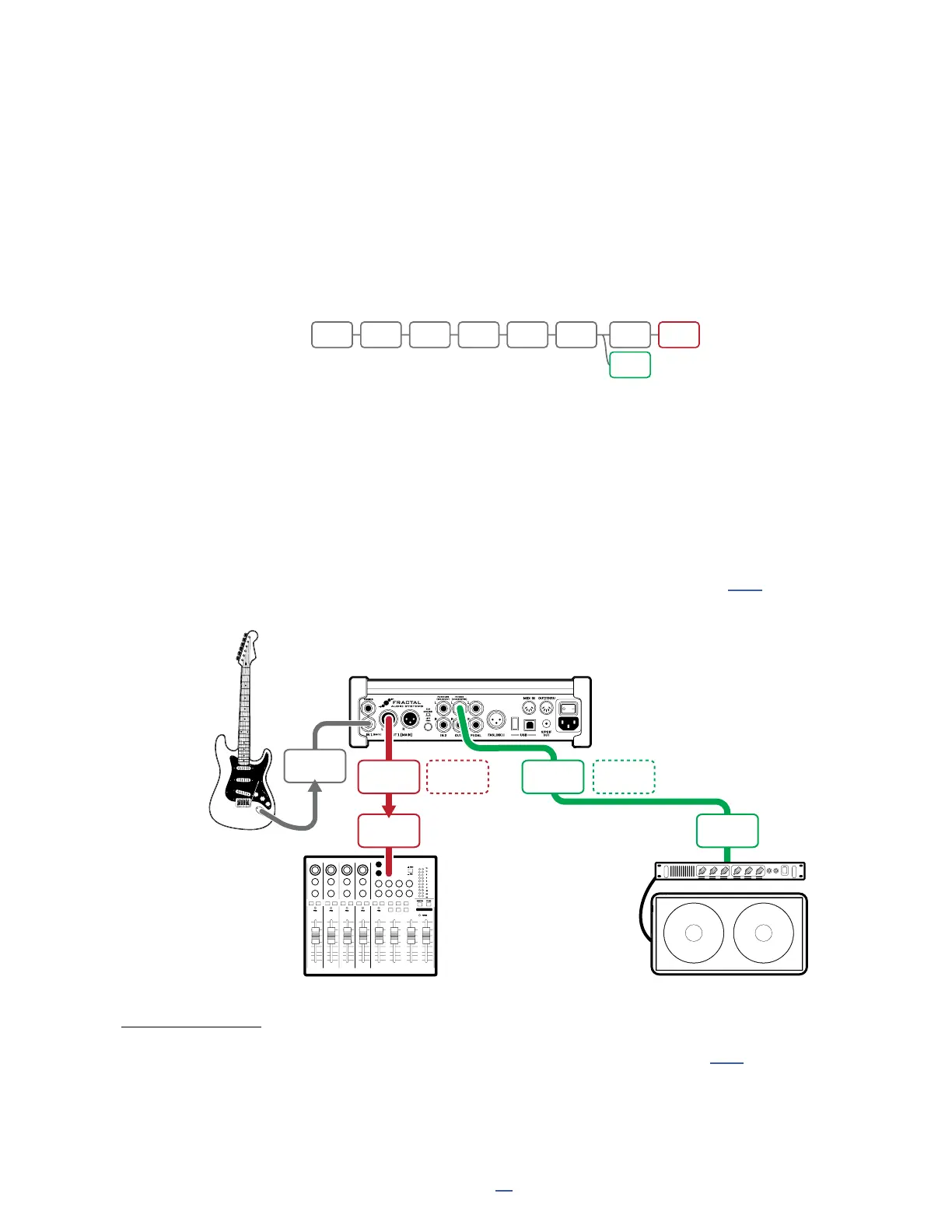
In this setup, custom presets simultaneously send two different signals at once to two different FM3 outputs. The rst
is a “direct” or “FRFR” signal for front-of-house, complete with speaker simulation. The second feeds a power amp —
without speaker simulation — into real guitar speakers for an authentic backline experience. As shown below, this is
achieved using the Output 2 block, which taps the signal prior to the cab block.
CONNECTIONS
Connect your guitar to Input 1 (Instrument).
Connect Output 1 to the front-of-house
PA. Inform the sound technician that the
FM3 outputs a direct, line-level signal.
Connect Output 2 to the input of your power
amp. Again, we are assuming a neutral
power amp is in use (see p. 30).
Humbuster™ cables are recommended for
output 2 to combat hum from ground loops.
Connect your amp to a speaker cab
as directed by the manufacturer.
FM3
FRONT-OF-HOUSE
MIXER/PA
OUTPUT
1L
LINE
INPUT
OUTPUT
1R
Optional
for Stereo
OUTPUT
2R
Optional
for Stereo
IN 1
(INSTR)
OUTPUT
2L
SPKR
IN
SPKR
OUT
GUITAR
SPEAKER
CABINET
POWER
AMP
INPUT
IN1 WAH DRV AMP CHO DLY CABOUT1
OUT2
Output 1: Front of House - The signal with speaker sims is sent via Output 1 to a full-range PA system. This provides
all the benets of going direct, with versatile, consistent tone at very controllable volume levels. Set output levels
using the OUT 1 knob and leave them alone after soundcheck. Remember, when using a mixer, use line level inputs
and avoid channel settings that might undesirably color the sound.
Note: Notice that the Cab block is placed after the “post” FX. If a stereo signal is required at Output 1, the cab block
must also be set for stereo use. Learn more about the Cab block in the Blocks Guide.
Output 2: Backline - This signal is basically identical to the rst, but without speaker simulation because it goes
to a power amp and traditional guitar speaker. This provides a very familiar playing experience with great natural
sustain feedback, and stage level (“moving air”). You must use a neutral power amp (see p. 30) since power amp
modeling needs to be active for Out 1, and it cannot be both on and off at the same time.


 To Next Page