92 PB
R-454B SEALED SYSTEM REPAIRS
Refrigerant Charging
Triple Evacuation
Friedrich requires all installations are Leak Checked and Evacuated in accordance to the “triple evacuation” process. This process promotes a dry tight
refrigeration system before opening the service valves. It recommended that a single port refrigeration manifold and hoses rated over 31.5 psi be used.
Refrigeration hose valves, along with a vacuum pump and micron gauge, must be used to ensure the system can be vacuumed and held under 500
microns. Check all equipment and hoses for proper usage and leaks before beginning.
1. 1st Nitrogen Pressure Test:
Ensure all refrigeration connections are properly ared, secured, and torqued to their respective settings.
Pressurize the system with nitrogen to 550 psi. Soap all connections with an approved refrigerant leak detection solution.
The pressure in the system must hold for one hour respective to the environmental conditions and should not vary less than 540psi. If pressure can not
be adequate held, check integrity of ares and torque specications. Once pressure is held adequately, purge the nitrogen charge to system pressure
of 5-10 psi. DO NOT RETURN TO ATMOSPHERIC PRESSURE.
2. 1st Vacuum Micron Test:
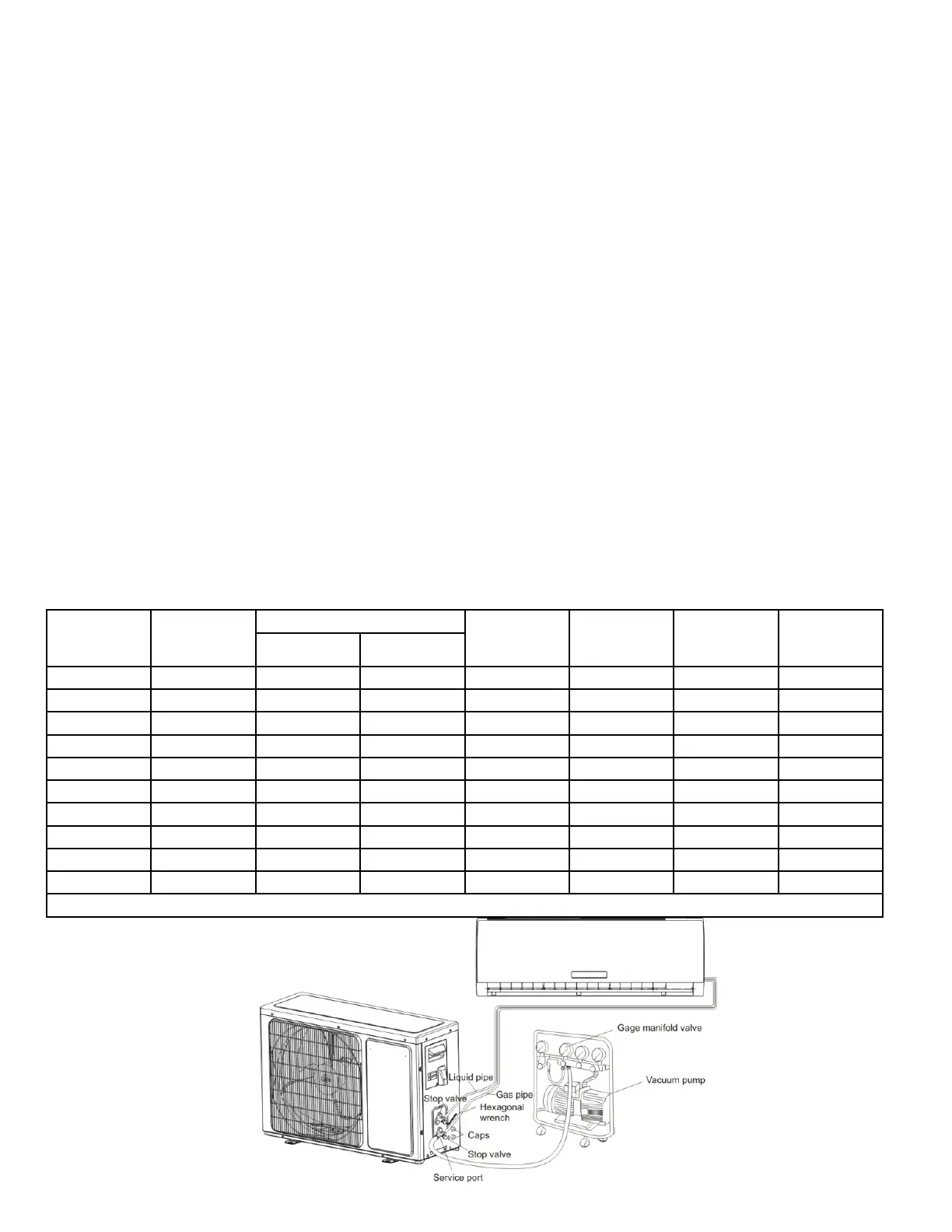
Connect hoses and vacuum pump to the outdoor unit as shown in Fig. 436. Start the vacuum pump and vacuum to 1000 microns. Close the valve to
the vacuum pump and check for micron rise for 15 minutes. If microns rise to near atmospheric pressure, there is a potential leak; repeat step 1. If
microns rise over 5000, the system is very wet and will require further nitrogen purges.
3. 2nd Nitrogen Break:
Once the system holds below 5000 microns, reconnect the nitrogen tank break the system vacuum with 30-50 psi of nitrogen. Wait 5 minutes, then
purge to 5-10 psi. DO NOT RETURN TO ATMOSPHERIC PRESSURE.
4. 2nd Vacuum Micron Test:
Reconnect vacuum pump and gauge and begin evacuation. Vacuum system to 500 microns. Close vacuum valve and check for micron rise. Vacuum
should hold under 1000 microns. Repeat steps 3 and 4 until achieved.
5. 3rd Nitrogen Break:
Once the system holds below 1000 microns, reconnect the nitrogen tank break the system vacuum with 30-50 psi of nitrogen. Wait 5 minutes, then
purge to 5-10 psi. DO NOT RETURN TO ATMOSPHERIC PRESSURE.
6. 3rd Final Vacuum Micron Test:
Reconnect vacuum pump and gauge and begin evacuation. Vacuum system to 300 microns. Close vacuum valve and check for micron rise. Vacuum
should hold under 500 microns. Repeat steps 3 and 4 until achieved. Once held under 500 microns, the system is considered dry and tight.
7. Charging the system:
Unscrew Service Valve Caps to expose the inner hexagon head. Use an allen-head spanner or service wrench with appropriate adapter to release the
refrigerant into the system. If the calculated line set length is over 2 ft, weight in the additional charge with an approved refrigerant scale as needed.
Refer to Table G.1.
Capacity
(Btu/h)
Refrigerant
Pre-Charge
Pipe Size
Standard
Length (ft)
Max.
Elevation
H (ft)
Max. Length
L (ft)
Additional
Refrigerant
(oz/ft)
LIQUID GAS
FPHSR09A1B 33.5 oz 1/4" 3/8" 25 50 66 .22
FPHSR09A3B 35.2 oz 1/4" 3/8" 25 50 66 .22
FSHSR09B1B 21.2 oz 1/4" 3/8" 25 50 66 .22
FPHSR12A1B 35.3 oz 1/4" 3/8" 25 50 66 .22
FPHSR12A3B 38.1 oz 1/4" 3/8" 25 50 66 .22
FSHSR12B1B 21.9 oz 1/4" 3/8" 25 50 66 .22
FPHSR18A3B 53 oz 1/4" 1/2" 25 50 100 .22
FSHSR18A3B 45.9 oz 1/4" 1/2" 25 50 100 .22
FPHSR24A3B 70.6 3/8" 5/8" 25 50 100 .32
FSHSR24A3B 47.6 3/8" 5/8" 25 50 100 .32
Table G.2
Figure G.3



 To Next Page