30
(4.6.3) Quick Parameters
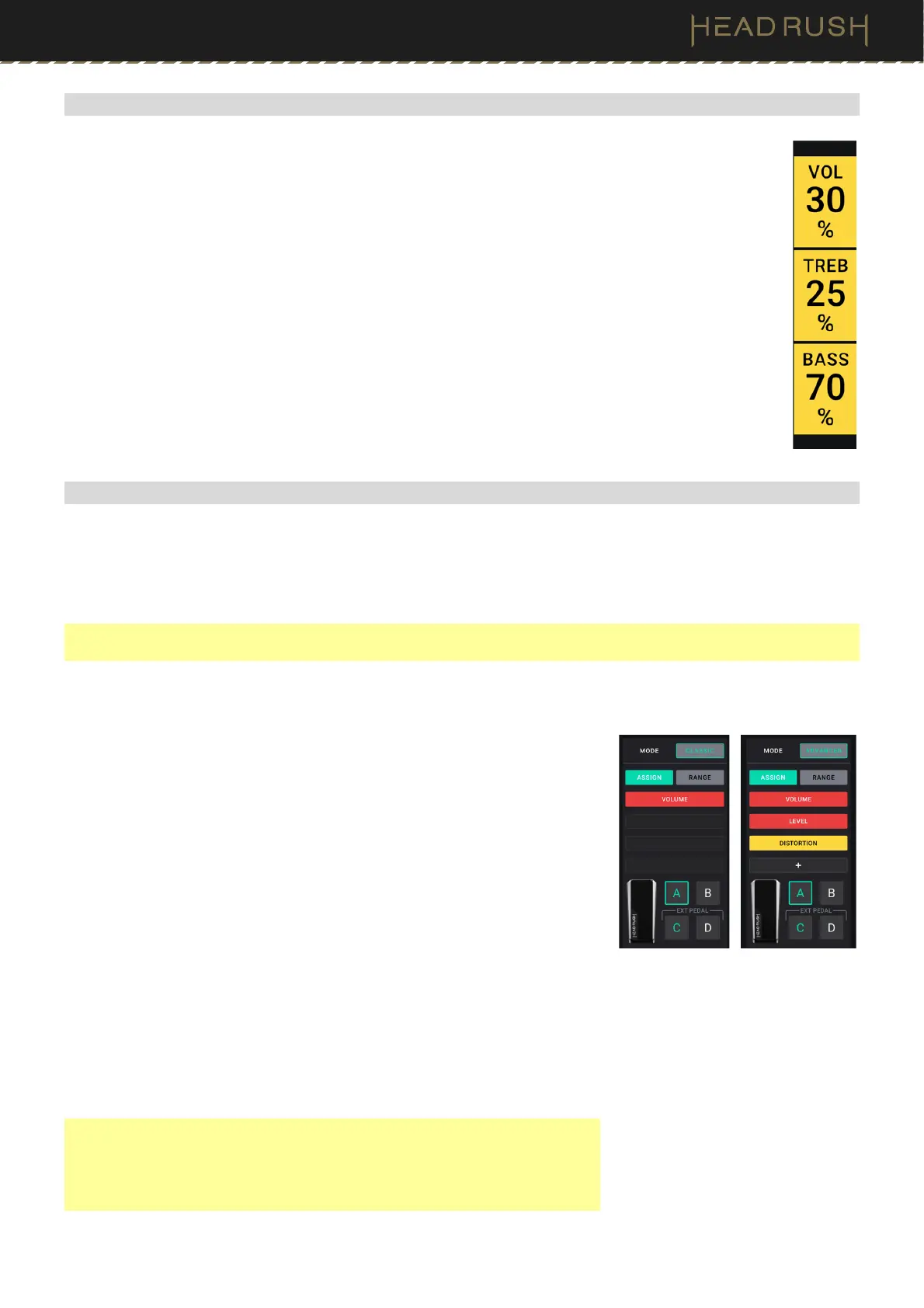
The right edge of the screen shows a column of fields for three parameters. These are the three
parameters that are shown first whenever you load a rig. When no block is selected on the main screen,
you can turn the three parameter knobs to adjust these parameters. You can assign any continuous
parameters to these knobs (parameters with a range of values rather than ones with only “on” and “off”
states).
To assign a parameter to a parameter knob:
1. Tap the field to which you want to assign a parameter. indicates an empty field.
2. In the list that appears, tap the model with the parameter you want to assign. You can also select
parameters for the incoming signal (Input) or outgoing signal (Output).
3. In the list that appears, tap the parameter you want to assign.
Tap Unassigned to unassign that parameter knob.
(4.6.4) Expression Pedal
HeadRush Prime’s internal expression pedal can control two parameters (in Classic Mode) or two sets of
parameters (in Advanced Mode). Use the toe switch to switch between them—Expression Pedal A or B.
To activate the toe switch, move the “toe end” of the expression pedal so it touches the Prime, and then
press down. The expression pedal status LED will indicate A or B.
Note: When you save your rig, the current selected Expression Pedal state (A or B) will be saved and then recalled
when you load the rig again.
When an external expression pedal with a toe switch is connected, it can also control two parameters (in Classic
Mode) or two sets of parameters (in Advanced Mode). Use the external pedal’s toe switch to switch between them—
Expression Pedal C or D.
The column of four boxes represents the expression pedal settings. You can
assign one or more continuously adjustable parameters (ones with a range of
values) to the expression pedal.
To set the expression pedal mode, tap the button above Range in the
upper-right corner to select Classic or Advanced.
• Classic: You can assign one parameter to each expression pedal
(A and B if using the internal pedal, C and D if using an external
pedal). Using the toe switch will select the other expression pedal
and deactivate (bypass) the current expression pedal’s parameter.
For instance, if you assign a wah pedal to Expression Pedal A and
a volume pedal to Expression Pedal B, only one of them will be
active at any time; when you are controlling the wah pedal, the
volume pedal will be bypassed, and vice versa.
• Advanced: You can assign up to four parameters to each
expression pedal (A and B if using the internal pedal, C and D if
using an external pedal). Moving the pedal will adjust all its
assigned parameters simultaneously. Using the toe switch will
select the other expression pedal and leave the current pedal’s
parameters active and at their maximum values.
Important: You cannot edit any parameters assigned to the expression pedal
in Classic Mode (they will show a lock icon and be grayed out in other screens
to indicate this). You can edit any parameters assigned to the expression pedal
in Advanced Mode (they will show a pedal icon in other screens to indicate
this).


 To Next Page