63
SV Measurement (Step Voltage Test)
4.3 SV Measurement (Step Voltage Test)
Used to determine whether the insulation resistance of an object under measurement
is aected by a change in test voltage.
The step voltage test is based on the following principle: An ideal insulating material
shows the same resistance at all voltages. And the resistance of a deteriorated
insulating material decreases when the applied voltage increases.
If the insulation resistance decreases as the test voltage increases, the object under
measurement is damp or unclean and requires attention.
(Reference standard: IEEE 95)
Overview of test
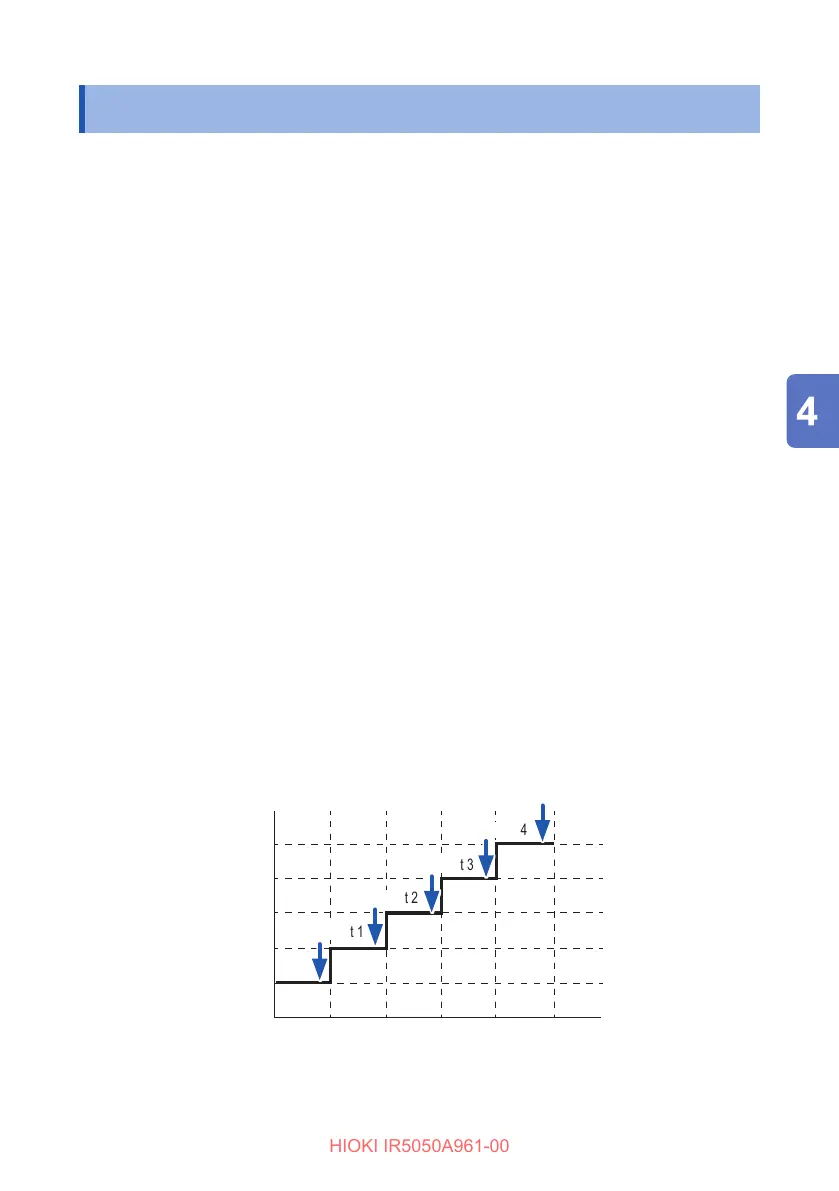
• The test voltage is increased in 5 steps of 20% each at regular intervals during
insulation resistance measurement. The resistance and current are measured once
at the end of every step.
• The voltage is increased when one minute has passed per step. When 5 minutes
has passed in total, measurement automatically stops (default setting).
The voltage application time per step can be changed. However, the voltage
application time cannot be varied for each step.
See “4.6 Changing Settings for the Insulation Diagnosis Functions” (p. 70).
Example:
When set to test voltage: 5 kV and voltage application time per step: 1 min.
Order of applied voltage: 1 kV → 2 kV → 3 kV → 4 kV → 5 kV
4 kV
3 kV
2 kV
1 kV
5 kV
1 min. 2 min. 3 min. 4 min. 5 min.
Measurement 1
Measurement 2
Measurement 3
Measurement 4
Measurement 5


 To Next Page