D-0126440-A – 2020/08
VisualEyes™ 515/525 Instructions for Use - US Page 23
4.5.3 Seat the infant patient in the AT/C chairs
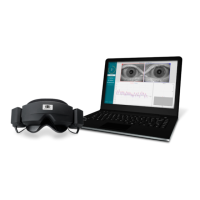
Open the door to the booth enclosure. Unscrew the head support and remove it. Slide the hook through the
seat belt slot of the safety seat so that a hook is available on each side of the infant seat. Secure the infant
seat and foam on top of the chair seat by attaching the hooks to the eye bolts on the chair frame. The chair’s
lap belt and shoulder belts may be left disconnected. Place the patient into the seat and secure the child with
the infant seat’s harness (refer to Figure 4.5-4).
Figure 4.5-4 Sequential images of infant car seat fitting on AT/C Chair (left to right)
4.5.4 Electrode placement and impedance test for ENG evaluation
When a patient is decided to be tested using electrodes (ENG evaluation), he/she should be prepared with
the appropriate electrode montage. The operator should either have Datalink or the ENG option as part of the
Orion/System 2000 AT/C chairs to proceed with the tests.
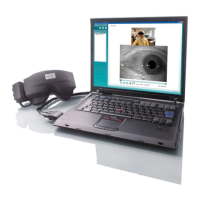
There are two montage options: bi-temporal and binocular. In general, bi-temporal montages are the
standard method for ENG evaluations. If the patient exhibits disconjugate eye movement, the binocular
montage can be used for the ENG evaluation. Based on these methods, the operator has four different
montage options in the software as shown below (Figure 4.5-5).
Figure 4.5-5 Electrode Montage Positions for ENG Evaluation






 To Next Page